










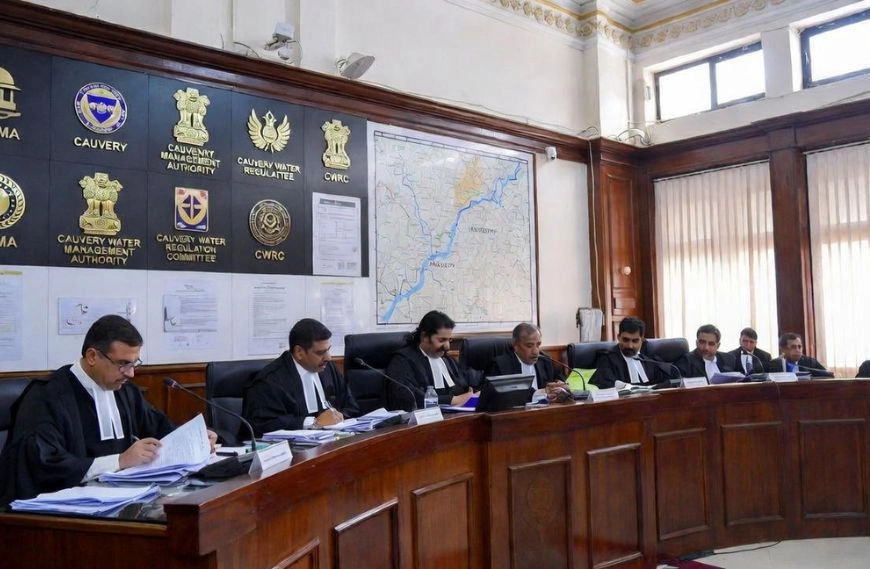
The Supreme Court of India has dismissed Tamil Nadu’s plea challenging Karnataka’s Mekedatu dam project on the Cauvery River, terming the petition premature. The apex court noted that the project is still under review by regulatory and expert bodies, and judicial intervention at this stage is not warranted.
Tamil Nadu had approached the Supreme Court seeking to halt Karnataka’s plan to construct a balancing reservoir at Mekedatu, arguing that it would significantly affect water flow downstream and harm farmers dependent on the Cauvery. The petition raised concerns over drinking water availability, irrigation needs, and ecological balance in the state, emphasizing potential risks to agriculture and communities in the Cauvery delta.
However, the Supreme Court clarified that the matter requires technical assessment by specialized authorities before it can be brought to the judiciary. The Court emphasised that bodies such as the Cauvery Water Management Authority (CWMA) and the Cauvery Water Regulation Committee (CWRC) are responsible for reviewing proposals, evaluating environmental and water distribution impacts, and ensuring compliance with the Cauvery Water Dispute Tribunal (CWDT) award. Only after their assessment can a legal challenge be considered appropriate.
The judgment underscores the principle of judicial restraint in technical disputes involving inter-state river waters. The Court noted that it is not equipped to make on-the-spot technical evaluations regarding hydrology, dam safety, or water allocation. Instead, it relies on expert institutions to provide detailed reports and recommendations.
For Karnataka, the ruling allows the state to continue preparatory work for the Mekedatu project, including detailed project reports (DPR) and environmental clearances, without immediate legal impediments. Once the expert bodies complete their review, Tamil Nadu may still raise its objections in court based on concrete technical and environmental findings.
This development also highlights the complexity of inter-state water disputes in India. Mekedatu has been a flashpoint in Karnataka-Tamil Nadu relations for decades, representing the delicate balance between infrastructure development, water security, and downstream rights. Both states have historically clashed over Cauvery water allocations, and Mekedatu adds another layer of negotiation and scrutiny.
Experts say the Supreme Court’s decision reinforces the importance of following regulatory processes before approaching the judiciary. It ensures that disputes are first examined by specialized authorities to maintain technical accuracy and fairness, providing a more informed basis for future legal challenges.
In conclusion, while Tamil Nadu may view the ruling as a setback, the Supreme Court’s judgment is primarily procedural, ensuring that expert assessments precede judicial intervention. The Mekedatu project remains under careful review, and its eventual implementation will depend on the conclusions of the Cauvery regulatory bodies, keeping the inter-state dialogue alive.
Subscribe Deshwale on YouTube


