











Death marks the end of the body and of life, and this is accepted as the natural order of the world.
In Hindu society, the body is cremated. In Muslim society, it is buried. In Christian tradition too, burial is the norm.
But there exists a place in the world where the body is neither buried nor burned.
Here, the dead are kept with care, affection, and deep emotional responsibility. In this place, you can encounter bodies that are 40 or even 50 years old, timeworn and fragile, yet still lovingly preserved by their families.
In South Sulawesi, Indonesia, lies a region where death is not an ending, but a continuation.
A place where the boundary between life and death is blurred.
Here, the dead are given the same love and respect as the living.
This is Tana Toraja, and this is the Ma’nene ritual, where death is not death, but a new phase of life.
Ma’nene challenges Western ideas of death and mourning. It offers a glimpse into a culture where devotion to ancestors is unbroken, where relationships do not end with the final breath. This ritual is not new. It is centuries old, deeply rooted in Torajan beliefs about death, lineage, and the spiritual world.
What may appear unsettling to outsiders is, for the Toraja people, a profound expression of love, respect, and a bond that even death cannot sever.
The Torajan view: Death is a journey, not an end
The Ma’nene ritual rests on the spiritual foundation of Torajan belief. Traditionally, the Toraja people follow Aluk Todolo, meaning “the way of the ancestors”. This ancient belief system centres on ancestor worship and holds that the spirits of the dead act as intermediaries between humans and divine forces.
According to the Torajan worldview, death is not a sudden ending but a gradual journey towards Puya, the land of souls.
When a person dies, they are not considered dead. Instead, they are referred to as to makula or toma kula, meaning ‘a sick person’ or ‘someone in deep sleep’.
The Toraja believe their loved one has not died, but is merely ill or asleep. For this reason, the body is dressed, cared for, and kept inside the home for long periods. The soul is believed to remain around the village until the final funeral rites are completed. During this time, the spirit is known as bombo.
Only after an elaborate funeral ceremony called Rambu Solo can the soul begin its journey to Puya, where it reunites with ancestors and continues life much as it did on earth.
Ma’nene: The ritual of cleaning the dead
Ma’nene is one of the most significant rituals in Torajan culture. It is a ceremonial act of cleaning and honouring ancestral bodies.
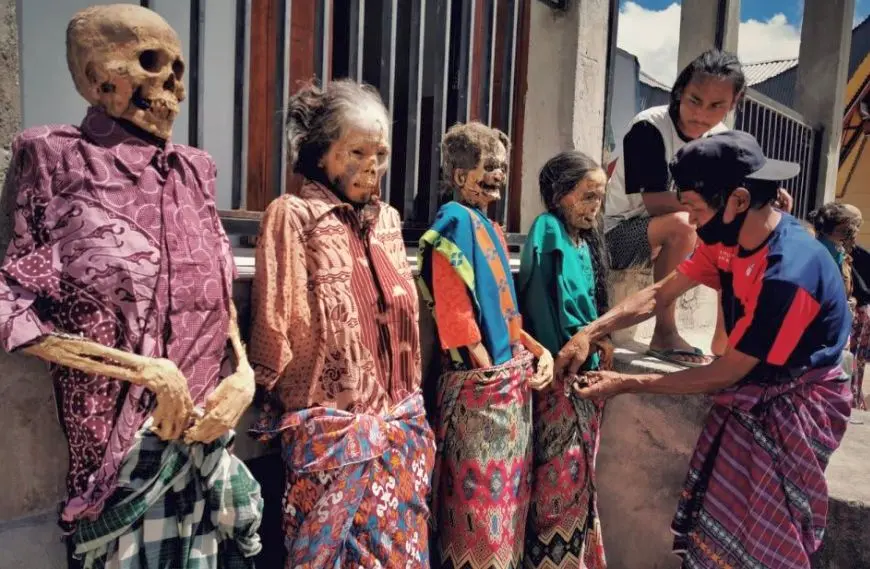
Held once every three to four years, families carefully remove the bodies of their deceased relatives from their burial sites. What follows may seem extraordinary to outsiders, but for the Toraja, it is an act of love and remembrance.
During Ma’nene:
- Bodies are gently taken out from tombs that resemble small houses
- The remains are cleaned with care
- Old clothes and wrappings are removed
- Fresh clothes are put on the deceased
- In some cases, cigarettes are even placed in their mouths
- Family members speak to them as if they were alive
- Selfies are taken together
- Relatives who cannot attend join through video calls to ‘meet’ their ancestors
Children who never met their ancestors in life are introduced to them during this ritual. The Toraja believe this keeps the bond between generations alive and tangible.
What may frighten others is, for the Toraja, a visible expression of affection and respect.
Prayer, permission, and preservation
The ritual begins with prayers led by a traditional tribal priest. In the ancient Torajan language, the priest seeks permission from the ancestors and asks for blessings for the coming sowing and harvest seasons.
Only after these prayers are the coffins opened.
Family members then carefully remove the bodies from the patane, the family burial structures. The remains are preserved using formaldehyde, allowing them to retain their form for decades.
Some of these bodies are 10, 20, 30, or even over 40 years old. Yet they are handled with the same tenderness as if death had occurred only recently.
As families carry out the ritual, village men sing traditional folk songs and perform dances. This is not mere celebration. It serves several purposes:
- Honouring the dead
- Providing emotional support to grieving families
- Strengthening unity within the community, a core value of Torajan society
After the ceremony, the ancestors are wrapped again, prayers are offered, and they are respectfully returned to the patane.
Their coffins and burial spaces are cleaned, and offerings are placed inside, money, cigarettes, clothes, soft drinks, sweets, and objects the deceased loved in life. These offerings are meant to make their journey to Puya more comfortable.
Rambu Solo and the journey to puya
To fully understand Ma’nene, it must be viewed within the larger framework of Torajan death culture, especially alongside the Rambu Solo funeral ceremony.
In Torajan belief, life, death, and the afterlife exist in continuous connection. Rambu Solo marks the beginning of the soul’s journey, while Ma’nene represents its ongoing presence.
Relationships with the dead do not end. They simply transform. Tradition, respect, and spiritual continuity keep them alive.
Cultural continuity in a changing world
Over time, Ma’nene has evolved while remaining deeply rooted in tradition. Modernity, global exposure, and tourism have influenced how the ritual is seen and practised.
Today, for the Toraja people, Ma’nene is not only a religious or family ritual. It has become a symbol of cultural identity, proof of traditions that have survived centuries of external influence.
Many families perform Ma’nene as an expression of gratitude to their ancestors and pride in their heritage.
Where modern societies confine the dead to graves and memories, the Toraja continue to see them as active members of the family, present in the past, the present, and the future.
Ma’nene is not merely a way of confronting death. It is a way of accepting a deeper truth of life itself, that those who leave us never truly disappear.
Also Read
Subscribe Deshwale on YouTube


