










By: Hiren Gandhi
Analysts Say Timing of Tariff Announcements Reflects Calculated Negotiation Tactic
Washington: In global trade negotiations, attention usually centres on tariffs, trade balances and policy outcomes. However, analysts are increasingly pointing to another factor shaping economic diplomacy under former and current US President Donald Trump timing.
A review of major tariff announcements during both the 2018–2019 US–China trade tensions and the current 2025–2026 phase of Trump’s leadership reveals a recurring pattern. A significant number of trade-related decisions and warnings have been issued toward the end of the week, particularly on Fridays.
Trade observers describe this as a deliberate communication strategy rather than coincidence.
A Pattern in Timing
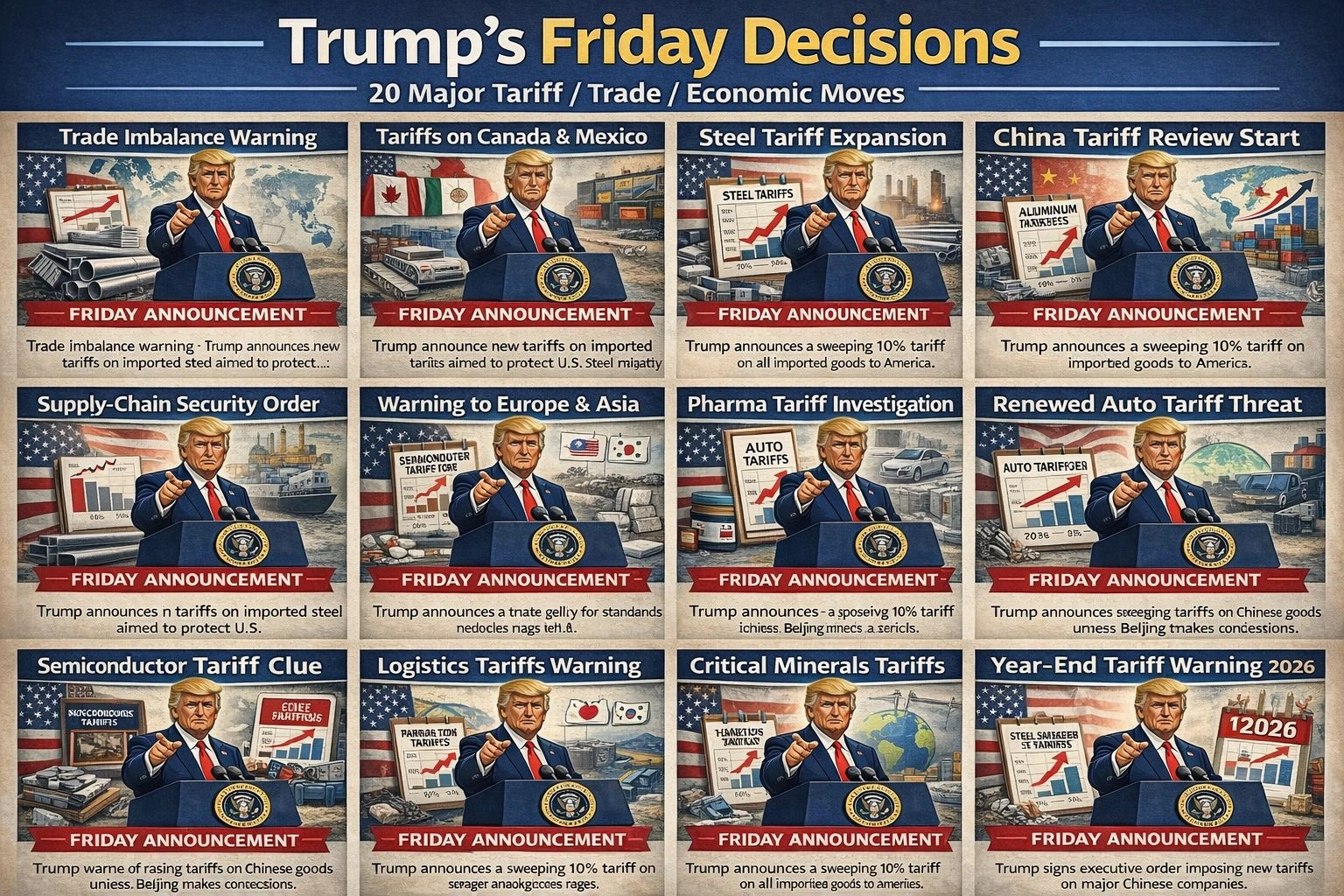
Data compiled from 2025–2026 trade actions shows that out of 20 major tariff-related announcements or signals, 15 occurred on Fridays, two during weekends, and only three mid-week. The clustering has led analysts to argue that timing itself is being used as a strategic tool.
According to trade experts, Friday announcements produce three immediate effects. First, they dominate the global news cycle over the weekend. Second, financial markets close shortly after US announcements, limiting immediate investor reaction. Third, foreign governments and corporations are forced into urgent consultations before markets reopen on Monday.
This window creates uncertainty without instant market correction, a factor negotiators often view as leverage.
From Volatility to Structured Pressure
During the first phase of US–China trade tensions, tariff announcements frequently triggered sharp Monday market volatility. At the time, critics viewed the moves as disruptive.
In the current phase, however, analysts say the strategy appears more structured. Legal groundwork often occurs earlier in the week, followed by strategic signals late Thursday or Friday. Weekend reaction then accelerates negotiations.
Industry observers describe this as a shift from spontaneous disruption to calculated economic pressure.
Why Tariffs Remain Central
Tariffs continue to serve as a preferred policy instrument because they create immediate financial impact, can be implemented under executive authority in certain cases, and directly influence domestic industries and employment narratives.
Unlike diplomatic statements, tariff announcements alter market expectations instantly.
Broader Implications
The timing trend reflects a wider transformation in global trade policy. Markets increasingly monitor political calendars alongside economic data. Negotiation signalling now plays a larger role than traditional efficiency-driven trade models.
Analysts argue that in modern economic statecraft, influence is exercised not only through policy substance but also through precision timing.
For exporters, investors and policymakers, the lesson is clear: in global trade politics, when a decision is announced may matter almost as much as the decision itself.


Secretary — InGlobal Business Foundation (IBF)
Director — ReNis Agro International LLP, Ahmedabad, India
Subscribe Deshwale on YouTube


