








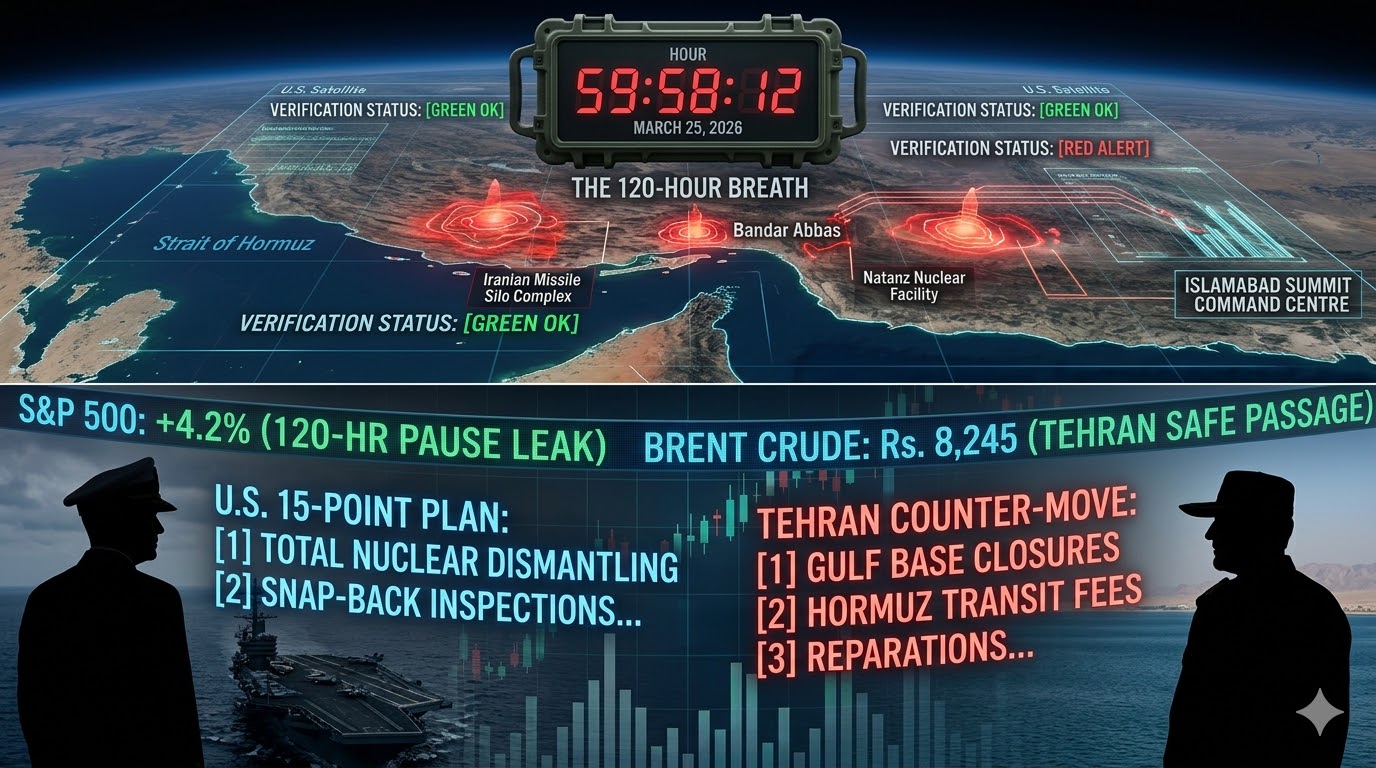
The world woke up today to a silence that feels heavier than the thunder of the last few weeks. For the first time since the latest escalation in West Asia began, the skies over Isfahan and Shiraz are not filled with the drone of MQ-9 Reapers or the streak of intercepting missiles. We are currently in the middle of a 120-hour diplomatic pause, a window of time carved out by the White House to allow a 15-point peace proposal to breathe. In the corridors of South Block in New Delhi and the high-walled compounds of Islamabad, the air is thick with a different kind of tension. This is not just a break in the fighting. It is a high-stakes gamble that could redefine the global order for the next decade.
The 120-hour pause is the centerpiece of a strategy that is vintage Donald Trump. It is a mix of overwhelming military pressure followed by a sudden, theatrical opening for a “deal.” But as the clocks tick down in Tehran and Washington, the question remains whether this is a genuine bridge to peace or a sophisticated diplomatic trap.
The Islamabad Connection and the Vance Mystery
The most intriguing aspect of this pause is not what is happening in Washington, but what is reportedly happening in Pakistan. Reliable intelligence whispers suggest that U.S. Vice President JD Vance has made an unannounced stop in Islamabad. While the State Department has not confirmed his itinerary, the heavy security presence at the Noor Khan Airbase suggests someone of his stature is on the ground.
Islamabad has long played the role of a “postal service” between Washington and Tehran. However, the stakes are higher now. If Vance is indeed meeting with Iranian intermediaries under the watchful eye of the Pakistani military establishment, it suggests that the 15-point plan is not a “take it or leave it” document, but a starting point for a brutal negotiation. The choice of Islamabad as a venue is strategic. It provides the Iranians with a comfort zone and allows the U.S. to leverage Pakistan’s unique position as a traditional ally with a long, porous border with Iran.
Breaking Down the 15-Point Trap
The 15-point proposal is, on the surface, a masterclass in transactional diplomacy. It demands the total dismantling of Iran’s nuclear infrastructure. We are talking about the decommissioning of the Natanz and Fordow sites, the export of all enriched uranium, and a “snap-back” inspection regime that would make the previous JCPOA look like a casual invitation.
In return, the U.S. is offering the “Great Reset.” This includes the lifting of all primary and secondary sanctions, the unfreezing of over 100 billion dollars in assets, and the reintegration of Iran into the SWIFT banking system. For an Iranian economy that has been gasping for air, this is a powerful carrot. But for the hardliners in the Islamic Revolutionary Guard Corps (IRGC), it looks like a surrender document.
The Ghost of Muammar Gaddafi
In Tehran, the history books are being flipped open to a specific chapter: Libya, 2003. The Iranian Supreme Leader and his inner circle are haunted by the fate of Muammar Gaddafi. In the early 2000s, Gaddafi agreed to dismantle his nascent nuclear and chemical weapons programmes in exchange for Western rapprochement. He was hailed as a reformed statesman. Less than a decade later, he was killed in a ditch during a NATO-backed uprising.
The Iranian regime sees a direct line between the loss of a strategic deterrent and the eventual fall of a government. To them, the 15-point plan is not a peace treaty; it is a disarmament sequence that precedes a regime change. This “Gaddafi Trap” is the single biggest hurdle to the Trump proposal. Why would Tehran give up the only thing that keeps the U.S. at a distance?
The Tehran Counter-Move: Sovereignty or Fees?
Tehran is not simply waiting for the clock to run out. Sources within the Iranian Supreme National Security Council suggest a counter-proposal is already being drafted, one that treats the Trumpian 15 points as an opening gambit rather than an ultimatum. The Iranian counter-move is built on a “Price of Peace” doctrine. They are reportedly demanding the immediate closure of several U.S. military bases in the Gulf, arguing that a nuclear-free Iran requires a region free of foreign intervention.
More provocatively, Tehran is floating the idea of a “Transit Service Fee” for the Strait of Hormuz. Instead of a simple reopening, they wish to formalise their control over the waterway, turning the global chokepoint into a sovereign revenue stream similar to the Suez Canal. They are essentially telling the world: if you want our “protection” and a guarantee of no strikes on tankers, you must pay for the service. It is a bold, perhaps desperate, attempt to gain leverage while their economy bleeds.
The Unrealistic Demands and the IRGC Grip
There is also the matter of “War Reparations.” Iran is allegedly asking for billions in compensation for the damage dealt to its energy infrastructure during the recent air campaign. For the IRGC, this is a matter of survival. They cannot be seen to be backing down without a “win” that they can present to their base. This creates a fundamental deadlock. Trump wants total nuclear dismantling; Tehran wants the U.S. out of the Gulf and a cheque for the damages. This clash of demands makes the 120-hour window look increasingly narrow.
Wall Street and the Art of the Market Move
However, not everyone is looking at the map of the Middle East to understand this pause. Some are looking at the tickers on Wall Street. Critics and market watchdogs have raised eyebrows at the timing of the announcement. The “Trump Pause” was leaked just as global markets were hitting a three-month low, only for indices to skyrocket the moment the 120-hour window was mentioned.
There is a growing, cynical whisper in financial circles that this might be less about peace and more about portfolios. Is Trump manipulating the stock markets by dangling a 5-day pause to help his kith and buddies? In the 48 hours leading up to the announcement, trading volumes in certain energy and defense ETFs saw unusual spikes. Imagine a hedge fund with “early access” to the internal White House timeline. By buying out-of-the-money call options on the S&P 500 or shorting volatility (the VIX) just before the leak, a small group of insiders could have turned a few million dollars into hundreds of millions in a single afternoon. If the pause ends and the strikes resume, those who “sold the top” of this relief rally will have made a killing. For a President who has always used the Dow Jones as his personal scorecard, the line between foreign policy and financial gain has always been uncomfortably thin.
The Silicon Shield: Real-Time Verification
Beyond the diplomats and the traders, a new kind of “peacekeeper” is at work: Artificial Intelligence. The 120-hour pause is being monitored by a “Silicon Shield” of high-resolution SAR (Synthetic Aperture Radar) satellites and AI-driven thermal analysis. Washington has allegedly integrated its 15-point plan with a real-time verification dashboard.
As the pause progresses, AI algorithms are scanning the Natanz and Fordow facilities for any sign of “centrifuge spinning” or unauthorized transport. This tech-heavy approach is a double-edged sword. While it offers the U.S. “absolute certainty,” it also creates a digital panopticon that the Iranians find deeply insulting. In this new era, peace is no longer about trust; it is about data points. If a single pixel of heat signature is detected in the wrong place at the wrong time, the 120-hour breath could be cut short by an automated military response.
The Tehran Letter and the Strait of Hormuz
While the diplomats argue, the maritime world is watching the Strait of Hormuz. In a rare move, Tehran sent an official letter to the International Maritime Organization (IMO) this morning. The letter stated that “non-hostile” vessels would be granted safe passage for the duration of the 120-hour pause.
This is a massive relief for the global economy. Oil prices had touched terrifying heights last week, but the “Tehran Letter” has acted as a cooling agent. Brent crude dropped significantly today, bringing some breathing room to energy-importing nations like India. For New Delhi, this is a vital development. The Indian economy, already grappling with the high cost of imports, cannot afford a shut Strait of Hormuz. The “Tehran Letter” shows that Iran is willing to use the global economy as a bargaining chip, proving they can turn the world’s energy tap on and off at will.
The Abraham Anxiety: Riyadh and Tel Aviv
The silence in the air has triggered a different kind of noise in Riyadh and Tel Aviv. The “Abraham Accords” partners are watching this U.S.-Iran dance with profound anxiety. For Saudi Arabia, any deal that does not address Iran’s ballistic missile programme or its regional proxies is seen as a betrayal. In Israel, the “diplomatic pause” is viewed with even more skepticism. Prime Minister Netanyahu has remained uncharacteristically quiet today, but sources close to the Kirya (Israel’s Ministry of Defense) suggest that the IDF remains at its highest state of readiness.
There is a fear among America’s traditional allies that Trump is so desperate for a “historic win” that he might settle for a “shallow peace.” If the 15-point plan is accepted, it would fundamentally shift the security architecture of the region. Would a reintegrated Iran become a more responsible actor, or would the influx of billions of dollars simply fuel a more sophisticated regional hegemony? This “Abraham Anxiety” is the silent factor that could derail the Islamabad talks before they even reach a conclusion.
Friendshoring and the New Trade Routes
The conflict has accelerated a trend that tech and trade analysts have been watching for years: “Friendshoring.” This is the practice of moving supply chains to countries that are politically aligned with your own. As the West Asia conflict flared, we saw a massive shift in how goods move.
If this peace plan succeeds, the “friendshoring” trend might actually slow down, but the scars on global trade are deep. Companies have already started looking at the India-Middle East-Europe Economic Corridor (IMEC) with renewed skepticism. Can a trade route be stable if it passes through a region that can explode at any moment? The 120-hour pause is a test for the markets. If the pause holds, we might see a return of investor confidence. If it fails, the move toward isolated, “safe” trade blocs will become permanent.
The View from South Block
India is playing a very delicate game. For the Ministry of External Affairs, a stable Iran is essential for the Chabahar Port project and for access to Central Asia. However, India’s growing strategic partnership with the U.S. and its deep ties with Israel and Saudi Arabia make it impossible to take a side.
Indian diplomats have been working the phones since the pause was announced. There is a sense in New Delhi that while the 15-point plan is aggressive, it is the only “deal” on the table. India has a vested interest in seeing the U.S. and Iran reach a functional understanding. If the war resumes after 120 hours, the impact on the Indian rupee—currently hovering around Rs. 88 to the dollar—and the domestic price of petrol would be disastrous. The government is likely preparing for both scenarios, but the hope is that JD Vance’s rumored presence in the region signifies a serious push for a result.
The Ordinary Life in Extraordinary Times
It is easy to get lost in the talk of missiles and treaties. But on the ground, the 120-hour pause means something very different for the people of the region. In Tehran, people are lining up at banks, hoping that the talk of lifting sanctions will finally bring down the price of bread and medicine. In the Gulf monarchies, there is a cautious sense of relief.
I remember talking to a veteran diplomat years ago who said that in the Middle East, “nothing is ever truly finished.” This pause feels like that. It is a moment of silence where you can hear the heartbeat of a region that is tired of being the world’s primary theater of war. The people just want to get on with their lives. They want to shop, they want to go to work, and they want to know that tomorrow won’t bring another siren.
The Reality of the 15-Point Trap
Is the 15-point plan a genuine offer or just a way for the U.S. to say “we tried” before launching a much larger military campaign? Critics of the Trump administration argue that the terms are designed to be rejected. By asking for the total dismantling of the nuclear programme upfront, the U.S. is setting a bar that no Iranian leader can jump over without fearing a coup at home.
However, the counter-argument is that Trump is a pragmatist who wants to exit the Middle East to focus on domestic issues and China. For him, a “big deal” with Iran would be the ultimate legacy. If he can achieve what three previous administrations couldn’t, he secures his place in history as the ultimate dealmaker. This tension between “peace through strength” and “peace through surrender” is what makes these 120 hours so critical.
What Happens at Hour 121?
The clock is ticking. As of this writing, we are about halfway through the pause. Reports from the Pentagon suggest that carrier strike groups remain in striking distance, and their pilots are on “hot standby.” In Iran, the missile silos are likely still manned.
The most likely outcome is not a grand signing ceremony, but an extension of the pause. Diplomacy of this magnitude rarely finishes in five days. We should look for a “Pause 2.0” announcement, which would signal that the Islamabad talks have yielded something tangible. If the 120 hours expire without a word, the world should brace for a return to the “kinetic phase” of this conflict.
The “Trump Pause” has given the world a brief, flickering hope. For five days, the guns are silent and the tankers are moving. It is a fragile peace, built on a foundation of mutual suspicion and ghost stories from Libya. But in a world that has seen so much fire lately, even a 120-hour breath is something worth holding onto.
The diplomatic movement in Pakistan is the real story here. If JD Vance is truly sitting across from an Iranian general, the 15-point plan is more than just paper. It is a map. Whether that map leads to a new Middle East or a dead end is the billion-dollar question. For the sake of global stability, we must hope that Tehran finds a way to accept the terms without feeling like they are signing their own death warrants. It is a thin line to walk, but in 2026, thin lines are all we have left.


