









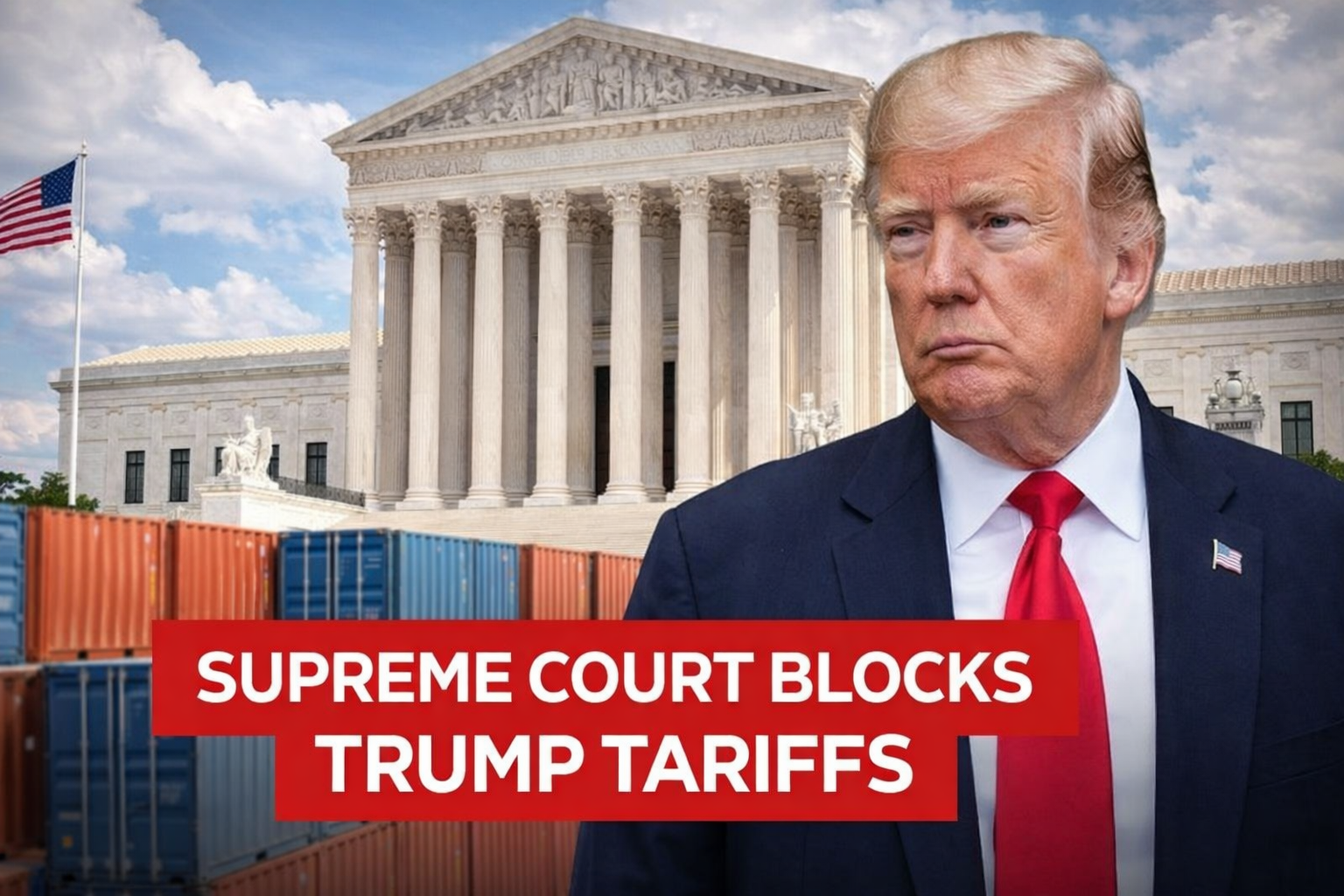
The US Supreme Court struck down Donald Trump’s sweeping tariffs on 20 February 2026. The president had a replacement ready by evening. That gap between constitutional symbolism and practical reality is the most important story nobody is telling.
On the morning of 20 February 2026, an aide handed Donald Trump a note during a private meeting with state governors at the White House. He read it, said aloud “that’s a disgrace,” and left the room. The Supreme Court had just ruled 6-3 that his signature economic policy, sweeping tariffs on goods from nearly every country on earth imposed without a vote of Congress, was illegal. By evening, he had signed a new executive order imposing a 10% global tariff using a different law. The tariff regime that a federal court, a federal appeals court, and now the Supreme Court had all called unconstitutional was, in practical terms, still largely in place before midnight.
That is the ruling’s central paradox. It is simultaneously the most significant constitutional rebuke of a sitting president in a generation and, as the dissenting justice appointed by Trump himself acknowledged, an event unlikely to substantially constrain presidential tariff authority going forward. Understanding why requires looking past the headlines and into the legal architecture beneath them.
What the Court Actually Said and What It Did Not
Chief Justice John Roberts, writing for the 6-3 majority, was precise to the point of severity. He wrote: “IEEPA contains no reference to tariffs or duties. The Government points to no statute in which Congress used the word ‘regulate’ to authorise taxation. And until now no President has read IEEPA to confer such power.” The International Emergency Economic Powers Act, a 1977 statute designed to give the president tools to respond to genuine foreign threats, had never been used to impose tariffs by any president before Trump. The court applied the major questions doctrine, which holds that executive actions of vast economic and political significance require clear and explicit congressional authorisation, and concluded that Trump’s attempted expansion of presidential tariff authority had no such basis.
What the court did not say is equally important. The ruling invalidates tariffs implemented using IEEPA but leaves in place those imposed under different laws, including Section 232 tariffs of 50% on steel and aluminium. The majority said nothing about refunds. It offered no guidance to the 301,000 importers who paid tariffs that have now been declared illegal. It did not address what happens to trade deals negotiated under the shadow of those tariffs. On every practical question that flows from the ruling, the court was silent.
The Dissent That Mapped the Way Out
The most revealing document in the entire ruling is not the majority opinion. It is the 63-page dissent written by Justice Brett Kavanaugh, joined by Justices Clarence Thomas and Samuel Alito. Kavanaugh was appointed by Trump during his first term. His dissent reads, in significant parts, less like a defence of the president’s legal position and more like an instruction manual for what comes next.
Kavanaugh called the majority’s reasoning “illogical,” arguing that if quotas and embargoes are accepted means to regulate importation under IEEPA, the distinction excluding tariffs has no basis in the statute’s text. He wrote: “The tariffs at issue here may or may not be wise policy. But as a matter of text, history and precedent, they are clearly lawful.”
He was equally clear, however, that the ruling would not meaningfully restrict Trump’s ability to impose tariffs going forward. He wrote: “Although I firmly disagree with the Court’s holding today, the decision might not substantially constrain a President’s ability to order tariffs going forward, because numerous other federal statutes authorise the President to impose tariffs and might justify most, if not all, of the tariffs at issue in this case, albeit perhaps with a few additional procedural steps that IEEPA, as an emergency statute, does not require.” Those alternatives, Kavanaugh specified, include Section 232 of the Trade Expansion Act of 1962, Sections 122, 201, and 301 of the Trade Act of 1974, and Section 338 of the Tariff Act of 1930.
Trump’s Treasury Secretary Scott Bessent had been reading the same statute books. Within hours of the ruling, he announced the administration would invoke Section 232 and Section 301 authorities and estimated that using these alternatives would result in virtually unchanged tariff revenue in 2026.
A Doctrine With a Fractured Foundation
The ruling’s constitutional significance is real. Its durability is another matter. Michael W. McConnell, the Richard and Frances Mallery Professor and Faculty Director of the Constitutional Law Center at Stanford Law School, was counsel of record for the small business plaintiffs in the case itself. Before the ruling, he had written in a New York Times opinion piece that the tariff litigation was “shaping up as the biggest separation-of-powers controversy since the steel seizure case in 1952” and predicted that if the court applied the major questions doctrine consistently, it would require clear congressional authorisation here as it had required it of President Biden.
The court did. But on the same day, McConnell identified a fault line running through the majority that carries direct consequences for how the doctrine operates in future cases. Writing publicly within hours of the ruling on the Divided Argument legal blog, he observed that Justices Gorsuch and Barrett, both in the majority, held sharply conflicting views on what the doctrine actually is. Barrett regards it as a commonsense principle of communication, a tool for reading what Congress most naturally intended. Gorsuch insists it is a substantive canon designed to enforce the constitutional boundary that law must be made by the legislative branch, not the executive. McConnell’s own position is that both justices are addressing the wrong question: the doctrine’s real function is to protect the separation of powers, and until the court resolves its internal disagreement about the doctrine’s foundations, any future president’s legal team will be able to exploit that fracture.
That matters because the alternative tariff authorities Trump has already invoked, particularly Section 232 and Section 301, will inevitably produce fresh constitutional challenges. Whether those challenges succeed will depend on which version of the major questions doctrine the court applies. On that question, the majority in this case did not speak with one voice.
The Workaround and Its Limits
Trump’s immediate response was to invoke Section 122 of the Trade Act of 1974, signing an order imposing a 10% global tariff on all imports. That statute allows the president to impose a baseline duty of up to 15% for no more than 150 days to address large and serious balance of payments deficits. The 150-day ceiling is significant. It means Trump’s replacement tariff expires before the November 2026 midterm elections. Every extension will require congressional action or a fresh invocation of a different statute. The legal clock is now running on his trade agenda in a way it was not before the ruling.
The Washington Post noted that Trump’s use of this rarely invoked law potentially puts him on course for a standoff with his own party in Congress. The Tax Foundation estimates that with IEEPA tariffs removed, the remaining Section 232 tariffs will raise approximately Rs. 53 lakh crore ($635 billion) over the next decade and reduce US GDP by 0.2%, compared to the IEEPA regime which would have reduced GDP by 0.3% and raised approximately Rs. 117 lakh crore ($1.4 trillion) over the same period. The tariff wall is lower after the ruling. It is not gone.
The Refund Question Nobody Wants to Answer
Kavanaugh’s dissent raised a second alarm that the majority entirely ignored. According to Penn Wharton Budget Model senior economist Lysle Boller, whose estimates were produced for Reuters and cross-checked against US Customs and Border Protection data, the government collected between Rs. 14.6 lakh crore and Rs. 15 lakh crore ($175 billion to $179 billion) in IEEPA tariff revenue between February 2025 and the date of the ruling. The model cross-references US Census Bureau import data across 11,000 product categories and 233 countries and calculates approximately Rs. 4,200 crore ($500 million) in IEEPA-based revenue collected daily. Refunding that accumulated sum would represent one of the largest outflows from the US Treasury in peacetime history.
Kavanaugh warned that the refund process was “likely to be a mess,” noting that some importers had already passed costs on to consumers and others, making clean restitution structurally impossible. Importers seeking refunds face a 180-day protest window through US Customs and Border Protection, and with 301,000 affected businesses that process alone will take years to work through. Trump suggested the administration had no plans to honour refunds. “It would take many years to figure out what number we are talking about,” he said, predicting it would be “almost impossible for our Country to pay.” PWBM director Kent Smetters told Reuters: “The Supreme Court did not talk explicitly about the $175 billion in tariffs that could potentially be refunded. On the other hand, their ruling today clearly does open that door for those refunds to be demanded.” The court’s silence leaves that door ajar, and the fight over what lies behind it will occupy lower courts for years.
The Tariff Map: What Was Charged and to Whom
Before the ruling, Trump’s tariff regime was the most expansive unilateral trade intervention by any US president since the Smoot Hawley Act of 1930. It included a 10% global baseline tariff applied to most countries, higher reciprocal tariffs on specific nations including 34% on China and 20% on the European Union, a 25% tariff on Canada and Mexico, Section 232 tariffs of 50% on steel and aluminium imports, and secondary tariffs of 25% on countries that purchased oil from Russia or Iran. The average effective US tariff rate reached 7.7% in 2025, the highest since 1947. The Supreme Court has now struck down the IEEPA-based elements of this structure. The remaining Section 232 tariffs are estimated to raise the weighted average applied tariff rate to 6.7% in 2026, the highest since 1973. The architecture is damaged. The foundation remains.
India: A Deal Built on Uncertain Foundations
The ruling’s most immediate international complication concerns India. The India-US interim trade deal, announced by Trump and Prime Minister Narendra Modi on 2 February 2026, was built partly on the IEEPA tariff framework that the Supreme Court has now invalidated. The deal reduced US tariffs on Indian goods from 50% to 18%, with the first tranche removing the 25% punitive tariff on India for purchasing Russian oil, and the second tranche lowering the IEEPA-based reciprocal tariff from 25% to 18%. It is the second tranche, the IEEPA component, that is now legally questionable.
Trump insisted after the ruling that “the India deal is on,” saying the administration would implement it “a different way.” However, the Global Trade Research Initiative warned India to reassess its position, noting that the removal of reciprocal IEEPA tariffs frees approximately 55% of India’s exports to the US from the previous 18% duty, with those goods now subject only to standard MFN tariffs. Section 232 tariffs of 50% on steel and aluminium and 25% on certain auto components remain in force.
The deal’s domestic politics in India are complicated further. Critics branded it a humiliating concession, with opposition leader Rahul Gandhi calling it a trap that would harm the textile industry and cotton farmers. The central concern is the potential flooding of India’s market with subsidised US agricultural products, a sector employing over 700 million people. According to the US Trade Representative’s own published data, US goods exports to India in 2024 stood at $41.5 billion, making India’s current imports from the US approximately Rs. 3.5 lakh crore ($41.5 billion). Trump’s claimed commitment of Rs. 42 lakh crore ($500 billion) in Indian investment in the US over five years represents a more than tenfold increase on that baseline, a target that the Stimson Center noted was not confirmed by Modi, who only acknowledged the 18% tariff rate. The deal was always more announcement than architecture. The Supreme Court has now made the architecture even less stable.
Midterms, Iran, and the Political Arithmetic
The ruling lands at a moment of acute political fragility for the Trump administration, not only on trade but across its entire foreign policy front. Trump’s tariff timelines will now collide directly with the November 2026 midterm elections for control of the House and Senate. A Federal Reserve Bank of New York analysis found that nearly 90% of the tariff burden fell on US companies and consumers in 2025, and that the average US levy on imports jumped from less than 3% to 13% during that period. The economic damage has been real and politically visible.
Marc Short, a senior White House official during Trump’s first term, argued that accepting the ruling could actually help Republicans in November. “Tax relief and deregulation helps spur the economy. The trade agenda is holding it back,” Short told NBC News, predicting the White House would nonetheless push forward using alternative statutory authorities. Pollster Scott Rasmussen of the Napolitan Institute offered a more measured Republican read: “Six out of 10 voters tell us that congressional approval should be required for tariffs. The Supreme Court ruling aligns with public sentiment, and if the economy does better with tariffs off, that would be good news for the GOP in two ways, a stronger economy and an energised Trump base with even higher turnout.”
That calculus is complicated enormously by the Iran situation. Trump deployed tariffs as one instrument among several to pressure Tehran, announcing a 25% levy on countries trading with Iran on 12 January 2026, calibrated to push for nuclear negotiations while Iran is at its most vulnerable. According to multiple regional security analysts and US and Israeli defence officials cited across major newswires, Israel launched large-scale strikes on Iran in mid-2025 and the US subsequently conducted strikes on Iranian nuclear sites. Negotiations resumed in early 2026 amid large-scale internal unrest in Iran, but the military posture remains elevated, with US forces building up across the Middle East and Israeli forces at heightened readiness.
A US-Israeli military confrontation with Iran in the months before the midterms would fundamentally alter the political landscape. A wartime electorate rarely punishes the incumbent on economic grounds. The tariff ruling’s political damage, real and measurable in battleground states, could be absorbed entirely by a security crisis that rally-round-the-flag dynamics would amplify. The administration’s willingness to push toward military confrontation with Tehran, even with a weakened domestic legal position on trade, suggests a White House that understands this arithmetic very clearly.
A Precedent That Constrains Everyone, Including the Next President
The ruling’s most durable consequence is not its effect on Trump’s current term but the constraint it places on all future presidents. The court deployed the major questions doctrine, which it had previously used to block Biden’s student loan forgiveness programme, against Trump’s tariffs, establishing a consistent principle: executive actions of vast economic and political significance require explicit congressional authorisation, whoever occupies the Oval Office. Senator Rand Paul, a Republican, captured the doctrine’s bipartisan utility with rare clarity: “This ruling will also prevent a future President from using emergency powers to enact socialism.”
That principle cuts both ways and will outlast Trump by decades. The ruling did not merely strike down a set of tariffs. It reasserted that Congress, not the White House, holds the power to tax. In an era of escalating executive ambition across both parties, that is a more consequential outcome than any refund cheque.
What it does not do is solve the immediate problem. The tariffs are partly down. The replacements are partly up. The refunds are legally contested and practically chaotic. The India deal is built on uncertain ground. The midterms are nine months away. Iran is a tinderbox. The president who received that note in the governor’s meeting has already demonstrated, in the hours since, that he treats a Supreme Court ruling not as a final answer but as the opening of a new negotiation.
Summary
The Supreme Court ruled 6-3 on 20 February 2026 that IEEPA does not authorise the president to impose tariffs, invalidating the legal foundation of Trump’s sweeping global tariff regime, which had raised the average effective US tariff rate to its highest level since 1947.
The ruling’s practical impact is significantly limited by the survival of Section 232 tariffs on steel, aluminium, and other goods, which remain fully in force and will collectively raise an estimated Rs. 53 lakh crore ($635 billion) over the next decade.
Justice Brett Kavanaugh, a Trump appointee, authored the principal dissent and simultaneously mapped out the administration’s path forward, identifying Section 232, Section 301, Section 122, and Section 338 as alternative statutory authorities under which most of the same tariffs could be reimposed with minimal procedural friction.
Michael W. McConnell, the Stanford Law constitutional scholar who was counsel of record for the small business plaintiffs, identified a fault line within the majority: Justices Gorsuch and Barrett hold conflicting views on what the major questions doctrine actually is, a disagreement that will shape how future tariff challenges under alternative authorities are decided.
Trump invoked Section 122 of the Trade Act of 1974 within hours of the ruling, imposing a 10% global tariff, but that statute permits duties of a maximum 15% for only 150 days, placing the administration on a collision course with the November 2026 midterm elections.
According to Penn Wharton Budget Model senior economist Lysle Boller, whose estimates were cross-checked against US Customs and Border Protection data and produced for Reuters, the government collected between Rs. 14.6 lakh crore and Rs. 15 lakh crore ($175 billion to $179 billion) in IEEPA tariff revenue. The Supreme Court offered no guidance on refunds, leaving the question to be litigated across hundreds of thousands of individual importer cases, with affected businesses facing a 180-day protest window through US Customs and Border Protection.
India’s interim trade deal with the US, announced on 2 February 2026 and structured partly on IEEPA-based tariff reductions, is now legally uncertain in its IEEPA component. According to the US Trade Representative’s published data, US goods exports to India in 2024 stood at $41.5 billion, making Trump’s claimed Rs. 42 lakh crore ($500 billion) five-year Indian investment commitment a more than tenfold increase on the current bilateral trade baseline.
The ruling’s midterm political implications are genuinely ambiguous: it aligns with public sentiment favouring congressional approval of tariffs and could ease economic pressure on consumers, but may be overshadowed entirely by a potential US-Israeli military confrontation with Iran, which would restructure the electoral landscape around security rather than economics.
The court’s deployment of the major questions doctrine places a durable constitutional constraint on all future presidents across both parties, but the doctrine’s internal fracture between the Barrett and Gorsuch formulations means its future application remains contested, a vulnerability that any future administration’s legal team will seek to exploit.
Subscribe Deshwale on YouTube


