



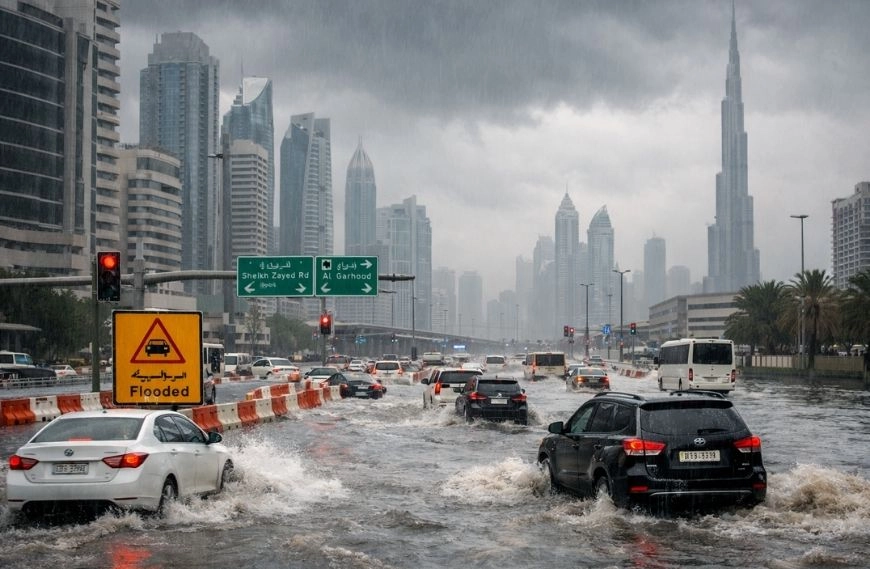
The weather of the United Arab Emirates (UAE) has long been characterised by extremes. Situated on the Arabian Peninsula’s arid fringe, the UAE historically experienced predictable desert heat and minimal rainfall. Over the past decade, however, these climatic norms have shifted noticeably, with weather patterns becoming more volatile, a development of significance not only for meteorologists but also for residents, expatriate communities including Indians, and planners of infrastructure and urban life.
Historical Climate Patterns in the UAE
For most of its modern history, the UAE’s climate fitted the classic desert profile: scorching summers, mild winters, and very low annual precipitation. Coastal cities like Dubai and Abu Dhabi typically recorded summer highs in the high 30s to low 40s °C, with inland desert regions occasionally breaching 45 °C. Rainfall was infrequent and usually light, averaging between 100 mm and 200 mm annually across the Emirates.
However, documented weather events over recent years signal departure from these historical norms. In April 2024, for example, Dubai experienced its heaviest rainfall in 75 years, with more than 250 mm falling in a single storm event exceeding annual averages by multiple times. Similarly, in 2022Heavy rains caused significant flooding in the northern Emirates, including Kalba and Fujairah, demonstrating that even traditional dry spells are now punctuated by intense precipitation.
These episodes are not isolated curiosities but part of a broader trend. The UAE’s National Centre of Meteorology (NCM) has noted shifts in both the frequency and intensity of stormy days. Scientific research indicates that the region has experienced up to two additional stormy days per year compared with conditions in 2000, a phenomenon that climate scientists attribute to global warming’s influence on atmospheric moisture and convection processes.
Heat Extremes: The Intensification of Desert Summers
Equally striking is the trend in summer heat. In 2025, the inland town of Sweihan reached 51.8 °C, approaching the UAE’s all-time national record and reflecting the persistence of extreme heat episodes during what is locally referred to as the Al Mirzam heatwave. Coastal megacities like Dubai and Abu Dhabi have regularly experienced mid-40 °C temperatures, often exacerbated by high humidity and dust. Such extremes are not merely statistical peaks; they have real implications for public health, energy usage, and outdoor labour.
These temperature excursions are consistent with broader regional warming trends. Recent reports from international meteorological agencies document that much of the Arab world including the Gulf states is warming at twice the global average rate, with severe heatwaves increasingly common.
Unstable Weather in Late 2025: The Present Situation
As of December 2025, the UAE is experiencing notable instability in weather patterns for this time of year. Traditionally mild winters in the Emirates have now begun with erratic conditions including rain, gusty winds, and fluctuating temperatures. The NCM has forecast intermittent showers and cloud cover across northern and island regions, alongside gusty winds and occasional rough seas, a set of conditions that would have been unusual even a decade ago.
Local authorities, such as the Dubai Police General Command, have issued public safety alerts in response to these unsettled conditions, urging residents and visitors to prepare for periods of rain and wind and to adhere to driving and water-safety advisories. A recent forecast also highlighted a drop in temperatures by around six degrees Celsius compared with November averages, as well as dense fog and cooler nights, marking the entrance of winter with greater variability than usual.
Contemporary weather data reflect this variability. In mid-December, evening temperatures in Dubai hovered around 22–26 °C, accompanied by moderate humidity and shifting wind direction conditions that contrast sharply with the region’s default summer extremes.
What Is Driving the Weather Instability?
Multiple factors underlie these emerging patterns. Climate change stands foremost among them. Warmer global temperatures enhance the atmosphere’s capacity to hold moisture, fueling more intense but less predictable convection and rainfall events in regions that were once reliably arid. This mechanism helps explain why the UAE, historically one of the driest countries on Earth, can now receive rainfall in magnitudes that overwhelm infrastructure originally designed for minimal precipitation.
Urban development further amplifies these effects. Rapid expansion of built environments in cities like Dubai, with extensive pavement, high-rise structures, and limited natural drainage, increases surface runoff and flood risk when heavy rainfall occurs. Recent studies examining extreme rainfall in nearby regions of the Arabian Peninsula have underscored this interaction between climate extremes and urban vulnerability.
Another unique facet of UAE weather management is the country’s investment in cloud seeding, a deliberate attempt to enhance rainfall through atmospheric intervention. While cloud seeding has been practised since the 1990s to augment scarce water resources, meteorological authorities emphasise that unusual storm events are primarily driven by natural atmospheric dynamics linked to climate change rather than artificial precipitation efforts.
Implications for Residents and Planning
For residents including the large expatriate Indian community these evolving weather patterns have practical consequences. Extreme heat necessitates sustained reliance on cooling infrastructure, with attendant energy costs and health risks for outdoor workers. Unpredictable rain and wind conditions demand robust urban planning, resilient infrastructure, and public alert systems. As climate variability increases, so too must preparedness across sectors such as transportation, construction, and emergency services.
Urban authorities in the UAE have responded with infrastructural investments, such as extensive stormwater drainage systems designed to mitigate flood risk and adapt to rising rainfall intensity. The evolution of these systems reflects a recognition that historic weather norms no longer suffice as the basis for planning.
A New Climatic Reality
The UAE’s conventional image as a landscape of endless sun and predictable heat is now giving way to a more complex reality. Extreme heat remains a defining feature of its climate, but rainfall events, storm variability, and seasonal unpredictability are increasingly integral to the nation’s weather profile. Historical records once relied upon for planning and expectation are being rewritten by data, observation and lived experience.
For communities accustomed to stable desert conditions, this instability represents both a challenge and a call to adaptation. Meteorological science, infrastructure resilience, and public awareness must evolve in tandem to navigate this shifting climate landscape.
In the broader context of global climate change, the UAE’s experience exemplifies how even the driest regions are not immune to weather volatility. The imperatives of adaptation, risk management, and foresight become not abstract goals but everyday necessities whether for residents in Abu Dhabi, workers in Dubai, or visitors navigating these dynamic skies.
Subscribe Deshwale on YouTube
