









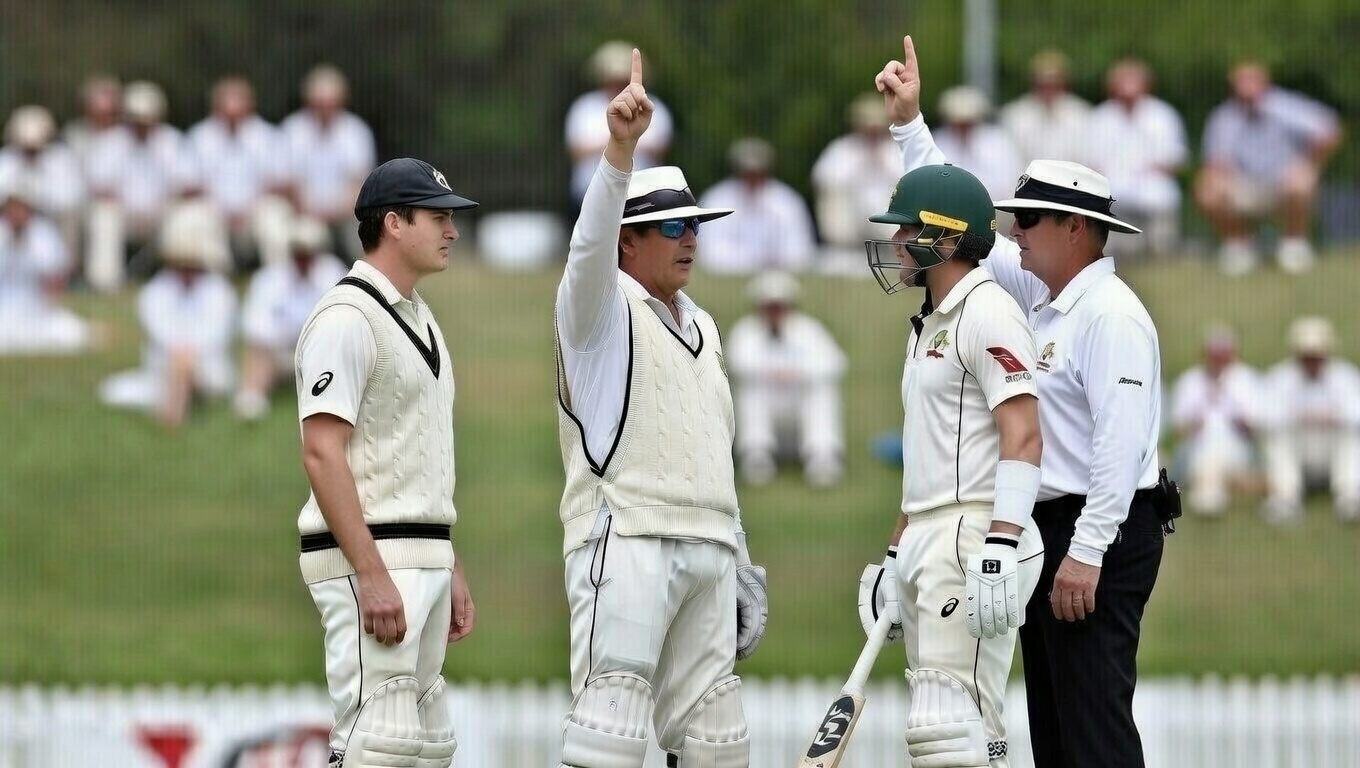
Umpiring remains one of the hardest jobs in sport. Split-second calls decide matches, series and sometimes careers. Most umpires get things right under huge pressure. Yet a handful of decisions have stood out for all the wrong reasons. Fans still debate them years later. This article as Part One looks at 10 such moments from international cricket. They span Tests and one day games. These cases show why the human element kept the game unpredictable, deeply frustrating, exciting, and unjust.
Umpire Javed Akhtar at his notorious best
At the 1998 Coca-Cola Cup final in Sharjah, as India were cruising to a win against Australia, needing only 25 more runs, Sachin Tendulkar, on 134 runs off 131 balls, was given out LBW by Pakistani umpire Javed Akhtar, delighting Australian pacer Michael Kasprowicz. Michael had delivered the ball from round the wicket. The ball possibly pitched outside the leg stump and was certainly going on to miss off stump. But this bad verdict didn’t stop India from winning the trophy some minutes later.
Shoulder-before-wicket in Adelaide
In December 1999, India was playing a Test against Australia at the pristine Adelaide Oval. Batsman Sachin Tendulkar ducked a short ball from Australian line-and-length master Glenn McGrath. The delivery hit his shoulder. There was no pad contact at all. Australian umpire Daryl Harper still raised his finger for lbw.
Replays confirmed the ball never touched the pad. Tendulkar walked back puzzled. The call shocked many observers, although some pundits, including umpire Harper, believed that the bounce wouldn’t have been that steep and the ball would have gone on to clip the bails. It came at a crucial moment in the Test and stayed in human memory as one of the oddest dismissals.
An unbelievably daft decision at Galle
During the first Test of the English tour of Sri Lanka in February 2001 at the scenic Galle, English wicketkeeper-batsman Alec Stewart was shockingly adjudged LBW to Sri Lankan all-rounder Sanath Jayasuriya by Sri Lankan umpire Peter Manuel. The ball from Jayasuriya had landed and pitched significantly outside Stewart’s leg stump, making it mathematically impossible to be out. Peter later confessed that it was the worst decision of his umpiring career.
Bounced ball given out caught
In the same Test series as mentioned above, in the second Test at Kandy in March 2001, with Sri Lanka 1-0 up and trailing by 90 runs, they commenced their second innings. Soon, they found themselves in a dire hole. After having scored two runs, they lost batsman Marvan Atapattu legitimately. Three balls later, what happened still dismays cricket aficionados. Sri Lankan captain Sanath Jayasuriya pushed at a wide, low full toss from English bowler Andrew Caddick. The ball hit the bat, hit the ground, and then ballooned up to be caught by Graham Thorpe at third slip.
Despite the ball clearly bouncing first, the Englishmen appealed, and Lankan umpire B.C. Cooray, after consultation with South African umpire Rudi Koertzen, raised his finger to give Jayasuriya out. Television replays confirmed that the ball had bounced approximately 30 cm after hitting the bat. An angry Jayasuriya stood his ground for a moment before walking off, later throwing his helmet at an advertising board and being docked 60% of his match fee.
Andrew Flintoff in disbelief and even his Kiwi opponents
In March 2002, at Auckland’s magnificent Eden Park, in the third Test between England and New Zealand, as England were 118/5, trailing by 84 runs, Kiwi pacer Andre Adams didn’t even appeal for a caught behind as the ball passed English all-rounder Andrew Flintoff’s bat. But the Kiwi wicket-keeper Adam Parore did appeal, and the Kiwi umpire Doug Cowie raised his finger. The replays showed a monumental gap between the bat and ball, leading to boos from the English spectators. Andrew, before his dismissal, had raced to 29 runs off 28 balls, and was shaping up to be a thorn in the Kiwi desire to level the Test series.
Missing off stump and other stumps in Brisbane
In December 2003 in Brisbane at the Gabba, in a Test match against Australia, Tendulkar, on nought, faced Australian fast-medium bowler Jason Gillespie, who was known for his bowling efficacy and also for being one of the few Australians with a partly Aboriginal bloodline to play for Australia. The lbw appeal sounded loud after the ball thumped Tendulkar’s pads high after he had shouldered his arms after picking the ball’s line early. Steve Bucknor gave him out. The ball had pitched outside off and was missing the stumps by a clear margin.
Bucknor admitted decades later that he got it wrong. Sachin’s early dismissal hurt India during its first innings though India managed to recover well thanks to captain Sourav Ganguly’s fine knock of 144 runs, helping India post 409 runs in response to Australia’s 323 runs. It has become one of those moments fans quote when talking about unlucky batsmen.
Glove left the handle
Edgbaston 2005. The second Ashes Test had reached its final overs. With Australia needing three runs to take a 2-0 lead in the Ashes series, Australian tailender Michael Kasprowicz had attempted to fend off a short-pitched delivery from English pacer Simon Harmison. The ball hit his glove, but the glove had already left the bat handle by then. Kiwi umpire Billy Bowden raised his finger. England won by two runs. Television pictures proved the contact happened after the glove detached. The decision sealed one of the greatest Test finishes ever yet left Australia feeling robbed.
Helmet lob ends masterclass
Hobart 2007. Sri Lankan wicketkeeper-batsman Kumar Sangakkara had batted brilliantly for 192 as Sri Lanka tried to chase down 507 runs at the Bellerive Oval in Tasmania to level the Test series 1-1. Australian pacer Stuart Clark sent down a short one. The ball brushed the shoulder, then the helmet and lobbed gently to Ricky Ponting at slip. South African umpire Rudi Koertzen gave it out caught typically iconically by slowly raising his left index finger, visibly distressing Kumar. No bat or glove touched the ball. Replays showed daylight between wood and ball. Sri Lanka lost a great innings, and the chase became harder. Sangakkara looked stunned as he left the field.
Knee roll, not edge
Sydney 2008. In the second Test of the four-Test series, with India trailing 0-1, Indian batsman Rahul Dravid pushed at Australian all-rounder Andrew Symonds as India were at 115-3, with the set Australian target of 333 runs on Day 5 looking increasingly unachievable for India. The ball had possibly hit Rahul’s knee roll as he had padded up to it outside off, the bat behind his pad and nowhere near the ball. There was no wooden edge to Australian wicketkeeper-batsman Adam Gilchrist.
Caribbean umpire Steve Bucknor still gave Rahul caught behind, visibly agitating and frustrating him. India were fighting back in the chase and trying to at least save the Test. The replays left no doubt. The call formed part of a larger set of controversial moments in that heated Test.
Andrew Symonds survives when he should not have
In the second Test at the SCG during the 2008 Indian tour of Australia, during the Australian first innings, Andrew Symonds, on 30, was clearly caught behind off the bowling of Ishant Sharma but umpire Steve Bucknor controversially did not give it out. Symonds then went on to make an undefeated 162, helping Australia reach a total of 463 runs. That series was marred by contentious umpiring decisions galore and the Monkeygate scandal.
These incidents show that even the smallest human error can drastically affect matches, series, and careers. Umpiring mistakes have shaped outcomes, created controversies, and sparked debates among fans for decades.


