






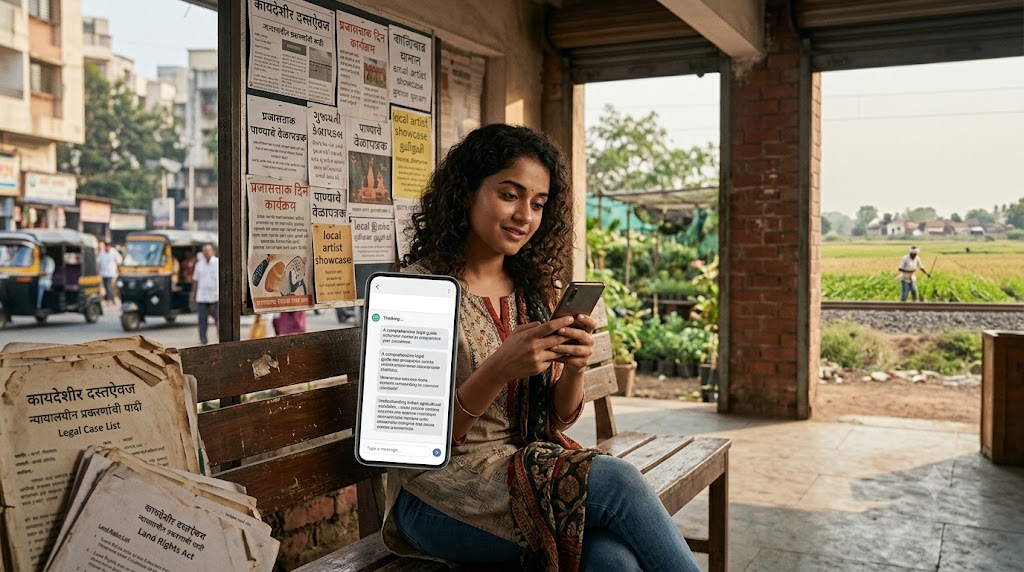
Ask a chatbot a question in Hindi about a land dispute or a rent agreement, and you will probably get a smooth, confident answer. That smoothness is the problem. A fluent answer is not always a correct one, and a confident tone can hide a wrong fact.
India is now one of the biggest markets for AI tools. Students use them for homework, young professionals for emails and reports, and ordinary families for questions about health, money and the law. Yet most of these systems were built, trained and tested far from India. So when something goes wrong here, who is supposed to notice?
Start with language. India has 22 scheduled languages, and in real life hardly anyone speaks them in a clean, textbook way. We mix Hindi with English in a single sentence. We slip into Gujarati or Marathi mid-thought. Accents and word choices change every few hundred kilometres. An AI that scores well on a standard English test can still stumble when a farmer in Vidarbha or a student in Surat talks to it the way they actually talk.
Then there is the law. India’s old criminal code, the Indian Penal Code, was replaced by the Bharatiya Nyaya Sanhita on 1 July 2024. A model trained mostly on older material can keep quoting the old section numbers with complete confidence. For a student, that is a small slip. For someone who is genuinely in trouble with the police, it can be a costly one.
The hardest problem is social context, and caste is the clearest example. Several independent tests of popular AI tools have found that they carry caste bias. In some cases the models linked certain castes with low-paid work and others with prestigious jobs, simply because those patterns exist in the data they learned from. The machine is not casteist by choice. It is a mirror, and it reflects the worst corners of the internet back at us, in polished language.
Early research on AI in education points the same way. Studies suggest that AI tutors may adjust how complex their explanations are depending on who they think the student is, such as their caste or whether they study in an English-medium school. These findings are still being tested, and we should treat them carefully. But the direction is worrying. Two students asking the same question should get the same quality of answer.
One more thing is worth noticing. Many of the best-known checks on these problems have come from individual researchers, universities and journalists, not from a fully operational government testing body. That is a fragile way to find out whether a tool used by millions of Indians is fair and accurate.
None of this means AI is useless for India. Many of these tools are genuinely helpful, and Indian teams are building better, local ones. Indian researchers are also creating datasets and tests that look specifically at Indian languages, caste, religion and regional identity. These are good first steps. But a test is only useful if someone runs it regularly, independently and in public, on the tools people actually use.
That “someone” is the missing piece. India announced an AI Safety Institute in January 2025, to work through partner institutions, but the post of its director was advertised only in May 2026. The idea is right. But an announcement is not the same as a working lab that can open a new model, test it in ten Indian languages, and tell the country honestly what it found. That kind of capacity takes time, talented people and a clear mandate.
Meanwhile, the world is not waiting. Rules and safety standards for AI are being drafted in other capitals. They will naturally be shaped around the worries of the countries writing them. Those worries may not be ours. For India, AI safety may be less about robots turning against humans and more about everyday failures: a wrong legal answer, a biased reply, a mistranslated medical instruction, a fake video that fools a village before anyone can check it.
So what would real Indian AI safety look like? It would start with regular, independent testing of popular models in Indian languages and dialects. It would mean publishing the results in simple words, so schools, companies and ordinary users can see them. It would mean checking models against Indian laws as they change, and against social realities that no foreign test captures. And it would mean making sure the people who find the problems are not only outsiders.
Think of it like food. We do not trust a packet of food just because a foreign company says it is safe. We want it tested here, against our standards, by someone who is answerable to us. AI should be no different, especially when more than 10 crore Indians already use ChatGPT alone every week, by OpenAI’s own count.
The real question, then, is not whether global AI is safe. It is whether anyone in India has the power to find out. Until we can answer that, we are trusting a system that has never been properly tested on us.
Subscribe Deshwale on YouTube


