






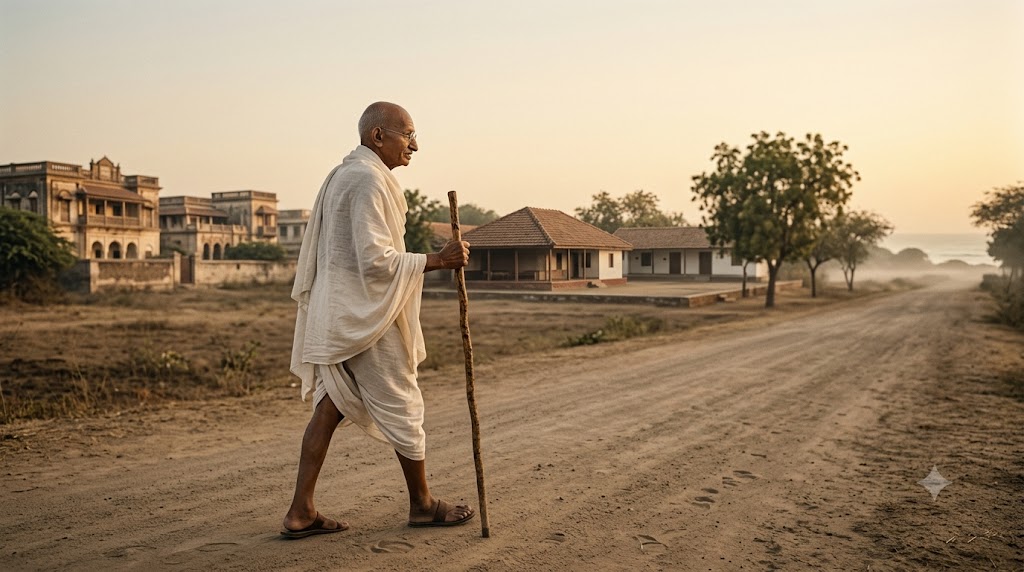
Most of us meet Gandhi as a finished product. He is on the currency note, in the textbook chapter, in the statue at the traffic circle with a stick in his hand.
It is easy to forget that he was once a nervous boy from Gujarat who feared the dark, ran away from conversations and, as a young lawyer, froze in court.
To understand how that boy became the Mahatma, it helps to follow him through the places that raised him. Almost all of them are in Gujarat.
The story starts in Porbandar, a port town on the Arabian Sea, where Mohandas Karamchand Gandhi was born on 2 October 1869. His father, Karamchand, was the dewan, or chief minister, of the small princely state.
His mother, Putlibai, was deeply religious and kept long fasts and strict vows. Gandhi wrote years later that her faith left a mark on him.
You can still visit the old family house, a tall and narrow building, with Kirti Mandir, a memorial built in his honour, standing right beside it. The house is plain, almost ordinary, and that is what stays with you after you leave.
The family did not stay in Porbandar for long. When Gandhi was about seven, his father took up a post in Rajkot, and that is where he grew up.
He studied at Alfred High School, later renamed Mohandas Gandhi High School and now a museum. By his own account, he was an average student. He was so shy that he ran home the moment classes ended, just to avoid talking to anyone.
One school incident is worth remembering. During an inspector’s visit, Gandhi spelled the word “kettle” wrongly, and his teacher tried to nudge him to copy from the boy sitting next to him. He refused.
He later called himself foolish for it, but a small streak of honesty was already there. Around the same time, he read a play about Raja Harishchandra, the king who gave up everything for the sake of truth. Gandhi said it stayed with him for a very long time.
Life moved faster in those days than it does now. Gandhi was married to Kasturba at 13, which was common at the time. His father died in 1885, when Gandhi was about 16, and he regretted for the rest of his life that he was not at his father’s side at the end.
The family home in Rajkot, known as Kaba Gandhi No Delo, is now a museum. Walking through its rooms feels oddly personal.
After finishing school in 1887, Gandhi joined Samaldas College in Bhavnagar. It was not a happy stay. He could not follow the lectures, felt completely lost, and went home at the end of the first term.
A family adviser then suggested he study law in London, and on 4 September 1888 he sailed from Bombay.
He became a barrister, and in 1893 he travelled to South Africa for a legal case. He ended up staying for more than twenty years.
There he faced racial humiliation, developed his idea of satyagraha, or non-violent resistance, and led protests for the rights of Indians. When he returned home in January 1915, he was a very different man from the one who had left.
He chose Gujarat as his base. In May 1915, he started an ashram at Kochrab, a village near Ahmedabad. About two years later, in June 1917, he moved it to open land beside the Sabarmati river.
In his autobiography, he explains that the site’s closeness to the Sabarmati Central Jail appealed to him, because going to jail was the normal lot of a satyagrahi. Popular tradition adds that a cremation ground lay on the other side, a reminder of how seriously the ashram took its cause.
He lived there until 1930. Visitors can still see Hriday Kunj, his small cottage, and the charkha, the spinning wheel that became a symbol of self-reliance.
Sabarmati was a place of work, not retreat. In 1918, he supported the textile mill workers of Ahmedabad in a wage dispute and joined them in a fast.
He edited Young India and Navajivan from Ahmedabad, two papers that let him speak to ordinary readers in simple language. In 1920, he founded Gujarat Vidyapith, a university meant to teach Indians in their own languages.
By then, people had started calling him Mahatma, a title he never liked. The man behind it had been shaped by daily routine, small habits and hard decisions, far more than by any grand moment.
The grand moment, when it came, began with a walk. On 12 March 1930, Gandhi left Sabarmati with 78 chosen volunteers to protest the British tax on salt.
They walked about 240 miles, nearly 390 kilometres, over 24 days and reached the coastal village of Dandi on 5 April. The next morning, Gandhi picked up a handful of natural salt from the shore, breaking the colonial salt law in full view of the world.
Before leaving the ashram, he had vowed not to return until India was free. He never did. India became independent in 1947, and Gandhi was assassinated in Delhi on 30 January 1948.
At Dandi today, a memorial honours the march and the people who walked it.
If you ever want to follow this trail yourself, it is easier than it sounds. Porbandar and Rajkot lie in Saurashtra, Bhavnagar is a few hours’ drive from Rajkot, Ahmedabad sits in the middle of the state, and Dandi is down south near Navsari.
Seen together, the places tell a simple story. Gandhi did not arrive in history fully formed. He was a shy, average student who stumbled, left a college, struggled as a lawyer and kept learning.
Gujarat watched all of it happen.
Subscribe Deshwale on YouTube


