






Imagine receiving your first telephone call today, but there is no caller ID, no contact name and no screen telling you who is calling. You simply pick up a strange machine and hear a voice from somewhere far away. What would you say? Today, most of us would say “Hello?” without even thinking about it. But that tiny word was not created for the telephone. Instead, the arrival of the telephone helped give an old expression a completely new job. And the most interesting part is that even the first famous telephone conversation did not begin with “hello”.
On March 10, 1876, Alexander Graham Bell successfully transmitted intelligible speech through his telephone to his assistant, Thomas Watson. Bell’s laboratory notebook records the words he spoke: “Mr. Watson – Come here – I want to see you.” Watson heard Bell and came into the room. The moment was important because it demonstrated that a human voice could travel through an electrical system and be understood at the other end. But as the telephone began moving from an experiment into everyday life, people faced a surprisingly simple problem: How do you start a conversation with someone you cannot see?
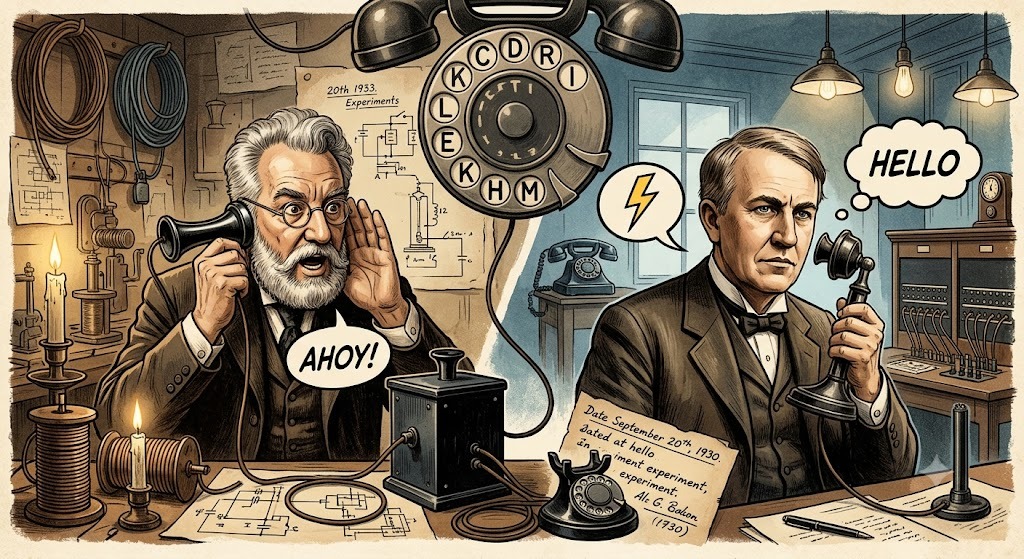
There was no established telephone etiquette. Nobody had grown up learning how to answer a phone because the technology itself was new. Alexander Graham Bell reportedly favoured “Ahoy” as a telephone greeting. The word was already used for calling someone’s attention, particularly in maritime communication. In fact, the Library of Congress notes that Bell initially recommended “ahoy” for telephone conversations. It sounds strange to us now, but at the time it was a perfectly understandable choice. The telephone was essentially allowing people to call out across a distance.
Then Thomas Edison entered the story. Edison favoured “Hello”. But there is an important myth to clear up: Thomas Edison did not invent the word “hello”. The word was already in use before the telephone. What Edison did was help establish its use in telephone communication. In 1877, Edison recommended “Hello” as a way to attract attention when using the telephone, and his recommendation eventually won out over Bell’s “Ahoy”. The reason was practical. “Hello” was short, clear and useful for getting someone’s attention before beginning a conversation.
As telephone networks expanded, “hello” became closely associated with answering a call. This is where the story becomes bigger than Edison or Bell. The telephone did not only change technology. It changed manners. Before telephones, a conversation usually began with two people physically meeting or one person calling out to another. Suddenly, a voice could arrive from miles away without warning. People had to develop new habits: how to answer, how to identify themselves, when to speak and even how loudly to talk. “Hello” gradually became part of that new social language.
What makes this story interesting is that no single person simply decided that the whole world should say “hello”. It became a habit because people kept using it until it felt natural. Today, we have smartphones that show us who is calling before we answer. We can see someone’s face during a video call and send a message without speaking at all. Yet the old habit remains.
Every time we say “hello” into a phone, we are using a small piece of language shaped by the arrival of a technology that once seemed almost magical. “Hello” did not become famous because someone simply invented it. It became important because millions of people adopted it until it stopped feeling like a choice.
So the next time your phone rings, notice what happens. You look at the screen, tap the answer button and almost instinctively say, “Hello?” A word that once simply helped get someone’s attention has travelled through history and become one of the most familiar openings to a conversation.
Subscribe Deshwale on YouTube


