









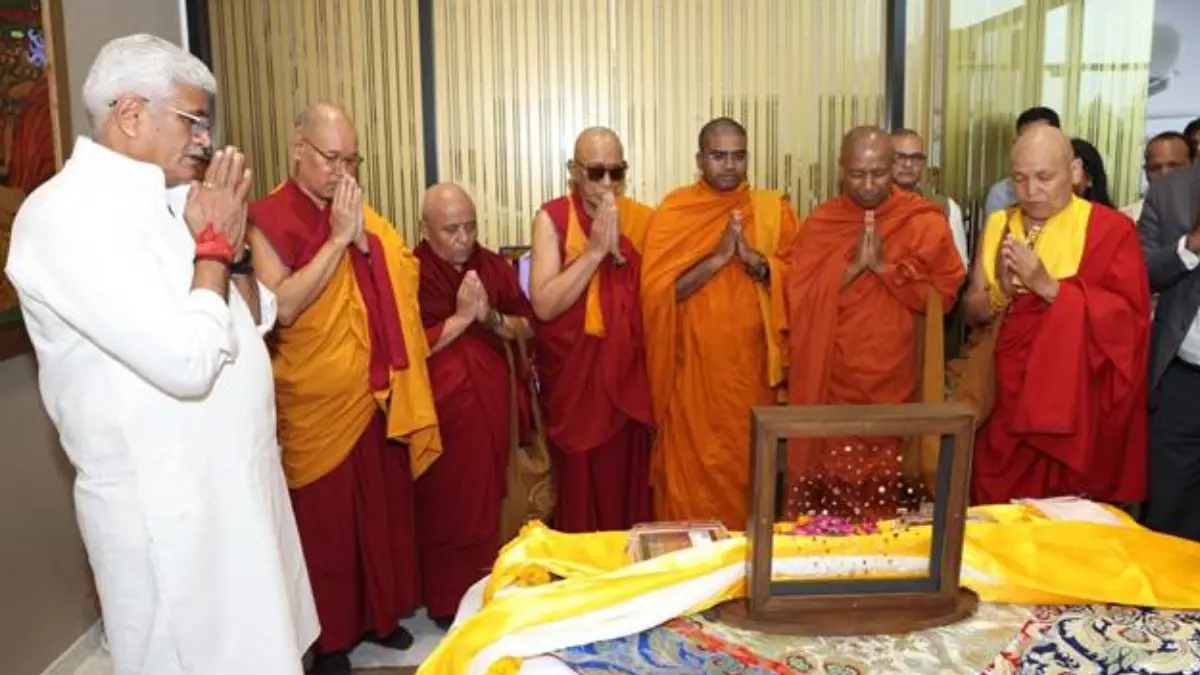
On a peaceful morning in New Delhi, chants of Buddham Sharanam Gacchami filled the air. Devotees gathered to witness a historic moment as a set of sacred gemstones linked to Buddha relics returned to India after 127 years. Their arrival was marked with prayers, flowers, and folded hands. For millions of Buddhists, it was not just the return of precious heritage. It felt like welcoming a part of their spiritual history back home.
A Journey Through Time
The story of these sacred gems began in 1898 when British archaeologist William Claxton Peppe excavated a stupa at Piprahwa in present-day Uttar Pradesh. Many historians believe Piprahwa was part of ancient Kapilavastu, where Buddha spent his early years. Among the findings were jewel-encrusted offerings and crystal caskets that bore inscriptions referring to Sakyamuni, another name for Buddha.
Over time, several of these sacred items left India. They passed through museums, private collectors, and auctions, travelling far from their original resting place. One set of these gemstones linked to Buddha relics eventually ended up in private hands and was recently listed for auction in Hong Kong.
From Auction to Homecoming
The news of the planned auction sparked outrage among Buddhists worldwide. The idea that sacred gems linked to Buddha relics could be sold was deeply unsettling. India’s Ministry of Culture swiftly intervened. Through diplomatic talks and with support from Buddhist organisations, the auction was stopped.
The owners eventually agreed to return the gems to India. Their homecoming was celebrated with a moving ceremony in Delhi. Monks in saffron robes chanted prayers, devotees showered petals, and the relic-linked gemstones were placed on display under soft lights. For those present, it was more than an event. It felt like witnessing a lost treasure finally return to its roots.
The Sacred Heart of Piprahwa
These gemstones are not ordinary artefacts. They are believed to be offerings associated with the enshrinement of Buddha’s relics after his Mahaparinirvana. Piprahwa, their place of origin, holds special significance because it is tied to Buddha’s own Sakya clan and early life.
For devotees, seeing these gems is a way to feel closer to Buddha’s teachings of compassion and peace. Pilgrims travelled from Nepal, Sri Lanka, Myanmar, and across India to witness their return. Standing before them, many felt a deep sense of calm and reverence, as if reconnecting with history itself.
Celebration Across Borders
The return of these sacred gems linked to Buddha relics was celebrated far beyond India. Temples in Thailand and Sri Lanka held special prayer gatherings. Monks in Bodh Gaya and Ladakh lit lamps to mark the occasion. Social media filled with images of the glittering gems, and messages of joy poured in from across the Buddhist world.
For many, this was not just the return of heritage. It was a powerful reminder that faith and history remain intertwined across borders and generations.
Restoring Heritage and Identity
The repatriation of these gems is part of India’s growing efforts to bring back lost cultural treasures. Historians point out that while ancient artefacts tell stories of empires, sacred objects linked to spiritual figures carry living meaning.
These gems are not just historical remains. They represent Buddha’s enduring influence and a connection that transcends time. For Buddhists, even a glimpse of them is a way to feel closer to his path of wisdom and compassion.
Back to Piprahwa
The government has announced that after an initial display in Delhi, the sacred gems will be moved to Piprahwa. They will be placed near the very stupa where they were discovered more than a century ago. Pilgrims from around the world will be able to see them in their original setting, allowing the site to regain its ancient sanctity.
For many, this moment carries deep symbolism. After years of being away, these gems linked to Buddha relics will finally return to the soil that connects them to his life and legacy.
A Day of Reflection
The return of these sacred gems is both a historic and spiritual milestone. It also reminds us of the work that remains in reclaiming India’s heritage still scattered abroad.
As the day of their arrival came to an end, monks in Delhi lit 127 lamps, one for every year the relics had been away. Their gentle glow reflected a simple truth: no matter how far they travel, what is truly sacred will always find its way home.


