










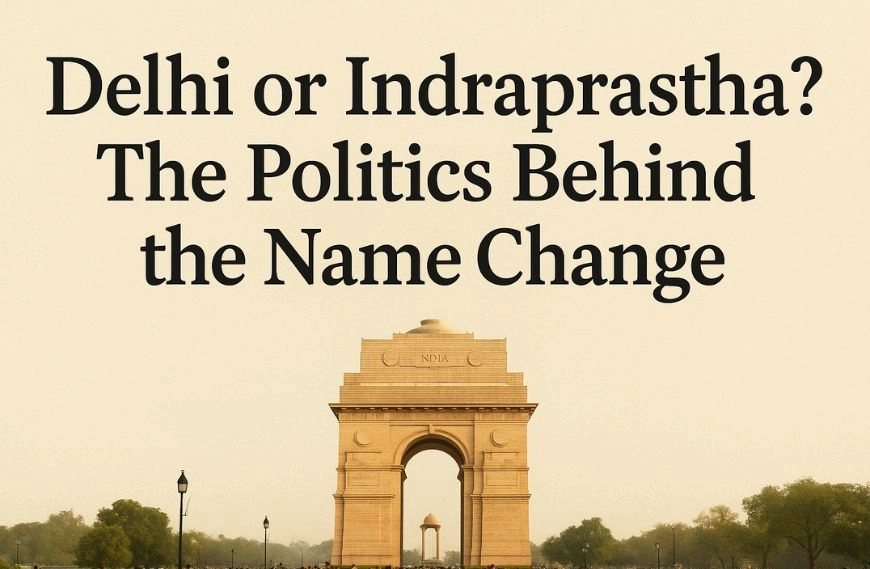
The question of what to call India’s capital city has once again become a matter of national debate. Should Delhi be renamed Indraprastha, as some politicians and cultural groups are demanding? Or should it continue to be known by the name that has stood for centuries as a symbol of India’s modern identity? The controversy highlights the intersection of history, politics, religion, and national identity.
The latest debate began when BJP MP Praveen Khandelwal wrote to Union Home Minister Amit Shah, urging the government to rename Delhi as Indraprastha. Khandelwal, who represents Chandni Chowk, argued that the region’s roots lie in the ancient city mentioned in the Mahabharata. According to him, the change would honour India’s civilisational heritage and re-establish the capital’s ancient identity.
He also suggested that major landmarks such as Old Delhi Railway Station, Indira Gandhi International Airport, and Delhi University could be renamed to reflect the new title. His statement found support among several groups, including members of the Vishva Hindu Parishad (VHP) and other cultural organisations that see the move as a step towards reviving India’s spiritual past.
The name Indraprastha originates from the Mahabharata, one of India’s greatest epics. It was said to be the majestic capital built by the Pandavas on the banks of the Yamuna River, a city of splendour and justice. In popular imagination, Indraprastha represents a golden age of governance and prosperity.
However, historians caution against taking myth as fact. While archaeological excavations have revealed evidence of ancient settlements near Purana Qila and Hastinapur, there is no conclusive proof that modern Delhi stands exactly where Indraprastha once existed. The Archaeological Survey of India (ASI) has acknowledged the site’s antiquity but has not confirmed it as the Mahabharata-era capital.
Delhi’s story spans thousands of years, shaped by numerous rulers and empires. It has been known by different names Dhillika, Dehli, Dilli, and finally Delhi. The Tomar and Chauhan dynasties ruled it before the arrival of the Delhi Sultanate, followed by the Mughals, who made it one of the world’s most magnificent capitals. Later, the British made Delhi the centre of their colonial administration in India.
Each period left behind layers of architecture, art, language, and culture. From Qutub Minar to Red Fort, and from Humayun’s Tomb to Lutyens’ Delhi, every corner tells a different story. Renaming the city, many historians argue, risks simplifying this complex and multi-layered history into a single mythological narrative.
Renaming cities is not new in India. In recent years, several states have changed city names to reflect their traditional or ancient roots: Allahabad became Prayagraj, Faizabad became Ayodhya, Gurgaon became Gurugram, and Aurangabad became Chhatrapati Sambhajinagar.
Supporters of such changes say they restore India’s heritage and correct colonial or Islamic distortions of local names. Critics, however, argue that renaming is often politically motivated, an attempt to shape public memory and consolidate cultural or religious sentiment ahead of elections.
In the case of Delhi, renaming it to Indraprastha could serve as a symbolic gesture aligning with nationalist narratives. Yet it also raises questions about inclusivity and the selective use of history for political ends.
Many historians, such as Prof. Mridula Mukherjee and Rana Safvi, have spoken against the proposal, warning that it undermines Delhi’s plural and multicultural identity. They point out that Delhi has always been a “living city,” absorbing influences from Hindu, Muslim, Sikh, and British cultures alike.
They also note that the name ‘Delhi ‘itself predates colonial rule and appears in several ancient inscriptions. The attempt to replace it, they say, risks erasing the contributions of centuries of diverse communities who shaped the city.
Beyond the symbolism, renaming a major global capital comes with significant costs and challenges. Changing Delhi’s name would affect administrative documents, government records, maps, travel itineraries, postal addresses, branding materials, and international databases.
Experts estimate that the expense could run into hundreds of crores of rupees, not including the cost of changing signage, legal records, and public awareness campaigns. Urban planners and economists argue that such efforts divert funds from more pressing civic needs like infrastructure, pollution control, and housing.
Delhi is not just a city it is a mosaic of eras and emotions. It has witnessed dynasties rise and fall, revolutions spark and fade, and communities coexist for centuries. It houses ancient temples, Mughal mosques, British-era avenues, and modern skyscrapers all within a few kilometres.
This blend of histories is what makes Delhi unique. Changing its name to Indraprastha, critics fear, would confine its identity to just one chapter of its story.
Names carry power. They shape how people see themselves and how others see them. The debate over Delhi’s name is ultimately about who gets to define India’s heritage. Should the capital’s identity be anchored in mythology, or should it reflect the many realities and communities that have built it over millennia?
Those supporting the renaming see it as reclaiming lost pride; those opposing it see it as rewriting history for political gain. Both sides, however, agree on one thing: Delhi holds deep emotional and cultural significance for India.
Whether Delhi becomes Indraprastha or remains as it is, the debate highlights the need to balance heritage with inclusivity, faith with facts, and history with modern priorities. Cities are not just names; they are living entities shaped by the people who inhabit them.
Delhi’s real identity lies not in its name but in its diversity, resilience, and spirit. It is both ancient and modern, sacred and secular, Indian yet global. Perhaps the city’s strength lies in that very contradiction and that is something no name change can capture.
Subscribe Deshwale on YouTube


