











I still remember the Delhi of the late nineties, a sprawling, radial beast of a city where every journey inevitably dragged you through the suffocating chokeholds of ITO or the crumbling arteries of the Ring Road. If you lived in the dusty northern peripheries and had business in the east, you did not plan a commute. You planned an expedition. The capital was a city of spokes, dragging everyone to the centre, leaving the fringes to fend for themselves in a perpetual gridlock.
On Sunday, the 8th of March 2026, the fundamental geography of this historic capital shifted.
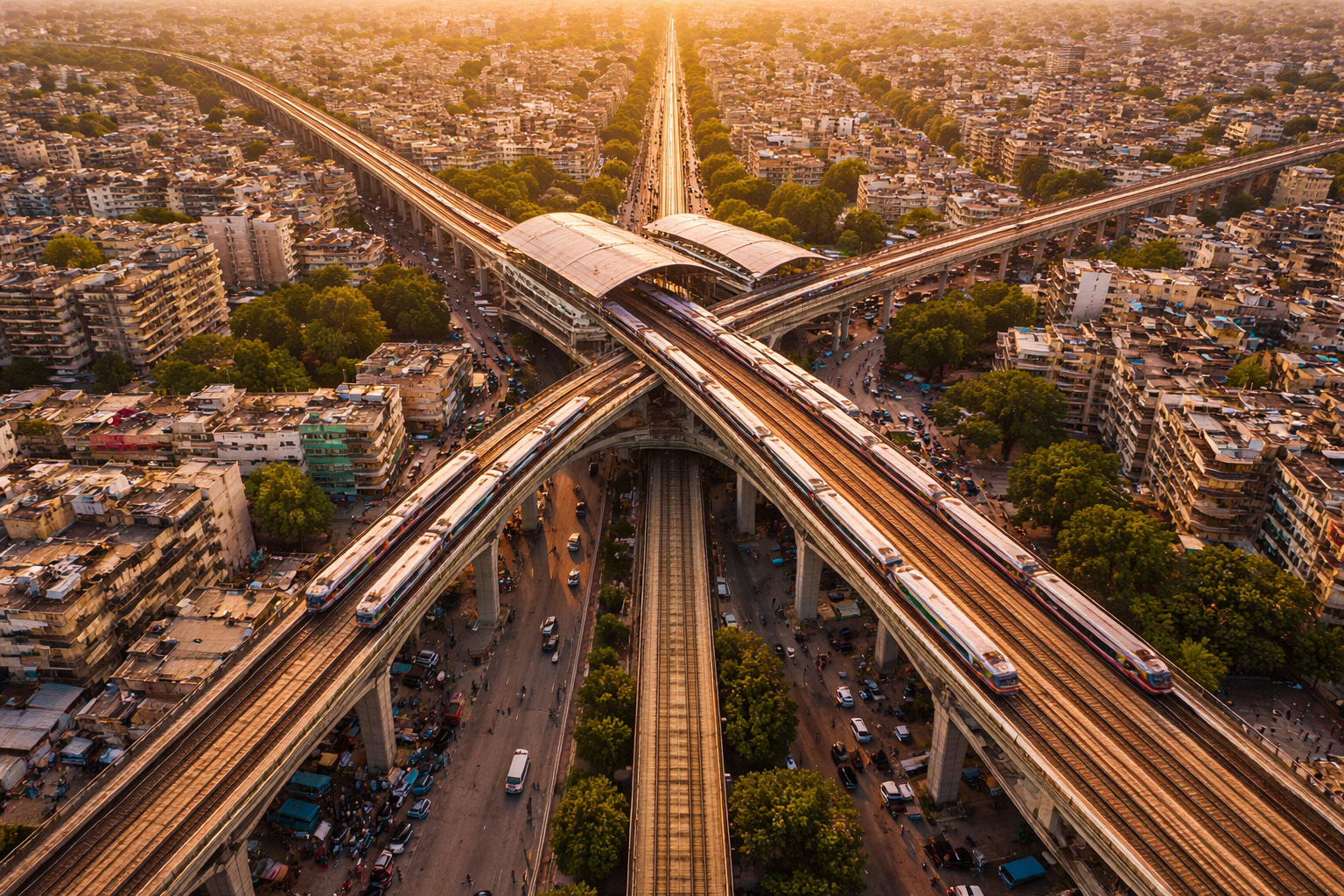
When the 12.3-kilometre Majlis Park to Maujpur-Babarpur section was officially inaugurated, it was not just another ribbon-cutting exercise to add to the archives. It was the closing of a colossal loop. The Delhi Metro’s Pink Line, now stretching a staggering 71.56 kilometres, has become India’s first fully operational Ring Metro. For a city that has spent decades choking on its own exhaust fumes, this continuous circular spine is nothing short of a modern milestone.
What a Ring Metro Actually Means
To truly grasp the magnitude of this achievement, one must look beyond the sheer length of the track. Urban planners have long viewed circular transit lines as the holy grail of metropolitan management. London has the Circle Line. Tokyo has the Yamanote Line. These networks allow millions to bypass the congested city centre, transferring seamlessly between radial lines.
Until now, navigating across Delhi’s outer neighbourhoods meant travelling inwards to a major interchange, such as Rajiv Chowk or Kashmere Gate, only to travel back outwards on a different line. The completed Pink Line eliminates this exhausting pendulum swing entirely. By stitching together 46 stations, the Ring Metro now intercepts almost every major radial line in the DMRC network.
The newly inaugurated stretch brings the following elevated stations into the fold:
- Majlis Park
- Burari
- Jharoda Majra
- Jagatpur-Wazirabad
- Soorghat
- Nanaksar-Sonia Vihar
- Khajuri Khas
- Bhajanpura
- Yamuna Vihar
- Maujpur-Babarpur
Connecting the Unseen City
What is most striking about this development is its profound sociological impact. When one sits in the power corridors of Lutyens’ Delhi, it is easy to view infrastructure purely in terms of capital expenditure, vote banks, and macroeconomic growth. But for the daily wage earner in Burari or the student commuting from Khajuri Khas, the Metro is the great equaliser.
For decades, the dense, working-class neighbourhoods along the banks of the Yamuna, places like Sonia Vihar and Bhajanpura, were entirely reliant on a fractured, unpredictable road transport system. They were the unseen Delhi, structurally isolated from the economic heart of the capital. The Ring Metro does not just lay down tracks. It democratises access. It bridges the gap between the affluent south and the aspirational north and east, pulling millions into the formal economic fold.
Engineering the Impossible
The sheer audacity of the engineering behind this project deserves full acknowledgement. Delivering infrastructure in the densely populated, chaotic urban sprawl of Northeast Delhi is a nightmare of logistics and land acquisition.
The Majlis Park to Maujpur corridor features a double-decker viaduct that carries both the metro track and a road flyover, a masterstroke of space optimisation in a city perpetually starved of it. Construction also involved throwing a brand-new bridge across the Yamuna River, the fifth metro bridge to span the river, serving as a vital artery connecting the eastern and northern banks.
It is a testament to the DMRC’s relentless push to overcome geographic and bureaucratic hurdles, many of which had delayed this final Phase IV completion by over two years.
The Magenta Line Extension and What Comes Next
While the Pink Line’s completion dominated the headlines, the broader infrastructure push of this weekend deserves equal attention.
Alongside the Ring Metro, the 9.92-kilometre extension of the Magenta Line was inaugurated, connecting Deepali Chowk to Majlis Park. This elevated corridor adds seven new stations and pushes the Magenta Line’s total length to nearly 49 kilometres. It features tracks ascending to a height of 28.36 metres above ground, one of the highest points in the entire network. This stretch will crucially connect the rural and industrial outskirts of West Delhi, including Haiderpur and Bhalswa, to the broader transit grid.
Looking further ahead, the laying of foundation stones for Phase V (A) projects signals that the administration is not resting on its achievements. Key components of the next phase include:
- A 9.9-kilometre underground Central Vista corridor linking RK Ashram Marg to Indraprastha, which will redefine access to the capital’s administrative and cultural monuments
- Golden Line extensions that will dramatically improve airport connectivity for residents of Noida and Faridabad, turning the National Capital Region into a truly cohesive economic bloc
A Circular Future for a City That Refuses to Stop Moving
Delhi is no longer just expanding outwards. It is finally knitting itself together.
The Ring Metro is more than steel, concrete, and signalling systems. It is the new circulatory system of a city that refuses to stop moving. It promises to slash vehicular emissions, decongest arterial roads, and return millions of hours to citizens, time previously lost to the merciless traffic of the Inner Ring Road.
For those of us who have chronicled Delhi’s evolution from the era of sputtering diesel buses to the sleek, air-conditioned efficiency of the Metro, the completion of the Ring Metro feels like a genuine watershed. The loop is closed. The city, at long last, has a centre of gravity that encompasses all its people, not just the privileged few.
Subscribe Deshwale on YouTube


