



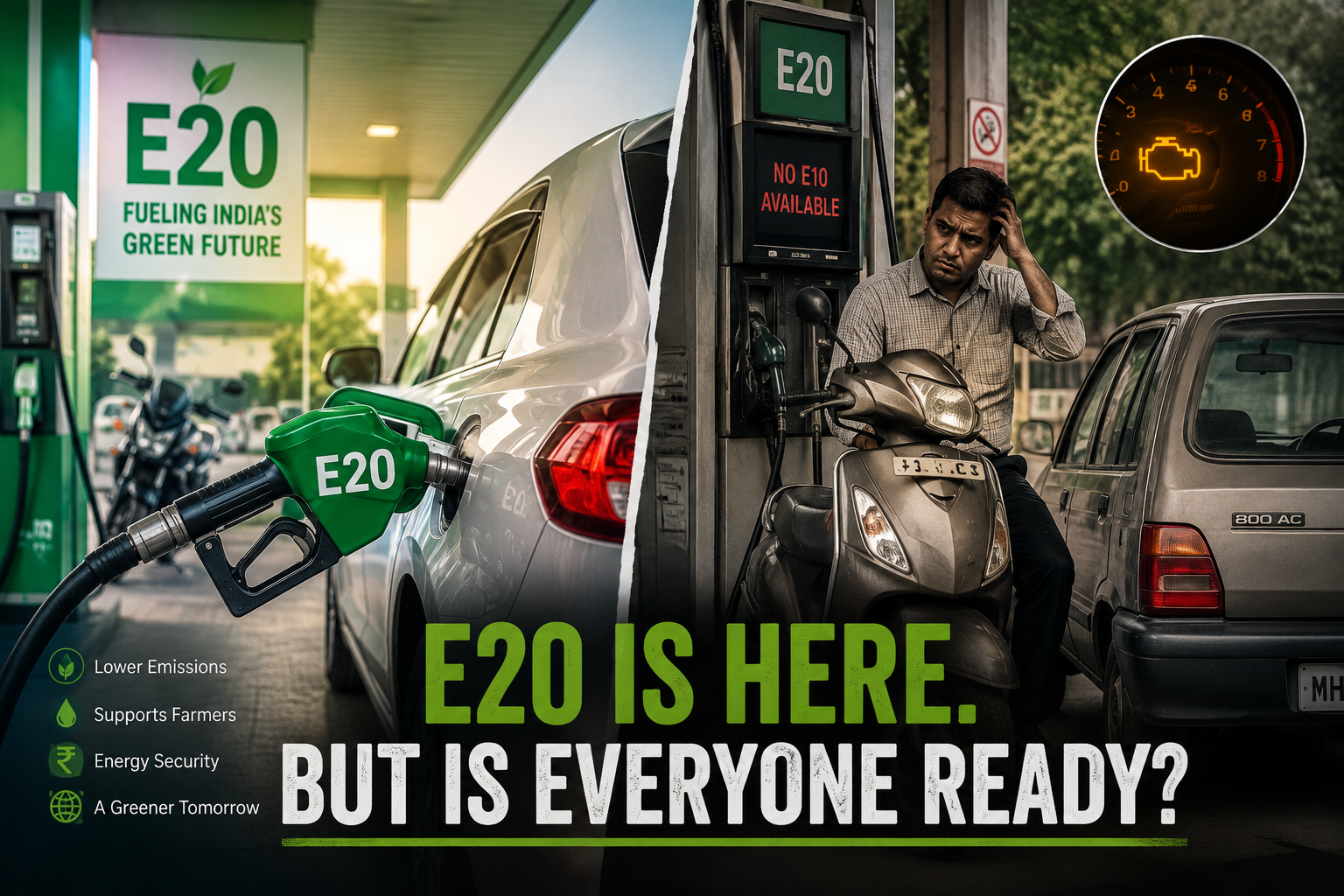
For the past year, the message from the government and the auto industry has been loud and consistent: E20 petrol is safe, tested, and here to stay. Posters at petrol pumps say so. Ministry statements say so. Even top executives from Maruti Suzuki, Toyota, Hero MotoCorp and Bajaj have gone on record defending it, citing service records from millions of vehicles with no unusual damage.
So here’s the question worth asking: if E20 is genuinely this safe, why do so many people, consumers, petrol dealers, even a Supreme Court petitioner keep demanding the return of a lower-ethanol option?
That’s the real contradiction sitting in plain sight. Not an industry cover-up, but a gap between what’s being said at press conferences and what’s happening at petrol pumps.
What E20 actually is
E20 is petrol blended with 20% ethanol, up from the 10% blend (E10) that was standard until recently. India hit its 20% blending target in December 2025, five years ahead of the original 2030 deadline ethanol content in petrol had climbed from just 1.5% back in 2013-14. From April 1, 2026, E20 became the only fuel available at petrol pumps nationwide. There’s no E10 or E5 option left at any retail outlet.
The policy logic isn’t controversial. Ethanol is partly plant-based, so blending it cuts crude oil imports, supports sugarcane and rice farmers, and is meant to lower emissions. Several countries, including the US, Brazil and Canada, already run on similar or higher ethanol blends.
The safety case
The government’s confidence rests on real testing. Back in 2014, the Automotive Research Association of India (ARAI), along with the Indian Oil Corporation and the Society of Indian Automobile Manufacturers (SIAM), ran extensive trials around 40,000 km on cars and 20,000 km on two-wheelers checking for damage to engines, rubber seals, and fuel lines. The results showed no major compatibility issues, only a marginal mileage dip.
Only vehicles made from April 2023 onwards are officially certified E20-compatible, under a specific technical standard (BIS IS 17021). SIAM has also publicly clarified that manufacturers will honour warranties on older vehicles running E20, regardless of what the owner’s manual says.
So where’s the resistance coming from?
Not from the industry from the road. Older vehicles, particularly those built to the earlier BS3 and BS4 emission standards, simply weren’t designed for this much ethanol. Ethanol absorbs moisture from the air, and over time this can speed up corrosion in metal tanks and wear down rubber gaskets and seals not built to handle it. The concern is sharper for two-wheelers, which use more rubber and polymer parts relative to their size.
This is exactly why a Supreme Court PIL was filed, asking for mandatory ethanol-content labelling at pumps and the choice to still buy E10. It’s why petrol dealers in states like Odisha have publicly said complaints about mileage drops and engine trouble have risen sharply since the switch, even though they have no control over the policy themselves. And it’s why a group of car owners in Delhi has staged public protests demanding a lower-ethanol option and a compensation mechanism for vehicles already affected.
The government’s response, delivered by Road Transport Minister Nitin Gadkari in Parliament, has been firm: based on the same ARAI-IOCL-SIAM study, there’s no plan to offer a phase-out or retrofit scheme for older vehicles. Routine servicing, the government says, is enough to manage the wear and tear.
The vehicles most likely to be affected aren’t luxury cars. They’re the decade-old scooters and hatchbacks that middle and lower-income Indians depend on daily vehicles bought on loans still being paid off, with no real option to upgrade just because the fuel changed under them. Independent estimates suggest a large share of India’s roughly 34 crore registered vehicles, especially the 24-crore-plus two-wheeler fleet, predates the April 2023 compatibility cutoff.
When the people closest to the actual complaints dealers, drivers, and petitioners keep asking for a way back to E10, while the official answer stays “there’s no need,” the honest picture is probably somewhere in between. E20 may well be a sound long-term policy for India’s energy security and farm incomes. But dismissing every concern from older-vehicle owners as pure misinformation ignores just how many different voices are now asking for the same thing: a choice at the pump.
Subscribe Deshwale on YouTube
