



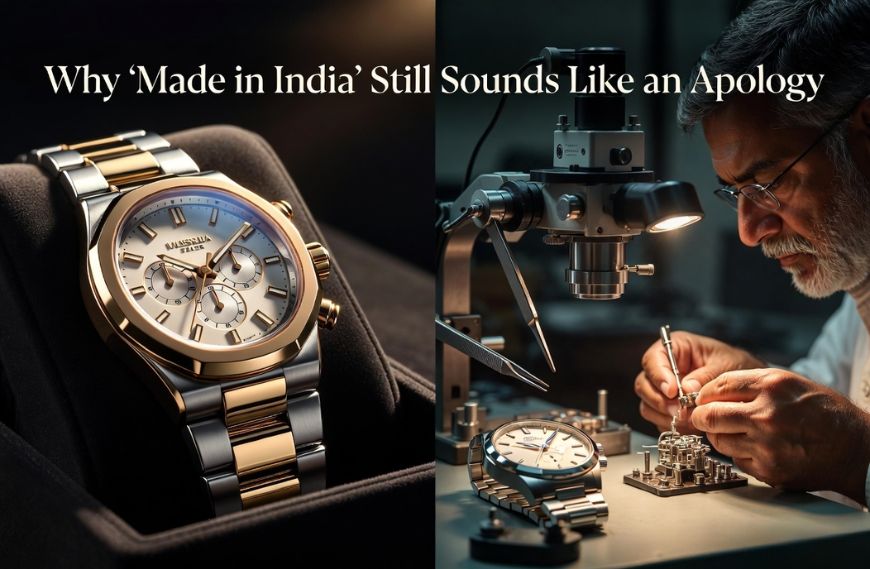
There’s a scene in the new series Made in India: A Titan Story that says more about Indian consumer psychology than the entire show around it. In a dramatised moment, a representative of a Swiss watchmaking family is approached by JRD Tata with a proposal to collaborate and build watches in India. The response is blunt: Indians, he says, are labourers, not watchmakers. They can assemble things. They cannot craft them.
That single line, dismissive as it was, sets up four decades of Indian manufacturing history in the show. Because the company that emerged from that rejection, Titan spent the next several decades trying to prove the opposite.
It’s worth asking why that line still stings. Not because Titan failed to prove him wrong. It succeeded, spectacularly. Titan became one of India’s most recognised consumer brands, sold across the world, and eventually built the retail and manufacturing muscle to rival companies many times older. And yet, the instinct voiced in that scene that Indian-made means adequate, while foreign-made means excellent never fully went away. It simply moved to newer products.
To understand why, it helps to go back to how Titan actually came into being. In the early 1980s, India’s watch industry was dominated by HMT, a government-owned company that had been manufacturing mechanical watches since 1961, in collaboration with Japan’s Citizen Watch Co. HMT watches were reliable and inexpensive, but they were built for utility, not aspiration. They sat on the wrists of teachers, clerks and government employees as practical objects, not status symbols.
Titan arrived as something different. It was incorporated in 1984 as a joint venture between the Tata Group and the Tamil Nadu Industrial Development Corporation, at a time when India’s economy was still tightly controlled and foreign collaborations were difficult to secure. Xerxes Desai, the founding managing director credited with building the company, wanted Titan to compete not just on price, but on design and quality the same territory Swiss and Japanese brands had claimed as their own. Titan introduced quartz watch technology to a market still dominated by mechanical ones, invested heavily in advertising, and built its own branded retail network through “World of Titan” showrooms, a first for the category in India. Within a few years, it had become the watch that marked personal milestones, graduations, promotions, weddings, the same emotional space that imported watches occupy in many households today.
That success is real, and it is well documented. But it also created an unusual side effect. As Indian consumers grew wealthier through the 1990s and 2000s, and as globalization made foreign brands easier to access, a quiet hierarchy formed in the way people talked about quality. Swiss brands stood for heritage and precision. Japanese brands stood for engineering reliability. Indian brands, including the one that had beaten the very scepticism they were built on, gradually came to stand for something more modest: familiarity. Useful, dependable, but rarely something to boast about.
This isn’t unique to watches. The same pattern shows up in electronics, in cars, in even food and clothing brands. Indian-made products are frequently trusted for being functional and affordable, but rarely given credit for being desirable in their own right. A foreign label, even on an ordinary product, often carries an assumption of superior craftsmanship that an equivalent Indian product has to work much harder to earn.
Part of this comes from history. For decades, India’s economy operated under strict import controls and licensing rules, which meant domestic companies rarely had to prove themselves against global benchmarks. When liberalisation opened the market in 1991, international brands arrived with decades of global marketing and brand-building behind them, while Indian companies were often still establishing themselves. That gap in perception has narrowed over the years, but it has not disappeared.
What makes the Titan story worth revisiting now is that it offers a rare counter-example. It wasn’t a company that competed by being cheaper. It competed by being genuinely well-made, well-designed, and confidently marketed and it won a large part of that argument decades ago. Yet even its own success didn’t fully change how “Made in India” is perceived by the generation that grew up wearing its watches, many of whom went on to save up for foreign brands as adults.
That is, in some ways, the real story behind the show. Not a company overcoming skepticism, but a country still working out whether it believes its own products can be excellent, not just adequate. The insult in that one scene wasn’t really about watchmaking skill. It was about legitimacy. And nearly forty years later, India still seems to be answering it, one industry at a time.
Subscribe Deshwale on YouTube
