










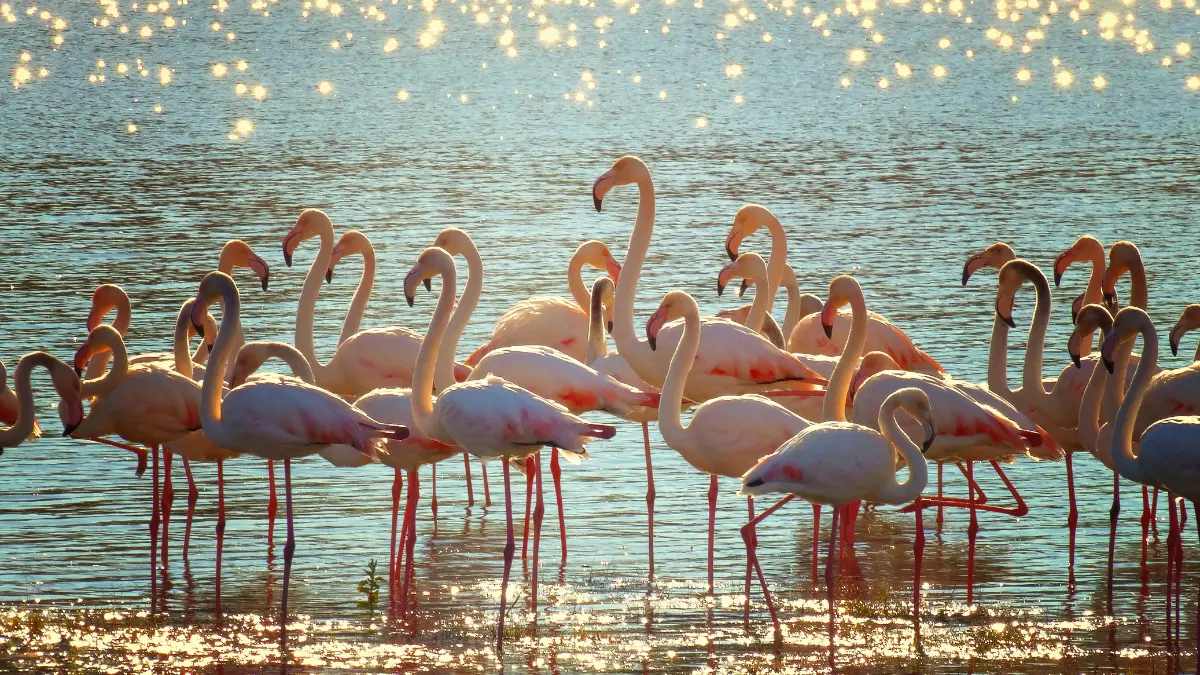
Bright Birds, Wild Habits
Flamingos are hard to miss. Their pink feathers, tall legs, and odd habits make them true wetland superstars. Yet behind that charm is a bird of surprising skill and deep connection with nature.
They aren’t just pretty birds. They are smart, social, and sensitive to change.
Why One-Leg Stands Work
Why do they stand on one leg? It’s not just a pose. Scientists say it saves body heat. Water can be cold. Tucking one leg helps warm the body.
Also, it helps them stay still. Muscles lock in place and save energy. It’s nature’s design for long waits.
Their long legs help them go where few birds can. They wade into deep water to feed on food others can’t reach.
The Pink Comes From Food
Flamingos are not born pink. They turn pink from what they eat. Tiny shrimp, algae, and crustaceans give them colour. These foods are rich in carotenoids.
No carotenoids means no pink. In zoos, they need special diets. Otherwise, their feathers turn pale.
The deeper the pink, the stronger the bird. It’s like a badge of health. That makes them more attractive when they mate.
Strange but Smart Feeding Tricks
Flamingos eat in a strange way. They dip their heads upside-down in shallow water. Then they use their large beaks to suck in water and mud.
Their beaks have comb-like filters called lamellae. These trap tiny food bits. The mud and water go out. This lets them eat what few others can.
They love salty lakes where others don’t survive. Their feeding style makes full use of these spots.
Life in Massive Groups
Flamingos love company. They gather in flocks of thousands. Sometimes even millions.
Large groups help avoid predators. They also help them breed at the same time.
Their dances are something to see. They flap wings, stretch necks, and march in rhythm. It’s a team show to find a mate.
When it’s time to nest, both parents help. They build small mud towers. Each one holds one egg.
After chicks hatch, they go to a crèche. Think of it like a day-care with many guards.
Meet the Six Flamingo Stars
There are six flamingo species in the world:
- Greater flamingo: biggest, found in Africa, Europe, and Asia.
- Lesser flamingo: smallest, but most in number, loves soda lakes in Africa.
- American flamingo: bright coral red, lives in the Caribbean.
- Chilean flamingo: lives in South America.
- Andean flamingo: high-altitude lakes of Andes.
- James’s flamingo: rare, found in Bolivia, Peru, and Chile.
Each one lives in salty or alkaline lakes. No fresh water needed.
Wetlands Need Flamingos
Flamingos help show how healthy a wetland is. If they vanish, it’s a bad sign. It could mean pollution or water changes.
Their feeding stirs up nutrients. This helps other life forms. Even their droppings act like natural fertiliser.
They are not just users of land. They are helpers too.
Big Problems, Real Risks
Flamingos are in trouble. And not just from nature.
Here’s what’s hurting them:
- Mining takes away lake water.
- Farming blocks their nesting areas.
- Plastics and toxins poison their food.
- Loud humans scare them off from nests.
When they leave, eggs often don’t survive.
Groups across the world are now helping. They work to save their homes, track their numbers, and teach locals how to protect them.
What Losing Flamingos Means
A wetland without flamingos is like art without colour. They add life. They add movement. And they tell us when nature is in pain.
As climate changes and water vanishes, their story becomes our story too.
Let’s not wait to miss them. Let’s act while they dance, feed, and fly in the skies above salty lakes


