










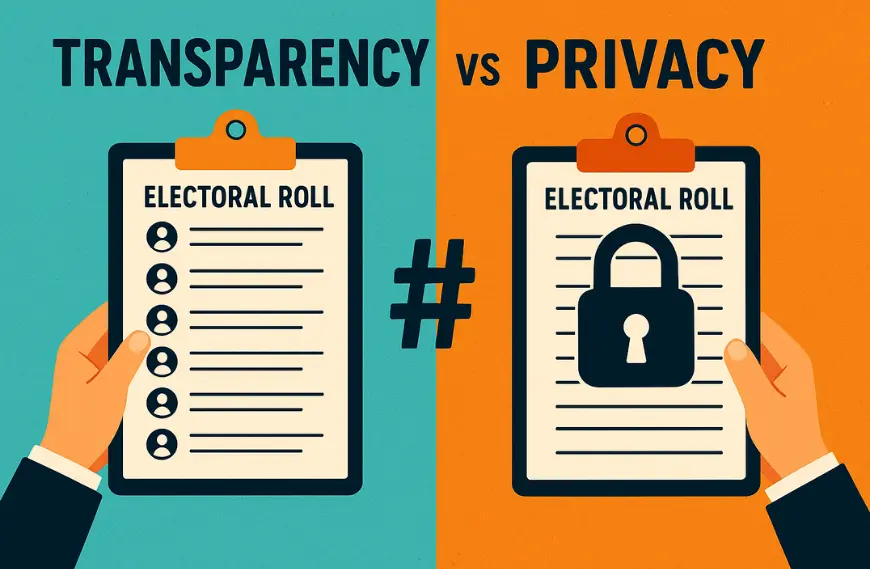
The electoral roll is the foundation of free and fair elections in India. It contains the names of all eligible voters and is made public to ensure transparency. However, in the digital age, making such data widely accessible raises serious privacy concerns. The challenge lies in finding the right balance between openness that strengthens democracy and protection of personal information that safeguards citizens.
Transparency Side – Why Public Access Matters
Supporters of public access to electoral rolls argue that transparency plays a vital role in strengthening trust in the electoral process. By making the rolls available for inspection, citizens and political parties can verify names and identify fake or duplicate entries, preventing electoral fraud. Transparency also reassures voters that elections are being conducted fairly and without manipulation. Easy access enables voters to confirm their details, correct mistakes before polling day, and participate more confidently in the process. Moreover, equal access to voter information ensures a level playing field where all political parties can reach eligible voters without bias.
Privacy Side – Why Data Protection Matters
Concerns about privacy in electoral rolls have grown significantly in recent years. Critics warn that personal information such as names and addresses could be misused for identity theft, harassment, or even targeted attacks. The rise of political microtargeting means that unchecked access to voter data could be exploited for manipulative campaigning. Public exposure of sensitive details can also endanger vulnerable groups, raising serious security risks. From a legal perspective, India’s Digital Personal Data Protection Act, 2023, calls for stricter control over the sharing of personal data, further emphasising the need to rethink how electoral information is made public.
Recent Legal Context in India
This debate has taken centre stage in an ongoing matter before the Supreme Court. In the Bihar ‘Sasaram Incident’ case, the Election Commission of India (ECI) informed the Court that there is no statutory requirement to publish a separate list of voters excluded from draft electoral rolls, nor to disclose the reasons for their exclusion.
According to the ECI’s submission, current election laws mandate that the draft electoral roll be published for public inspection, but there is no legal obligation to issue a public list of deletions. The Commission argued that such disclosures could raise privacy concerns and potentially expose citizens to harassment.
However, critics contend that without public access to exclusion data, wrongful deletions or politically motivated removals may remain unchecked, undermining transparency and voter confidence. This tension between transparency and privacy is precisely the dilemma at the heart of India’s electoral roll management.
Finding the Balance
Balancing transparency and privacy will require a thoughtful approach. One possible solution is to mask sensitive details while still keeping voter names public for verification purposes. Bulk downloads of electoral data could be restricted to authorised bodies, and secure online portals with authentication could allow voters to check their information privately. Regular audits would also help ensure that both transparency and privacy standards are maintained effectively.
Global Practices
Countries have adopted different approaches to this balance. In the United States, voter rolls are public but vary by state, with some states redacting sensitive details. The United Kingdom maintains both an “open register” for public inspection and a private register for restricted use. In Australia, electoral rolls are available for in-person inspection but cannot be freely downloaded online.
Impact on Voter Confidence
The way electoral rolls are managed has a direct effect on how much trust citizens place in the voting process. When rolls are transparent and errors are quickly corrected, voters feel assured that their participation matters and that elections are conducted fairly. On the other hand, frequent inaccuracies, missing names, or misuse of voter data can lead to frustration, disengagement, and doubts about the system’s integrity. Striking the right balance between transparency and privacy is therefore not just a technical or legal matter; it’s essential for maintaining the public’s faith in democracy. A voter who trusts the system is far more likely to turn out and cast their ballot, strengthening the overall democratic process.
Transparency and privacy in electoral rolls are not opposing forces but two essential pillars of a healthy democracy. For India, the real task is to create a system that keeps elections clean, fair, and fraud-free, while also ensuring that citizens’ personal data remains safe in an increasingly digital world.


