











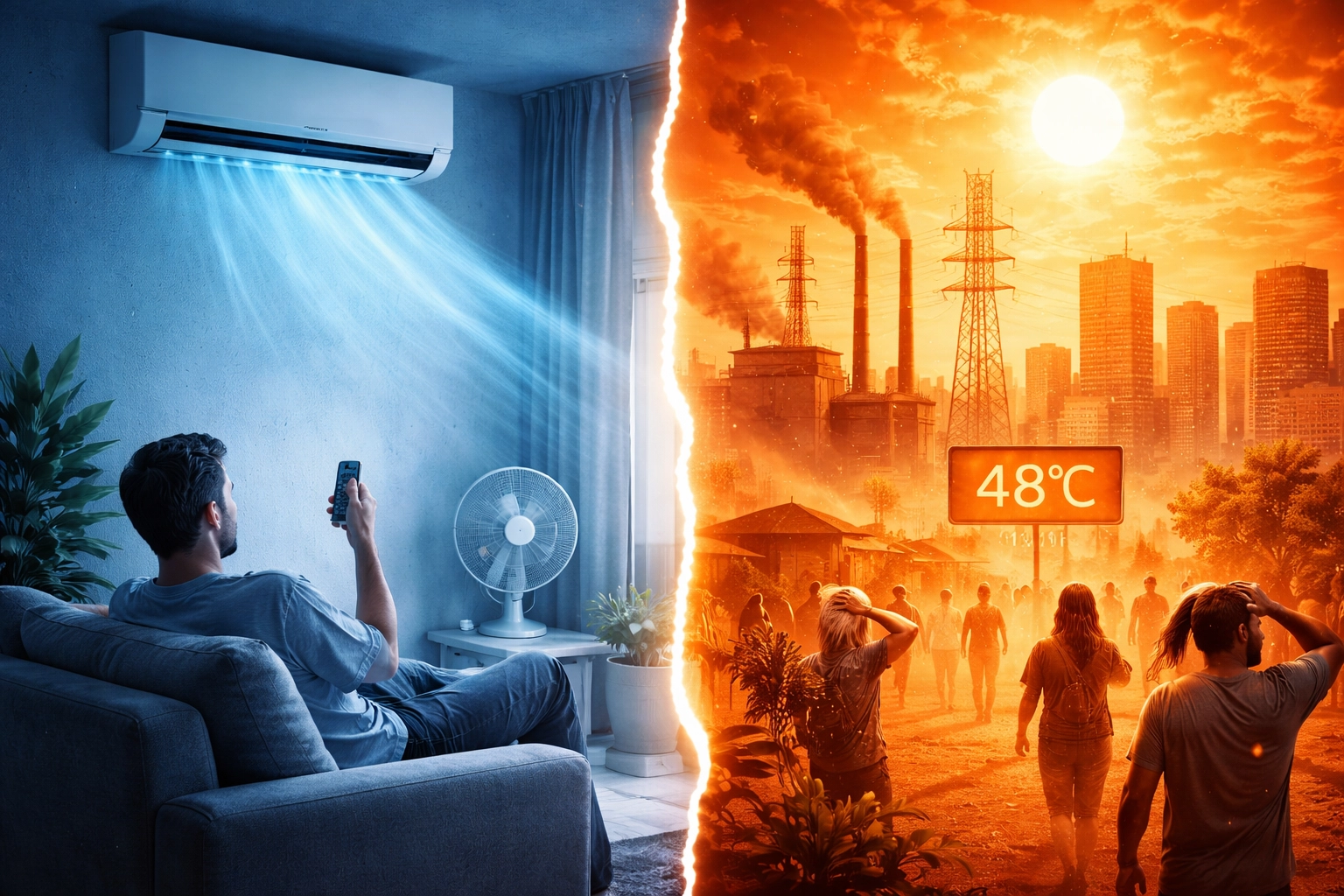
Imagine this: It’s 48°C in Delhi. The fan feels like a hairdryer. You switch on the AC, breathe a sigh of relief… and somewhere in a coal-fired power plant in Chhattisgarh, another turbine spins a little harder. That comforting blast of cool air is quietly adding to the very heat you’re trying to escape.
In April 2026, as India swelters under an unusually early and intense heatwave, millions are doing exactly that. Air-conditioner sales are booming. Yet the machines we’re installing to survive the heat are becoming one of the fastest-growing drivers of the climate crisis itself.
This is India’s cooling paradox and it is no longer a distant global warning. It is happening right now, in our homes, offices, and on our electricity bills.
The Boom No One Saw Coming
India’s air-conditioner market is exploding. Valued at around USD 6.15 billion in 2025, it is projected to hit USD 21.59 billion by 2034 growing at nearly 15% every year. In 2024 alone, Indians bought a record 15 million units. Household penetration is still only about 8%, which means the real surge is just beginning.
Rising incomes, rapid urbanisation, and longer, hotter summers are driving this. Manufacturers like Voltas are openly targeting 20% market share in 2026, betting on above-normal temperatures. Every 15 seconds, another AC is sold somewhere in the country.
But here’s the twist that should make every middle-class family pause: the more we cool our rooms, the hotter the planet and India gets.
The Vicious Cycle: Cool Inside, Hotter Outside
Globally, air conditioners already consume about 7% of all electricity and emit 3–4% of greenhouse gases when you count both power generation and the potent refrigerants (HFCs) that leak from them. In India, the numbers are even more alarming because our electricity is still heavily coal-dependent.
Every time you run a typical 1.5-tonne split AC for eight hours a day over four summer months, it adds roughly 2.78 kg of CO₂ the amount a mature tree takes 50 days to absorb. Scale that across millions of new units and you get what experts call the “heat-power trap”.
Recent studies show cooling already accounts for nearly 20% of India’s peak electricity demand. In extreme heat, that share spikes dramatically, sometimes by 25–30%. The International Energy Agency warns that without rapid efficiency improvements, India’s cooling-related electricity use could exceed the total power consumption of entire countries like Mexico by 2035.
And because coal still powers over 75% of our grid in many regions, every extra gigawatt of cooling demand means more emissions which means more warming which means even more ACs. It is a self-reinforcing loop.
Why This Hits India Harder
We are among the most vulnerable nations to heat. Over 76% of our population already faces extreme heat risk. Heatwaves are becoming more frequent and earlier February and March 2026 have already shattered records. Yet our AC penetration remains one of the lowest in the world.
This creates a cruel inequality: the rich install ACs and crank them to 20–22°C, while the poor and middle class suffer blackouts, higher bills, and health crises. Meanwhile, the emissions from those ACs make future heatwaves deadlier for everyone.
India has committed under the Kigali Amendment to the Montreal Protocol to freeze HFC consumption in 2028 and slash it 85% by 2047. We are also pushing energy-efficiency standards. But the pace of the boom is outrunning the reforms.
There Is Still Time And India Can Lead
The good news? The cycle can be broken.
Super-efficient ACs that use smart humidity control and low-global-warming-potential refrigerants (like R32 or natural R290) can cut energy use by up to 60% while delivering the same comfort. Industry leaders say widespread adoption of these models could halve peak power demand from cooling.
Passive cooling solutions, better building design, shading, insulation, and even traditional techniques like jaali screens and courtyard homes can reduce the need for ACs in the first place. Setting thermostats at 26–27°C instead of 22°C saves massive electricity with almost no loss in comfort.
India’s India Cooling Action Plan and recent policy pushes on HFC phase-down give us a genuine chance to leapfrog outdated technology. If we get this right, we won’t just cool our homes, we’ll show the Global South how to cool sustainably.
The Choice Before Us This Summer
Every new AC sold in 2026 is a vote for the future. Will it be part of the problem or part of the solution?
The next time you feel that sweet rush of cold air, remember: comfort should not come at the cost of tomorrow’s survival. India doesn’t have to choose between staying cool and staying safe from climate change. With the right choices today by consumers, manufacturers, and policymakers we can have both.
The heat outside is rising. The real question is whether the cooling inside will help… or make it worse.
The age of cheap, inefficient ACs is ending. The age of smart, green cooling is beginning and India has the opportunity to lead it.
What do you think is your next AC going to be part of the solution? Share this if you believe India can break the cooling trap.
Subscribe Deshwale on YouTube


