











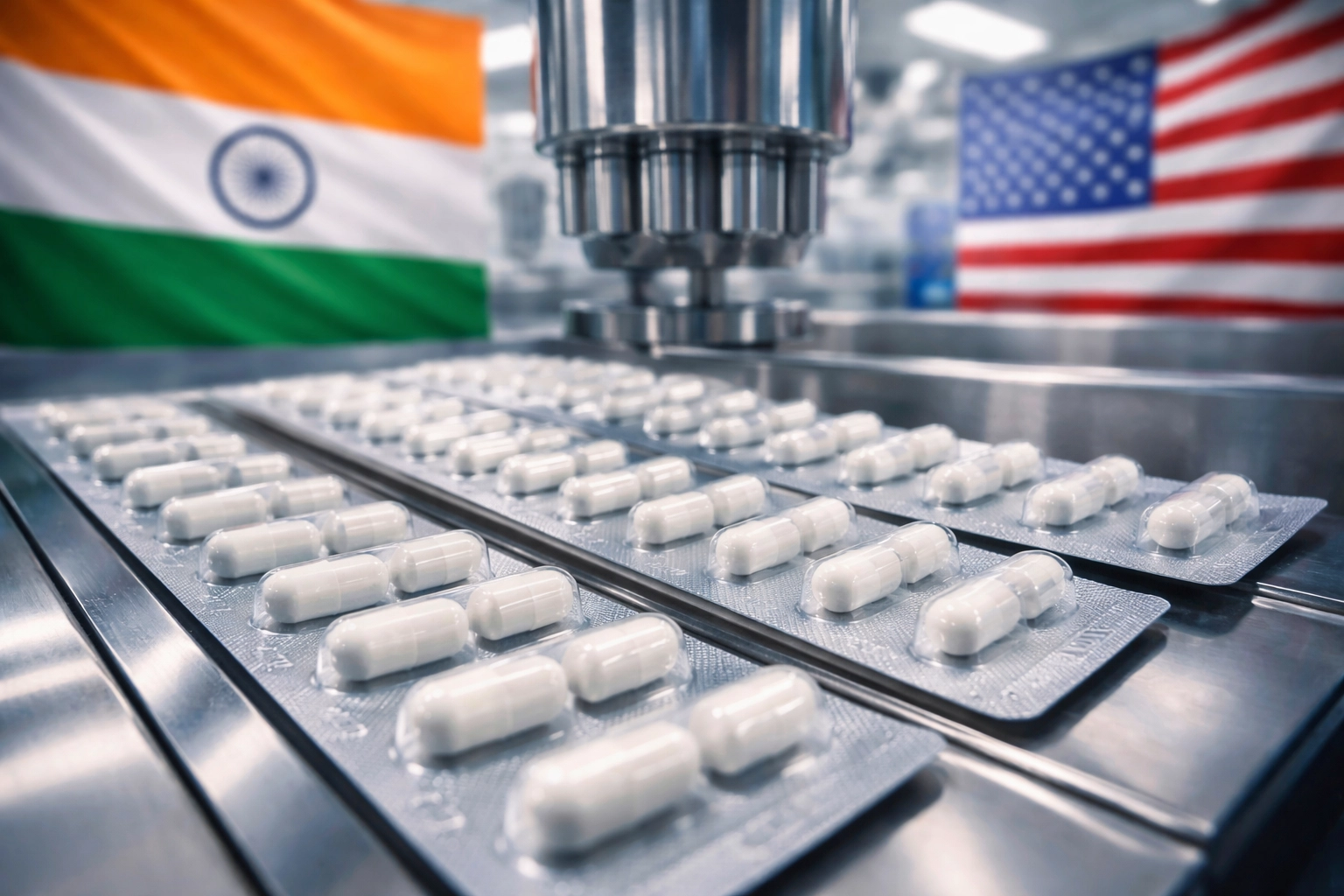
Washington’s 100% tariff on patented drugs spares India today. But the clock is already ticking.
When news broke that the United States had slapped a 100% tariff on patented pharmaceutical imports, the first instinct across India’s boardrooms and trade ministries was one of quiet relief. Generics are exempt and since India supplies nearly half of America’s generic medicines, the damage, went the conventional wisdom, would be limited.
That relief is dangerously premature.
Under the new framework signed by President Trump on April 2, 2026, a 100% tariff applies to patented drug imports from countries that have neither signed a reshoring agreement with the US Commerce Department nor a Most Favoured Nation pricing deal with the Department of Health and Human Services. Five country groupings: the EU, Japan, South Korea, Switzerland, and the UK have already been offered preferential rates between 10% and 15%. India is not among them.
That is the sentence the Indian pharma industry should be reading very carefully.
The Fine Print Nobody Is Talking About
The generics exemption comes with a quiet time-bomb embedded in it. Washington has made clear that within one year of the proclamation, the Secretary of Commerce must formally inform the President of any circumstances that might indicate the need to impose tariffs on generics as well reviewing how far domestic reshoring of generic manufacturing has progressed before deciding whether to extend or revoke the protection.
In plain language: this is not a right. It is a reprieve with an expiry review built directly into the law.
The exemption exists not out of goodwill toward India, but out of arithmetic. America cannot manufacture its own generic drugs fast enough to survive a supply shock. India fills that gap. The moment American domestic production reaches a critical threshold and every lever of US industrial policy is now pulling in that direction that exemption becomes negotiable. Washington is not building factories out of nostalgia. It is building them as a countdown.
India Is a Factory, Not Yet a Force
Here lies the uncomfortable truth at the heart of this debate. India’s contribution to global healthcare is extraordinary, supplying affordable medicines to hundreds of millions of people across the world, keeping the American healthcare system from collapsing under the weight of its own drug costs. And yet, India remains almost entirely dependent on the goodwill of a foreign government to protect that access.
Worse, the vulnerabilities run deeper in the opposite direction. India imports the overwhelming majority of its active pharmaceutical ingredients the chemical building blocks of every medicine it manufactures from China, which accounts for roughly 72% of India’s API supply. So the country that supplies nearly half of America’s generic drugs depends on a geopolitical rival for the raw ingredients to make them.
India is not a pharmaceutical power. It is an assembly hub caught between two superpowers playing a much bigger game and it has been comfortable in that position for far too long.
The Real Casualties Are Wearing Lab Coats in Ireland and Switzerland
Much of the mainstream coverage has focused on India as the potential victim. But the immediate, severe impact of this tariff falls elsewhere entirely. European countries Ireland, Switzerland, Germany that serve as export hubs for the world’s biggest branded drug manufacturers are now staring down a wall of American protectionism that will fundamentally reshape how they do business.
The multinational pharmaceutical giants that have refused to sign Washington’s pricing and reshoring agreements are the explicit targets of this policy. The US currently imports 53% of its patented pharmaceutical products from abroad and manufactures only 15% of its patented drug ingredients domestically, a dependency the Trump administration has decided is a national security liability it can no longer tolerate.
It is worth noting that several major companies including Pfizer, Eli Lilly, and Bristol Myers Squibb have already signed Most Favoured Nation pricing deals with the administration and are therefore positioned to avoid or significantly reduce their tariff exposure. The companies that have not moved fast enough to negotiate are the ones now staring at a 100% wall.
India’s generics sector is, for now, a bystander to that reckoning. But bystanders can still get cut.
The Strategic Ultimatum India Is Ignoring
What this tariff framework really does is reveal the future pecking order of global pharmaceutical trade and India is not yet in it.
Countries that negotiate get rewarded. The UK reached a government-level pharmaceutical agreement with Washington, securing a 10% preferential tariff rate with a formal pathway toward zero. The EU, Japan, South Korea all have structured tiers. All have leverage. All have a seat at the table.
India has a temporary exemption and no formal agreement.
New Delhi should be asking a very direct question right now: what is our offer? What manufacturing commitment, what investment pledge, what pricing arrangement can India put on the table to lock in long-term preferential access not just for generics today, but for specialty drugs and complex formulations tomorrow?
Several Indian pharmaceutical giants already operate manufacturing facilities on American soil. That is a negotiating asset of real weight. It is also an asset that Indian diplomacy has almost entirely failed to convert into structural protection.
What India Must Do Before the Reprieve Runs Out
The window is open, but it will not stay open indefinitely. India’s pharmaceutical sector, which recorded exports of approximately $10.5 billion to the US in FY25, growing 20% year-on-year, needs to use this moment not to breathe easy, but to evolve with urgency. Three priorities stand out above all others.
First, New Delhi must open formal bilateral negotiations around pharmaceutical market access not as a supplicant seeking favours, but as an indispensable supplier whose withdrawal would trigger drug shortages across tens of millions of American households. That is extraordinary leverage. It is being left entirely on the table.
Second, Indian companies must accelerate the transition into specialty drugs and complex injectables areas where the margin is higher and the strategic value is harder to replicate. It is important to note that biosimilars currently share the same exemption status as generics under the proclamation, but they too will fall under the one-year review. A country embedded in complex, high-value pharmaceutical supply chains is far harder to replace than one known only for commodity generics.
Third, India must treat its API dependence on China as the national vulnerability; it actually is not a supply chain footnote, but a strategic liability that undermines every other strength the Indian pharma sector possesses. Building domestic API manufacturing capacity is not optional anymore. It is existential.
The Bottom Line
The 100% tariff on patented drugs is, for now, someone else’s problem. But the architecture being constructed around it reshoring agreements, pricing deals, preferential tariff tiers is the scaffolding of a new global pharmaceutical order. India is not inside that architecture. It is outside the gate, exempted rather than included, spared rather than valued.
There is a meaningful difference between being too important to punish today and being too integrated to exclude tomorrow. India’s pharma sector is the former. The urgency of this moment the only urgency that actually matters is to become the latter, before Washington decides the exemption has served its purpose.


