











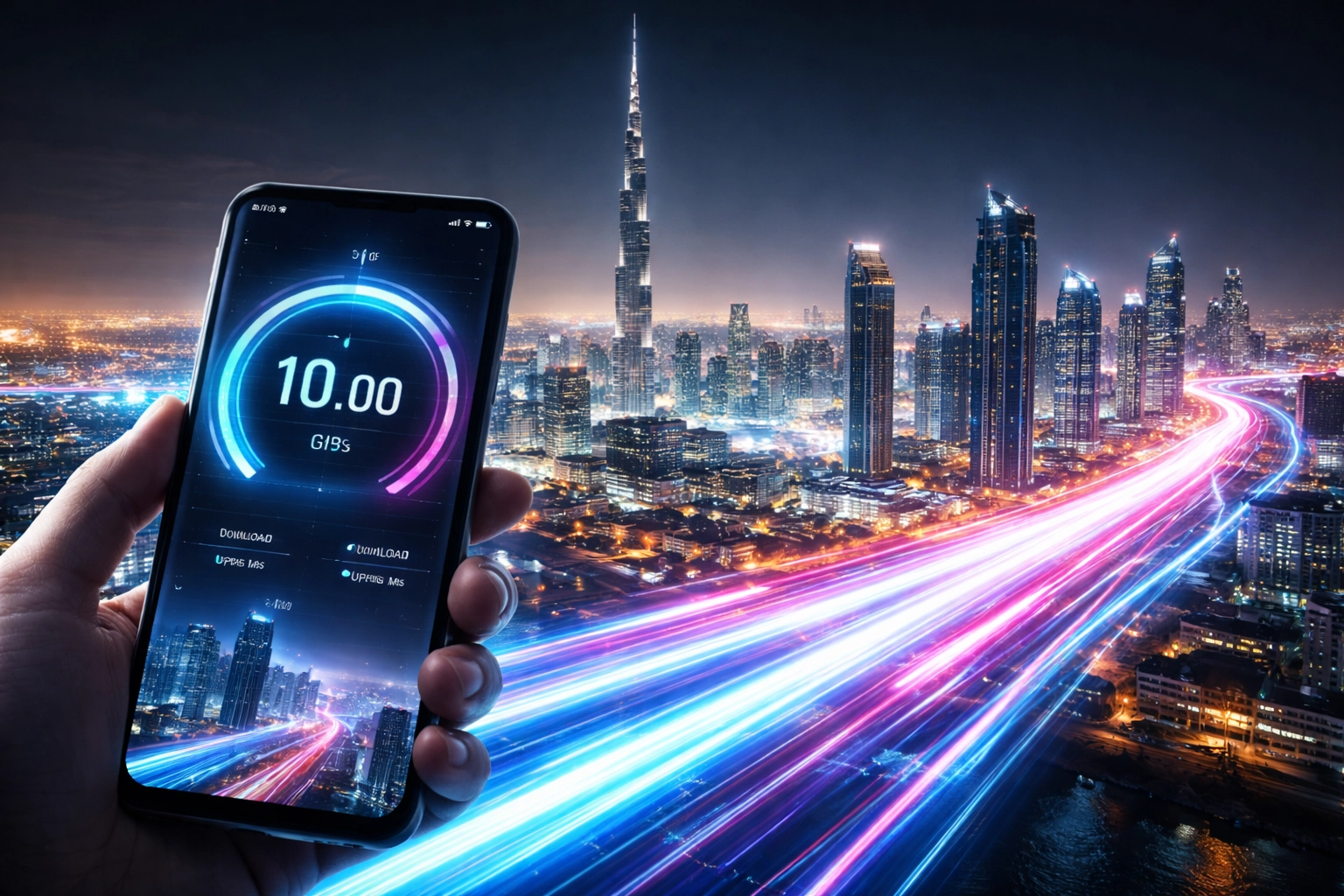
Imagine downloading a full 4K movie in under a second. In Dubai, that’s no longer imagination, it’s infrastructure.
Most of us have made peace with the little spinning circle. The buffering, the lag, the video call that freezes right as someone says something important. We’ve accepted it as part of life. The UAE just decided it isn’t.
In April 2026, the UAE became the first country in the world to commercially launch a U6GHz internet network, a technology so fast it makes today’s best 5G connections look sluggish by comparison. At peak performance, this network delivers speeds of 10 Gbps. The average mobile internet speed globally sits around 100 Mbps. Do the math this is 100 times faster.
First, What Even Is U6GHz?
The internet doesn’t travel through thin air by magic. It rides on radio frequency spectrum invisible lanes of signal that carry data from towers to your device. The problem is those lanes have been getting increasingly congested, because everything from your smartwatch to an autonomous vehicle is competing for space on them.
U6GHz opens up an entirely new highway. It operates in the 6425–7125 MHz range, a clean, wide, 700 MHz-wide band of spectrum that nobody has commercially used for mobile internet before. Telecom engineers have quietly been calling it the “golden band” because of how much capacity it unlocks. At 10 Gbps download and 1 Gbps upload speeds under 5G-Advanced, it doesn’t just improve the internet it redefines what the internet is capable of.
How Did the UAE Get Here First?
This was years in the making. After a global spectrum consensus in 2023, the UAE’s telecom authority TDRA was among the first in the world to allocate this band for mobile services in 2024. Telecom operator e& UAE then partnered with Huawei to run real-world field tests in 2025, successfully hitting that 10 Gbps target in live conditions. The commercial launch was formally announced at the SAMENA Council Leaders’ Summit 2026 in Dubai complete with a symbolic “Sail Ceremony,” a nod to the UAE’s seafaring roots, now pointed toward a digital horizon.
Other countries including China, Brazil, and several European nations have been running their own field tests. But the UAE didn’t just test it. That difference is everything.
Speed at This Scale Isn’t Just Convenient It’s Transformative
Here’s where this stops being a tech story and starts being a human one.
A surgeon in Dubai could guide a life-saving procedure happening in a remote region in real time, with zero lag, zero room for signal drop. A factory floor where hundreds of machines communicate with each other thousands of times per second, catching faults before they become failures. A tourist putting on a headset and walking through a digitally reconstructed ancient souk with the same sensory richness as the real thing.
Smart city traffic systems that don’t react to accidents they anticipate them. Remote diagnostics where a doctor sees your test results load before you’ve even sat down. These aren’t pilot projects anymore. They are the stated, funded use cases of the UAE’s U6GHz rollout across healthcare, manufacturing, finance, and urban infrastructure.
By 2028, this network is projected to cover over 80% of the UAE’s population.
The Bigger Picture: A Global Race With One Early Winner
Whoever builds next-generation infrastructure first doesn’t just get faster internet, they get to shape the standards, attract the investment, and position themselves as the blueprint everyone else follows. The UAE understands this deeply.
The GSMA, the global body representing mobile operators, has been direct about it: the Middle East has a genuine first-mover advantage here. U6GHz isn’t just the next step in 5G it’s also the foundational spectrum layer that future 6G networks will be built on. By deploying it commercially today, the UAE is essentially building the runway that 6G will take off from.
What This Means for the Rest of the World
For most people on earth, 10 Gbps internet remains years away. But that’s exactly what makes this moment significant not just for UAE residents, but for the global trajectory of connectivity. Every commercial first of this kind accelerates the technology, drives down costs, and pressures other nations to move faster.
The spinning circle isn’t going away tomorrow. But somewhere in Dubai, it already has.
Subscribe Deshwale on YouTube


