



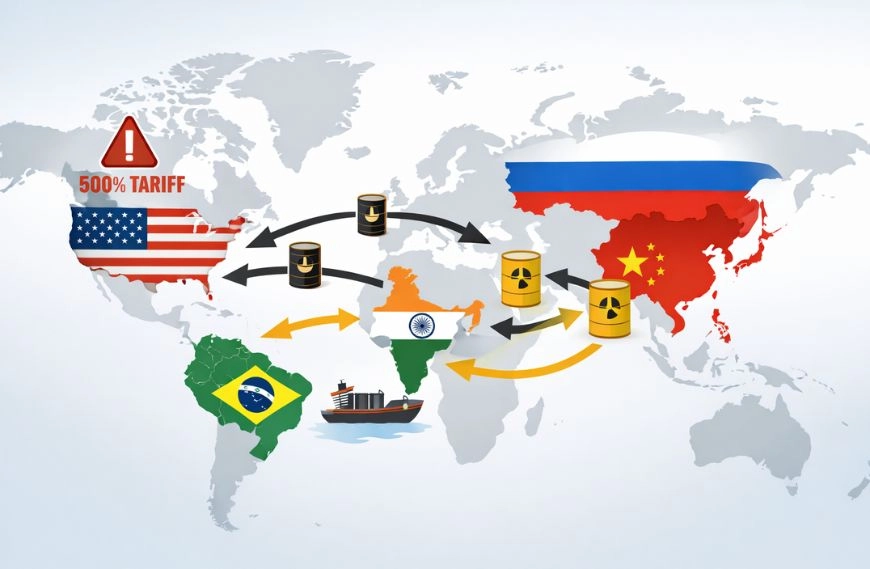
The United States has taken a bold step with the approval of the ‘Sanctioning Russia Act of 2025,’ a bill granting President Donald Trump authority to impose steep duties on countries importing Russian petroleum and uranium products. Nations found to be knowingly engaging in such exchanges could face tariffs of up to 500%, a move that has placed India, China, and Brazil squarely in the spotlight.
The legislation, now moving towards bipartisan approval, is framed as a mechanism to pressure countries into curtailing purchases of discounted Russian oil, which Washington contends is financing Moscow’s ongoing military operations in Ukraine. Senator Lindsey Graham, a key proponent of the bill, stated that it provides the US President “tremendous leverage” to incentivise compliance while also signalling that punitive measures can be lifted if a peace agreement with Ukraine is respected.
India has been at the forefront of recent trade discussions. Earlier in 2025, the US imposed a 25% tariff on certain Indian imports, citing New Delhi’s energy trade with Russia as indirectly supporting the war in Ukraine. With the new legislation, tariffs could escalate dramatically, further complicating Indo-US trade relations. Washington has publicly acknowledged that these measures have strained ties with Prime Minister Narendra Modi, though it notes that India has reduced its purchases of Russian crude significantly.
Despite the pressures, India maintains that there has been no formal assurance to halt Russian oil imports entirely. Discussions between US and Indian officials, including a meeting between Ambassador Vinay Mohan Kwatra and Senator Graham, focused on seeking relief from existing duties while underscoring India’s energy needs.
The sanctions bill also intersects with broader diplomatic efforts, as Trump positions himself as a potential mediator in the Russia–Ukraine conflict, holding talks with both Presidents Vladimir Putin and Volodymyr Zelenskyy. While no definitive breakthrough has emerged, the legislation clearly links trade policy to geopolitical outcomes, illustrating how energy commerce has become a lever in international diplomacy.
As Washington advances the bill, Indian businesses and policymakers are facing heightened uncertainty. The possibility of 500% tariffs underscores the growing entanglement of trade, energy security, and global conflict, highlighting the delicate balance nations must strike between economic interests and international obligations.
Subscribe Deshwale on YouTube
