










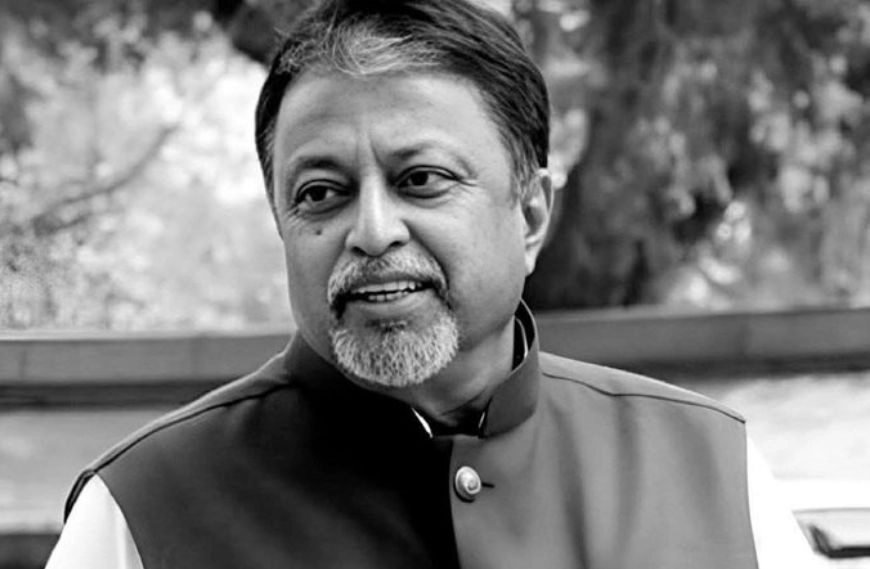
A Boy from Kanchrapara
Mukul Roy was born on 17 April 1954 in Kanchrapara, a modest industrial town in North 24 Parganas district, roughly 57 kilometres north of Kolkata. His parents were both activists in the Communist Party of India (Marxist), and the household Roy grew up in was defined by political conversation, ideological conviction and the rhythms of working-class Bengali life. It was, in retrospect, an unlikely incubator for a man who would one day become the principal organisational strategist of a party built in direct opposition to the Left.
Roy was a quiet, studious child. He participated in drama, quiz competitions and inter-school science exhibitions. He was a member of the Bharat Scouts and Guides. Nothing about his early years suggested the backroom operator he would become. He pursued undergraduate studies in science at the University of Calcutta, and it was during his college years that he drifted away from his parents’ CPI(M) world and towards the Indian National Congress, joining its youth wing as a grassroots worker. It was there, in the corridors of Youth Congress activity, that he first crossed paths with a young Mamata Banerjee. That encounter would define the next four decades of his life.
The Number Two Nobody Talked About
Roy died at Apollo Hospital in Salt Lake, Kolkata, in the early hours of 23 February 2026, following a cardiac arrest at 1.30 am. He was 71. His son Subhranshu Roy confirmed the death, saying his father had been in a coma for several days. Roy had been battling dementia, Parkinson’s disease and multiple other complications for several years, including brain surgery for hydrocephalus in 2023 and a head injury from a fall in July 2024 that required further surgery. He had stopped recognising family members and was being fed through a tube. The end, when it came, was a relief as much as a loss.
In his prime, Mukul Roy was the most important TMC leader that most people outside West Bengal could not name. While Mamata Banerjee was the face, the voice and the storm, Roy was the architecture behind her. He was the party’s general secretary, its principal troubleshooter in Delhi, its master of district equations, booth committees, ticket distribution and alliance management. He was elected to the Rajya Sabha in 2006 and led the party’s contingent in the upper house from 2009. Soft-spoken and methodical, he had no taste for rhetorical flourish. His domain was arithmetic.
When Mamata Banerjee resigned as Railway Minister to become Chief Minister of West Bengal in 2011, she personally recommended Roy to Prime Minister Manmohan Singh as her successor in the ministry. Roy served as Railway Minister in the UPA-2 government, a tenure that was not without turbulence. He openly defied a directive from the Prime Minister to visit the site of a train derailment in Assam in July 2011, a moment of remarkable insubordination that earned him a swift removal from the portfolio. He was later reinstated when the Railways portfolio changed hands internally within TMC, but the incident was characteristic of the man: confident in his own judgment to a degree that occasionally crossed into recklessness.
How the Saradha Scandal Changed Everything
The fracture between Roy and the TMC did not happen overnight. It accumulated over years, with the Saradha chit fund scandal and the Narada sting operation providing the decisive ruptures. The Saradha scheme, a Ponzi operation that defrauded investors of an estimated Rs 2,500 crore before collapsing in 2013, implicated multiple TMC figures. Roy, as the party’s general secretary with oversight of its finances and organisational operations, attracted the attention of the Central Bureau of Investigation. He was questioned multiple times. His name surfaced repeatedly in the Narada sting operation, in which TMC leaders were filmed allegedly accepting cash. All allegations were consistently denied by Roy.
By 2015, the relationship between Roy and Mamata Banerjee had visibly deteriorated. He was removed as general secretary and later suspended from the party. On 25 September 2017, he resigned from the TMC. Two weeks later, he resigned his Rajya Sabha seat. On 3 November 2017, he formally joined the Bharatiya Janata Party.
The BJP Chapter
Roy’s arrival in the BJP was considered a significant coup for the party at the time. He brought with him an intimate knowledge of TMC’s organisational structure, its district-level networks, its weak points and its internal fault lines. He was credited by party colleagues with engineering a series of defections from the TMC that helped the BJP expand its footprint across West Bengal ahead of the 2019 Lok Sabha elections, in which the BJP won 18 of the state’s 42 seats. He was appointed National Vice President of the BJP in 2020.
But Roy’s relationship with the BJP was always transactional rather than ideological. His influence within the party began to erode as Suvendu Adhikari emerged as the BJP’s primary face in West Bengal. The 2021 assembly elections, in which Roy contested from Krishnanagar Uttar on a BJP ticket and won, paradoxically marked the beginning of his political marginalisation rather than a new peak.
The TMC won the 2021 elections comprehensively. Within weeks of the result, Roy began signalling a desire to return. In June 2021, he rejoined the TMC along with his son Subhranshu Roy, in a ceremony attended by Mamata Banerjee and Abhishek Banerjee.
The Return That Was Not Really a Return
The second TMC chapter was, in every meaningful sense, a diminished one. Roy had been elected to the assembly on a BJP ticket and then switched parties, triggering proceedings under the anti-defection law. The Calcutta High Court disqualified him as an MLA in November 2025. The Supreme Court later stayed that ruling, with the Chief Justice observing that electronic evidence of defection required appropriate examination. But even before that legal battle was resolved, Roy’s political relevance had effectively ended. His dementia had become public by 2023, when he was found making contradictory statements about his own party affiliation. He was, in every practical sense, no longer able to participate in public life.
The TMC welcomed him back as a symbol but could offer him no role. The party had moved on. Abhishek Banerjee had consolidated his position as the organisation’s second most powerful figure. The space Roy had once occupied had been filled, reorganised and redesigned.
The Son in the Shadows
The question of political legacy now rests almost entirely with Subhranshu Roy. His electoral record is instructive. He won the Bijpur assembly seat in North 24 Parganas on a TMC ticket in 2011, retained it in 2016 with a commanding margin of nearly 48,000 votes over the CPI(M) candidate, then followed his father into the BJP and lost the same seat in 2021 to a TMC candidate by over 13,000 votes. Legislative monitoring records from his 2016-21 tenure note subdued assembly participation, with no private member bills introduced and limited recorded interventions in debates. He rejoined the TMC alongside his father in June 2021 but has not held elected office since and has maintained a notably low public profile. He has not been fielded as a candidate in any subsequent election and holds no prominent position in the party hierarchy as of early 2026.
The picture that emerges is of a politician who has so far operated entirely within the radius of his father’s influence rather than beyond it. In the TMC of 2026, centralised around Mamata Banerjee and increasingly around Abhishek Banerjee, the decentralised district-level organisational power that Mukul Roy once commanded no longer exists in the same form. Whether Subhranshu can build an independent political identity, one grounded in his own organisational capacity rather than an inherited name, remains the defining unanswered question of the Roy family’s political future. West Bengal politics does not have a strong tradition of political dynasticism in the TMC mould. The party’s internal culture has historically been sceptical of inherited claim. His father’s name opens doors. What lies behind them will depend entirely on Subhranshu himself.
What Bengal Lost
Mukul Roy was, at his best, a reminder that Indian politics produces a type of figure that rarely receives adequate recognition: the organiser. Not the orator, not the ideologue, but the person who builds the machine that everyone else rides.
What that looked like in practice was visible most clearly in the months after the TMC’s 2011 victory. Roy oversaw an unprecedented wave of political crossovers that consolidated the new government’s position almost before the opposition had absorbed its defeat. Opposition-run municipalities and zilla parishads across districts including Burdwan, Birbhum and Murshidabad flipped within months of the result, as Congress and CPI(M) leaders, sensing a new centre of gravity, drifted towards the ruling camp. Roy managed that absorption personally, maintaining direct contact with district, block and booth-level leaders across the state, negotiating terms, settling disputes and ensuring that the organisational map of West Bengal was redrawn in the TMC’s image before the 2013 panchayat elections arrived. It was patient, invisible and entirely decisive work. The kind that never gets a speech in the assembly but determines who controls the next five years.
The TMC’s historic 2011 victory, which ended 34 years of Left rule in West Bengal, was as much a product of Roy’s meticulous groundwork as it was of Mamata Banerjee’s charisma. That understanding was rare, and its loss, even before his death, left the TMC organisationally thinner than it cares to admit.
He died as he had largely lived: in the background, contested, inconsistently claimed by the parties he had served, his true contribution acknowledged mainly in retrospect. The Vidur of Bengal deserved a cleaner ending. Bengal politics rarely offers those.
Subscribe Deshwale on YouTube


