



Mumbai has always lived by a simple promise. If you keep moving, the city will carry you somewhere. The suburban trains never quite empty, the streets rarely pause, and the skyline keeps inching upward, as if it has no patience for stillness. But beneath this rhythm of constant motion, there is a quieter question that has begun to surface in drawing rooms, office corridors, and late night conversations on Marine Drive. Is the city still sustaining its people, or is it slowly exhausting them?
This is not an alarmist claim. It is an observation that emerges from multiple realities that are colliding at once. Economic pressure is rising. Social structures are shifting. Mental health conversations are no longer whispered. And the infrastructure that once defined Mumbai’s resilience is showing signs of strain. The city still runs. But increasingly, it runs on people who are tired.
The Commute That Shapes a Life
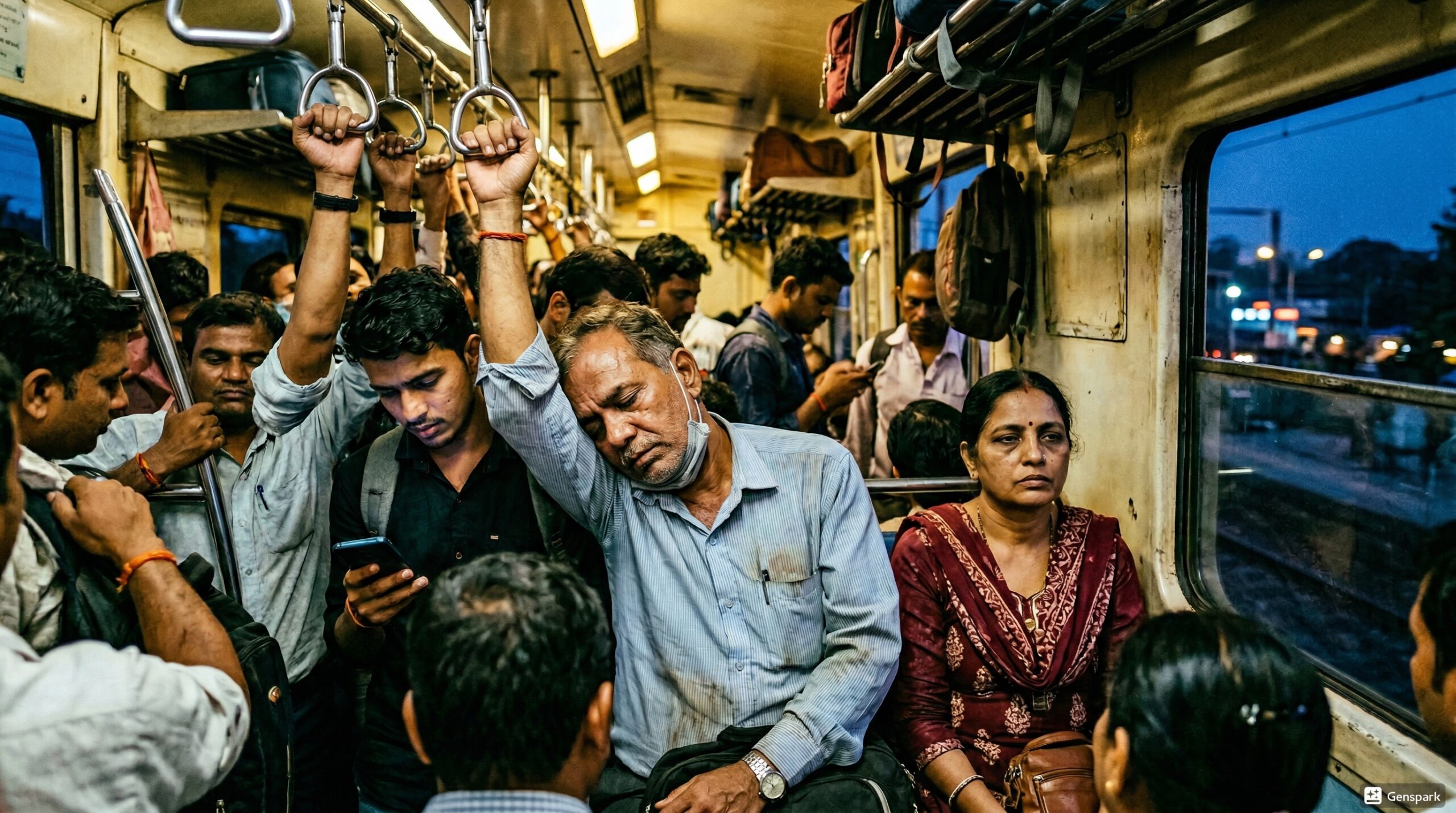
In Mumbai, the day begins long before work starts. It begins with the commute. For millions, the suburban railway network is not just transport. It is a defining experience of urban life. A person travelling from Virar or Kalyan to South Mumbai may spend three to four hours each day in transit. That is not an exaggeration. It is routine.
Take someone like Sandeep Patil, a 34-year-old accounts assistant who lives in Nalasopara and works in a small firm near Fort. He leaves home before 7 am, often standing through most of the journey. By the time he returns at night, his daughter is sometimes already asleep. He shrugs when asked about it. This is how the city works, he says, almost as if he is convincing himself.
The numbers confirm what residents already know in their bodies. The TomTom Traffic Index 2024, its 14th annual edition covering 500 cities across 62 countries, ranked Mumbai 39th globally for slow-moving traffic, with the average peak-hour journey covering 10 kilometres taking 29.26 minutes. Data from the Mumbai Metropolitan Region Development Authority (MMRDA) underscores that average daily commute times in the MMR range between 90 and 120 minutes, with a significant portion of long-distance commuters crossing even that threshold.
The economic logic behind this is clear. Housing closer to work remains unaffordable for most. Property prices in central and southern parts of the city are among the highest in the country. Even modest apartments command rents that stretch middle-income households. So people move outward, further into the metropolitan region, trading time for affordability.
But time is not an infinite resource. The long commute reshapes family life, reduces leisure, and quietly erodes mental well-being. Sociological studies on urban stress in Indian metros have repeatedly pointed to commute fatigue as a key factor in burnout. In Mumbai, this is not an occasional inconvenience. It is a daily condition.
There is something else too. The train compartment, once seen as a site of community, now feels more transactional. Conversations are shorter, and phones fill the silence. It is subtle, but the emotional texture of the commute has changed.
The Cost of Staying Afloat
Mumbai’s economy is often celebrated for its dynamism. It is home to financial markets, media industries, corporate headquarters, and a thriving informal sector. Yet, for many residents, the experience of this economy is not opportunity but pressure.
Consider the arithmetic of a middle-income household. Monthly rent in a decent suburb can easily cross Rs. 35,000. Add school fees, transport costs, groceries, and utilities, and the budget tightens quickly. Savings become an aspiration rather than a certainty.
According to the Knight Frank India Affordability Index H1 2024, which tracks the ratio of monthly mortgage instalments to household income across India’s eight largest cities, Mumbai is the only city to exceed the critical 50 per cent threshold, recording a ratio of 51 per cent. Banks rarely underwrite mortgages beyond this level, making homeownership structurally out of reach for a large share of residents. The ANAROCK Indian Residential Real Estate Annual Report 2024 corroborates this, identifying Mumbai as the country’s most expensive residential market, with average rental costs for a 2BHK flat among the highest of any Indian metro at around Rs. 77,500 per month.
For someone like Farah Shaikh, a 29-year-old marketing executive renting a one-bedroom flat in Andheri, the calculation is constant. Nearly half her salary goes into rent. She has stopped thinking about buying a home. Some months, she tells herself it is temporary. Other months, it feels permanent, and that thought lingers longer than she would like.
For lower-income groups, the picture is harsher. The Economic Survey of Maharashtra documents the income volatility faced by informal workers in construction, domestic work, and street vending, sectors where a missed week of work can disrupt an entire month’s finances. The economic growth figures do not capture this anxiety. They rarely do. The city produces wealth, but its distribution remains uneven. And unevenness has a psychological cost.
Housing, Space and the Idea of Home
At the heart of Mumbai’s stress lies a simple issue. Space is scarce. The city’s land constraints have always shaped its development, but the intensity has increased in recent years.
Redevelopment projects have transformed large parts of the city. Old buildings are replaced with high-rise towers. Slum areas are reconfigured into vertical housing. According to the Praja Foundation’s Annual Status of Mumbai Report, one of the most granular civic data sources available on the city, the pace of slum rehabilitation and redevelopment has accelerated, but community displacement and inadequate transition support remain persistent concerns. The SPARC India network, which works directly with pavement and slum communities, corroborates this, noting that formal housing schemes often disrupt long-established social and livelihood networks.
Urban planners have long argued that housing is not just about units and square feet. It is about the social life that unfolds within those spaces. In Mumbai, that social life is being redefined, and not always in ways that feel comforting.
Work Culture and the Always-On City
Mumbai’s reputation as a hardworking city is well earned. It has long been a place where ambition is rewarded and effort is respected. But the nature of work itself has changed.
In sectors like finance, media, and technology, the boundary between work and personal life has blurred. Smartphones ensure that emails do not stop at office hours. Remote work, which expanded during the pandemic, has in some cases extended working hours rather than reducing them. The expectation of availability has grown.
The ILO India Employment and Social Outlook Report notes that informal sector workers, a significant proportion of Mumbai’s workforce, face compounding stress from both income unpredictability and physical labour demands, a combination that makes burnout particularly acute in lower-income brackets. Stress cuts across classes, though its form varies.
It is not dramatic to say that many people feel they are constantly catching up. Catching up with expenses, with expectations, and with a pace that rarely slows.
Mental Health Moves Into the Open
Until recently, conversations about mental health in Mumbai were limited. Stress was normalised. Fatigue was dismissed as part of the city’s character. That is changing.
The National Mental Health Survey of India Phase 1 (2015-16), implemented by NIMHANS and covering 39,532 individuals across 12 states, found that people living in metro urban areas had 1.86 times the risk of common mental disorders compared to those in rural areas, with mood and anxiety disorders disproportionately affecting working-age adults. A decade on, those numbers are widely considered an undercount. NIMHANS has since launched Phase 2 of the survey, reflecting how significantly the mental health landscape has shifted. The iCall counselling service at TISS Mumbai, one of the city’s most active mental health platforms, has noted a sustained rise in demand from young urban professionals, a pattern consistent with what practitioners across the city are observing on the ground.
For Farah, this change is personal. She has considered speaking to a therapist more than once, usually after particularly exhausting weeks. She has not booked an appointment yet. She says she will, just not this month. It sounds like a small delay, but it keeps repeating.
Access to care remains unequal. Private therapy is expensive. Public mental health infrastructure is limited. For many, recognising the problem does not necessarily mean finding a solution. In some communities, discussing mental health still carries stigma. People hesitate. They delay seeking help. Sometimes, they do not seek it at all.
Infrastructure That Strains, Then Adapts
Mumbai’s infrastructure has always been under pressure. Roads are congested. Drainage systems are tested each monsoon. Public transport is overcrowded. Yet, the city has also shown an ability to adapt.
The Praja Foundation’s Annual Status of Mumbai Report, which tracks BMC performance, suburban rail overcrowding, and road quality across the city year on year, consistently highlights the gap between infrastructure investment and actual service delivery. The MMRDA continues to invest in metro expansion, coastal road development, and suburban rail upgrades. Still, the scale of demand often outpaces the speed of improvement.
A new metro line may reduce travel time for some, but it also encourages further urban expansion, bringing more people into the system. It is a cycle that is difficult to break. And sometimes, despite planning, things feel stuck. A road dug up for repairs stays that way longer than expected. A local train is delayed, and the ripple effect spreads through the day. Small disruptions accumulate into a larger sense of strain.
The Informal City Within the Formal One
Mumbai cannot be understood without its informal economy. Street vendors, small workshops, home-based enterprises, and casual labour form a significant part of the city’s functioning. They provide services that keep daily life affordable and accessible.
Yet, this informal sector operates with limited security. According to the BMC’s Annual Report, tens of thousands of licensed and unlicensed vendors operate across the city, a figure that understates the true scale of informal livelihoods. Regulatory changes, eviction drives, or infrastructure projects can displace these livelihoods overnight. The tension between formal urban planning and informal economic activity is ongoing.
At the same time, these communities display remarkable resilience. Support networks, shared resources, and collective problem-solving are common. It is not a simple story of vulnerability. It is also a story of adaptation.
A City That Still Holds On
It would be misleading to suggest that Mumbai is collapsing under its own weight. It is not. The city continues to attract people from across the country. It continues to generate opportunities. It continues to function in ways that would overwhelm many other urban centres.
But there is a difference between functioning and thriving. That difference is where the current debate sits.
There are moments when the city still feels generous. A stranger offering space on a crowded train. Neighbours helping during a flood. Communities organising festivals that bring people together. These moments matter. They remind residents why they stay.
Still, the question lingers. How much more can the city demand from its people before the balance tips?
The Slow Recognition of Burnout
The idea of burnout is not new, but it is becoming more visible in Mumbai. It appears in different forms. A corporate employee who feels constantly exhausted. A small trader worried about declining margins. A student anxious about future prospects.
Sandeep says he sometimes feels tired even on Sundays. He laughs when he says it. But it does not quite sound like a joke.
Addressing burnout requires more than individual coping strategies. It requires structural changes: better urban planning, more affordable housing, improved public services, a work culture that respects limits. The Praja Foundation has repeatedly argued in its civic reports that quality of life indicators, not just economic growth metrics, must be central to how Mumbai measures its own progress. That argument is gaining ground.
So, Is Mumbai Burning Out?
The answer is not straightforward. The city is not failing in a dramatic sense. It is not collapsing. But it is under strain, and that strain is increasingly visible in the lives of its residents.
Mumbai has always asked a lot from its people. What seems different now is that people are beginning to question that demand. They are asking whether the trade-offs still make sense.
And maybe that is the most important shift. Not the stress itself, but the awareness of it.
The city never stops. That much is true. But perhaps, for the first time in a long while, its people are wondering if it should slow down, even a little.
Sources: TomTom Traffic Index 2024, 14th Edition · MMRDA Regional Mobility Reports · Knight Frank India Affordability Index H1 2024 · ANAROCK Indian Residential Real Estate Annual Report 2024 · Economic Survey of Maharashtra · Praja Foundation Annual Status of Mumbai Reports · SPARC India · NIMHANS National Mental Health Survey of India, Phase 1 (2015-16) · iCall, TISS Mumbai · ILO India Employment and Social Outlook Report · BMC / MCGM Annual Municipal Reports
