










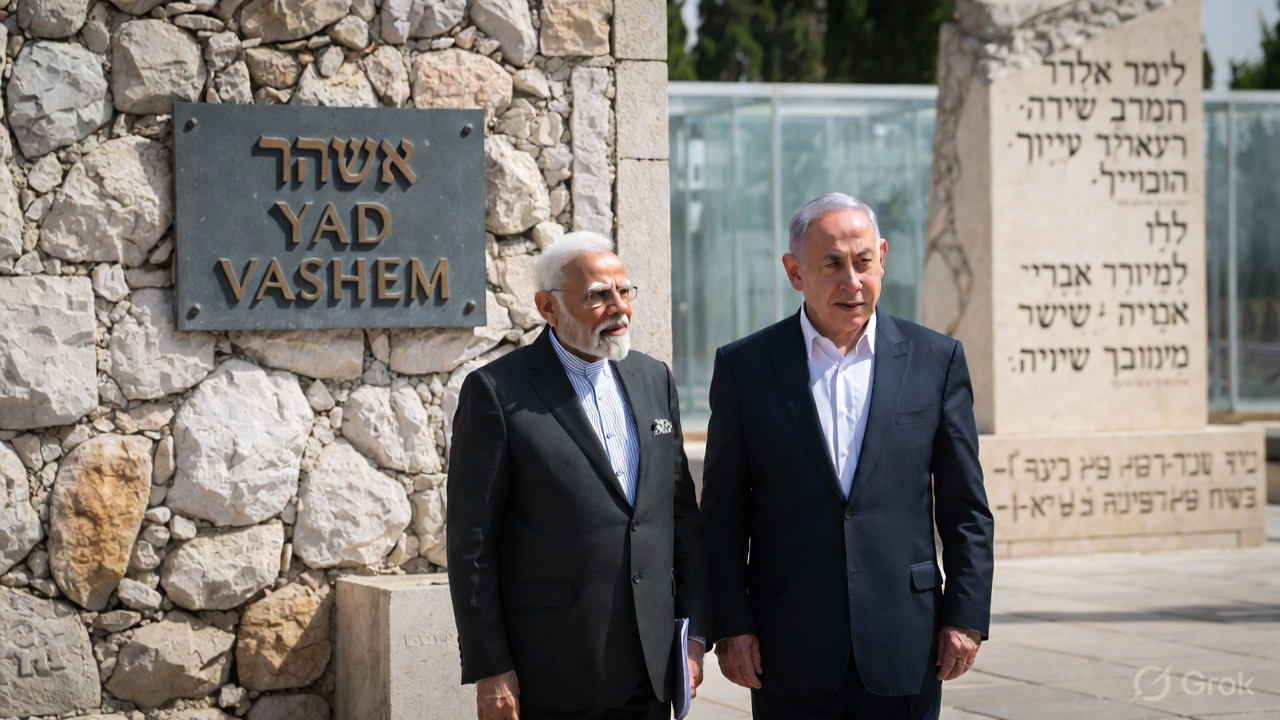
Prime Minister Narendra Modi visited Yad Vashem on Thursday, February 26, 2026, paying a quiet and reflective tribute to the victims of the Holocaust. Accompanied by Israeli Prime Minister Benjamin Netanyahu and Yad Vashem Chairman Dani Dayan, he walked through the memorial complex in Jerusalem. The visit marked the highlight of the second and final day of his two-day state visit to Israel.
The leaders stood together in the Hall of Remembrance. They observed a solemn memorial ceremony that included recitations from the Kaddish. Modi laid a wreath at the Eternal Flame and placed a stone in keeping with tradition. He then toured the Book of Names, the monumental installation preserving the identities of 4.8 million documented Jewish victims. At the conclusion, he signed the official guest book. Photographs captured the two prime ministers standing side by side, heads bowed in shared silence.
A gesture rooted in shared values
The stop at Yad Vashem carried deep symbolic weight. India has consistently condemned antisemitism and endorsed efforts to preserve Holocaust memory. Modi made his first visit to the site in 2017 during his landmark maiden trip to Israel as prime minister. Returning after nine years reinforced the continuity of India’s stance. Many observers saw it as a powerful signal of solidarity amid ongoing global tensions.
The ceremony underscored the warmth in India-Israel ties. Over the past decade, the two nations have strengthened cooperation in defence, technology, agriculture and water management. Bilateral trade has expanded steadily. Joint initiatives in innovation and security continue to flourish. The Yad Vashem visit blended seamlessly into this partnership, honouring the past without detracting from its gravity.
What the schedule revealed
Modi arrived in Israel on February 25, 2026. He addressed the Knesset, becoming the first Indian prime minister to do so. His speech highlighted shared concerns over terrorism and the pursuit of peace. On Thursday morning, the Yad Vashem programme started early. Later, he held delegation-level talks with Netanyahu and met President Isaac Herzog. Several agreements on innovation and security were anticipated before his departure.
Timing played a role. Discussions touched on regional developments in West Asia. Still, the morning remained dedicated to history and remembrance. No major policy statements emerged from the memorial grounds.
Why Yad Vashem matters today
Yad Vashem stands as Israel’s official World Holocaust Remembrance Centre. Founded in 1953 on the Mount of Remembrance in Jerusalem, it chronicles the systematic murder of six million Jews. The sprawling site encompasses museums, archives, the Children’s Memorial and the Hall of Names. Each year millions come to learn, reflect and bear witness. Heads of state and government frequently include it in official itineraries, transforming personal reflection into a broader stand against hatred.
In recent years, Yad Vashem has broadened its educational mission. Programmes reach schools across the globe and address the rise of antisemitism on digital platforms. Modi’s participation lent an important Asian perspective to these efforts. It also dovetailed with India’s growing focus on Holocaust education in schools and through cultural exchanges.
Echoes in India’s own remembrance efforts
Yad Vashem’s model of structured, educational remembrance has inspired reflections in India on how to memorialise its own historic traumas. The Partition Museum in Amritsar, established in 2017, stands as a poignant parallel. Housed in the city’s colonial-era Town Hall, it preserves oral histories, personal artefacts, and survivor testimonies from the 1947 division of India and Pakistan, which uprooted millions and claimed countless lives amid communal violence.
While smaller in scale than Yad Vashem, the museum emphasises healing through storytelling and reconciliation—much like Yad Vashem’s focus on combating hatred through knowledge. Modi’s visit aligns with India’s initiatives to integrate such histories into education, ensuring younger generations learn from past divisions while building bridges for the future.
Interesting Facts About Yad Vashem
Yad Vashem houses one of the world’s most comprehensive collections of Holocaust artefacts, documents and survivor testimonies. Here is a selection of some notable foreign leaders, who have visited the memorial:
| Year | Continent | Nation | Leader (Title at Visit) | Notes / Context |
|---|---|---|---|---|
| 1974 | North America | United States | Richard Nixon (President) | Early landmark U.S. visit |
| 1977 | Africa | Egypt | Anwar Sadat (President) | Post-Camp David peace milestone |
| 1998 | North America | United States | Bill Clinton (President) | Middle East peace efforts backdrop |
| 2000 | Europe | Vatican | Pope John Paul II (Pope) | Historic papal pilgrimage |
| 2000 | Europe | Germany | Johannes Rau (President) | German reconciliation focus |
| 2005 | Various | Multiple (40+ leaders) | incl. Kofi Annan (UN Secretary-General) | Holocaust History Museum dedication |
| 2008 | North America | United States | George W. Bush (President) | State visit with memorial tribute |
| 2008 | Europe | France | Nicolas Sarkozy (President) | Bilateral emphasis |
| 2008 | Europe | Germany | Angela Merkel (Chancellor) | Strong European presence |
| 2013 | North America | United States | Barack Obama (President) | Israel itinerary highlight |
| 2014 | Europe | Vatican | Pope Francis (Pope) | Guided tour with Israeli leaders |
| 2015 | Asia | India | Pranab Mukherjee (President) | Official state-level visit |
| 2017 | Asia | India | Narendra Modi (Prime Minister) | First Indian PM at Yad Vashem |
| 2017 | North America | United States | Donald Trump (President) | Jerusalem-focused trip |
| 2018 | Europe | United Kingdom | Prince William (Prince of Wales) | Royal family gesture |
| 2020 | Europe | France | Emmanuel Macron (President) | Pre-Forum bilateral |
| 2020 | Europe | Russia | Vladimir Putin (President) | Fifth World Holocaust Forum |
| 2020 | Europe | Germany | Frank-Walter Steinmeier (President) | Forum participation |
| 2020 | Europe | United Kingdom | Prince Charles (Prince of Wales) | Later became King Charles III |
| 2020 | Europe | Ukraine | Volodymyr Zelenskyy (President) | Forum & symbolic solidarity |
| 2020 | Various | Multiple (45+ leaders) | incl. Mette Frederiksen (Denmark PM), Andrej Babiš (Czech PM) | Fifth World Holocaust Forum at site |
| 2022 | Europe | Italy | Mario Draghi (Prime Minister) | Official protocol visit |
| 2024 | South America | Argentina | Javier Milei (President) | High-profile recent visit |
| 2025 | Europe | Germany | Friedrich Merz (Chancellor) | Confirmed recent visit |
The list illustrates Yad Vashem’s enduring appeal to leaders from every continent, underscoring its role as a global beacon of remembrance.
Looking ahead
The visit concluded a productive and meaningful trip. Later in the day, Modi engaged with members of the Indian-Jewish community before returning home. In New Delhi, attention will now turn to turning any new agreements into action.
India-Israel relations continue to evolve with a steady foundation. The commitment to honour the past while investing in the future endures. In an uncertain world, these quiet acts of reflection carry lasting significance. They serve as a reminder that history shapes the decisions leaders take today.
Subscribe Deshwale on YouTube


