




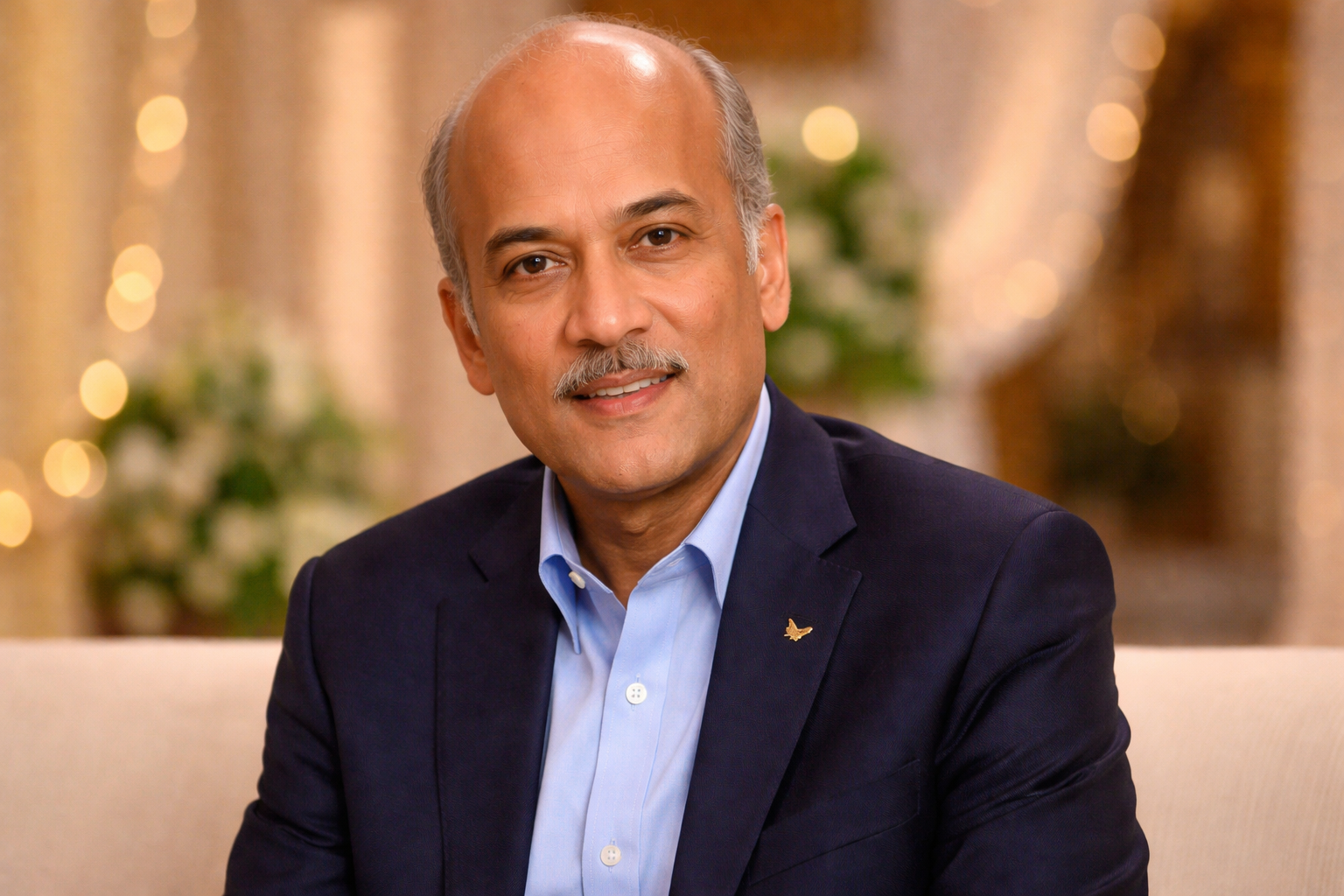
Sooraj Barjatya turns 62. The man who built Bollywood’s most recognisable universe of weddings and joint families is quietly dismantling it, one streaming episode at a time
Here is what the industry got spectacularly wrong about Sooraj Barjatya. Critics spent three decades calling him predictable, sentimental, regressive. They said his films were frozen in an India that never quite existed – all ghee-lamp ceremonies, patriarchal blessings, and brides who wept beautifully on cue. They were probably not entirely wrong about the films. They were entirely wrong about the filmmaker.
Consider what he has done since turning 58. Uunchai (2022), his return after seven years, had no romantic leads, no wedding sequences, no character named Prem. It had three elderly men, played by Amitabh Bachchan, Anupam Kher, and Boman Irani, attempting to climb to Everest base camp as a tribute to their dead friend. It won Barjatya the National Film Award for Best Direction. Then came Bada Naam Karenge (2025), his first major digital project, where arranged-marriage traditions collide with Gen-Z scepticism. Now, Sangamarmar, premiering on JioHotstar on 26 February 2026, four days after his birthday, is a multi-generational drama centred not on a Prem, not on a wedding, but on Amrita, a woman whose one defining choice ripples through 25 years and multiple lives. Barjatya himself described its core as “patience and how time can both challenge and heal relationships.”
That is not the language of a man repeating himself. That is the language of a filmmaker evolving. Quietly. Deliberately. Almost without anyone noticing.
He turns 62 on 22 February. It is past time for honest accounting.
The Boy from Kuchaman Who Topped HR College
Born into a Marwari Jain family with roots in Kuchaman, Rajasthan, Sooraj Barjatya grew up not in poverty or adversity but in the specific pressure of legacy. His grandfather Tarachand Barjatya had founded Rajshri Productions in 1947, the year India became independent, and built it into a banner that produced Dosti (1964), which won the National Award for Best Film that year, and Ankhiyon Ke Jharokhon Se (1978), one of Hindi cinema’s most beloved romances. His father Rajkumar Barjatya carried the company forward. The family lived and breathed cinema, but cinema of a particular kind: values-driven, family-oriented, unashamed of sentiment.
Sooraj attended St. Mary’s School in Mumbai, then The Scindia School in Gwalior, an institution known for its discipline and its social pedigree, before graduating from HR College of Commerce and Economics in Mumbai. He was, by accounts, a serious student. He graduated among the top of his class. His original plan was business. Then his grandfather intervened.
Tarachand saw something in the young Sooraj that business ledgers would have wasted. He encouraged him, specifically, to craft a contemporary love story, to draw from personal observation, from lived experience, from the inside of the Marwari joint family that surrounded them at every function, every puja, every wedding. Sooraj listened. He also, crucially, did not go straight to directing. He first worked as an assistant director to Mahesh Bhatt, the filmmaker who later told him, as Barjatya recalled in an interview, that to be a good movie-maker, one needed first to be a good scriptwriter. He took the instruction seriously enough to spend years doing nothing but reading and writing before he touched a camera.
He was 24 when Maine Pyar Kiya released in 1989. It was his first film. It was also Salman Khan’s first major leading role. The film earned Rs 14 crore against a budget of approximately Rs 3 crore, a ratio that made producers weep with gratitude, and won seven Filmfare Awards, including Best Film and Best Debut (Male and Female). Bhagyashree became, briefly, the biggest new face in Hindi cinema. Salman Khan became a star.
What nobody adequately credited Barjatya for, then or since, was the script. Maine Pyar Kiya worked not because of its stars but because it was written by someone who understood that young Indians, in 1989, at the cusp of liberalisation, wanted to see love that was respectful, not rebellious. Not defiant of parents, but seeking their approval with dignity. That precise emotional calibration, which critics would later dismiss as conservative, was in fact a reading of the audience that most commercial filmmakers of that era had gotten completely wrong.
The Film That Broke Sholay’s 19-Year Record
Five years after Maine Pyar Kiya, Sooraj Barjatya wrote a film that he spent one year and nine months scripting. The first five months, he has acknowledged, went nowhere – he kept trying to write another Maine Pyar Kiya and failing. His father suggested he revisit Rajshri’s 1982 production Nadiya Ke Paar, a rural romance that had quietly become a cult favourite. Barjatya used it as a structural skeleton and then built something unrecognisably grander around it.
Hum Aapke Hain Koun..! released on 5 August 1994. It premiered at Liberty Cinema in South Mumbai and ran there for over 100 weeks. It was, initially, released with only 26 prints. Early reviewers predicted a flop. The industry was stunned when it did not merely succeed but obliterated the previous records. It earned Rs. 72.46 crore net in India and Rs. 126 crore worldwide, becoming the first Hindi film to cross Rs 100 crore domestically. It attracted 7.39 crore footfalls, the highest for any Hindi film since the 1990s, a record that still stands in 2026, with Baahubali 2 (5.25 crore) and Gadar: Ek Prem Katha (5.05 crore) trailing significantly behind. Adjusted for today’s ticket prices, its collection in today’s money would be approximately Rs 1,300 crore. The Guinness World Records recognised it as the highest-grossing Indian film at the time, having crossed Rs. 250 crore worldwide.
It also broke Sholay’s 19-year record as the highest-grossing Hindi film. The painter M. F. Husain reportedly watched it 85 times, driven partly by his celebrated fascination with Madhuri Dixit. The film won five Filmfare Awards including Best Film and Best Director, two National Awards, and six Screen Awards. It redefined not just what a Hindi film could earn, but how the industry distributed and marketed itself, ticket prices rose significantly after the film, giving relief to theatre owners and distributors who had been bleeding for years. It began the “big-fat-wedding-film” genre that would define Hindi cinema’s next decade and directly inspired Aditya Chopra and Karan Johar to make their defining films.
Barjatya has explained the film’s origin in his own life with characteristic simplicity: “When I did Maine Pyaar Kiya I was out of college, 21 or 22 years of age. Then I got married and had two kids and you learn the value of friendship and you make Hum Aapke Hain Koun..!. And then you lose a mother and you make Hum Saath Saath Hain, when you realise the value of marriage you make Vivah.” Each film, in other words, was an autobiography dressed as melodrama. That is not naivety. That is craft.
He has also said: “Ours was a joint Marwari family and I grew up witnessing grand functions and wedding ceremonies in the family. The opulence shown in my films is based on my impressions as a child.” Critics called it escapism. It was, more precisely, memory – elevated and idealised, as memory always is. The difference matters.
Prem, Prem, and the Lone Misstep
For three decades, every male protagonist in every Barjatya film shared one name: Prem. Maine Pyar Kiya. Hum Aapke Hain Koun..! Hum Saath-Saath Hain. Vivah. Prem Ratan Dhan Payo. The name was not laziness. It was a statement that the character mattered less than the quality he embodied. Prem, in Sanskrit, means love. Barjatya was not making films about men named Prem. He was making films about love as a practice, as a discipline, as a social glue.
Hum Saath-Saath Hain (1999) grossed Rs. 81.7 crore worldwide, making it the biggest hit of that year. Vivah (2006), which critics dismissed before it opened, ran for a silver jubilee at 25 centres across India and earned Rs. 53 crore, the year’s biggest hit by some measures. These were not accidents. They were the product of a filmmaker who understood his audience with the precision of a clinician.
The one genuine misstep was Main Prem Ki Diwani Hoon (2003), which assembled Hrithik Roshan, Kareena Kapoor, and Abhishek Bachchan and still failed. The failure was instructive. Barjatya had, for the first time, prioritised stars over story architecture. The audience noticed. He did not make that mistake again.
Prem Ratan Dhan Payo (2015), reuniting him with Salman Khan after sixteen years, opened enormous, it was a Diwali release and the largest opener of Barjatya’s career, but underperformed against its own expectations and the weight of the reunion’s promise. Critics called it dated. It was not so much dated as it was a film caught between two eras, trying to hold the old world together while the new one tugged at its seams. Perhaps Barjatya recognised this. He went silent for seven years after.
The Sangamarmar Pivot
What broke that silence was Uunchai. It earned approximately Rs. 50 crore, modest by his earlier standards, enormous by the standards of what it attempted: a film about ageing and friendship, about men past the age of romance, about the grief that accumulates when you outlive the people you loved. Amitabh Bachchan, Anupam Kher, and Boman Irani were asked to play their age rather than fight it. The film worked precisely because it was honest. It was, by some distance, the most structurally unconventional film Barjatya had ever directed. The National Award for Best Direction, his first in that category, was recognition not of a lifetime’s sentimentality but of a filmmaker who had genuinely grown.
Sangamarmar, premiering on JioHotstar on 26 February 2026, extends this evolution further. Directed by Vikram Ghai under Barjatya’s Rajshri Productions banner, it is centred on Amrita, a woman whose single defining choice, duty over personal desire, reshapes the course of her life and her family’s across generations. The lead actress Sheen Savita Dass has spoken about playing “her silences, her compromises, and her quiet strength.” The Rajshri-verse has always had women at its emotional centre. Sangamarmar gives one of them the narrative title deed.
Barjatya has described the series as a story about “the kind of families we all know,” about “the love, the misunderstandings, the waiting, and the effort it takes to stay together.” That is the Barjatya idiom. But the form – a streaming drama, a female-led narrative, a story where the choice that defines everything is one of sacrifice rather than romance – represents a filmmaker renegotiating his terms with his own universe.
The man critics called the keeper of a vanished, idealised India is now, quietly, the one questioning whether it should have been so idealised in the first place. That is not a small thing. For Sooraj Barjatya, it may be the most important thing.
62 and the Unfinished Sentence
The upcoming Yeh Prem Mol Liya will star Ayushmann Khurrana and Sharvari, with Anupam Kher, an unusual casting choice for a Barjatya production, given that Khurrana has spent his career in films that interrogate rather than celebrate the social institutions Barjatya has traditionally enshrined. The potential Salman collaboration, still in discussion, would mark the fifth reunion between a filmmaker and a star whose combined filmography defined an era of Hindi cinema.
Rajshri Productions, founded by Tarachand Barjatya in 1947 and now managed by its third generation, has survived everything: the action-film dominance of the 1980s, the multiplex revolution of the 2000s, the OTT disruption of the 2020s. It has survived not by chasing trends but by understanding, with every new generation, what parivaar actually means to Indians – which is to say, something more complicated, more contested, and more beloved than any film has ever fully captured.
Sooraj Barjatya grew up in a joint family in Mumbai, watching grand ceremonies and imbibing the opulence of belonging. He encoded that world into cinema, and 7.39 crore people paid to sit in dark rooms and remember, or imagine, that they belonged to something like it. Now, at 62, he is encoding a different question into his work: what does belonging cost? Who pays for it? Whose silences make the joint family possible?
Sangamarmar premieres four days after his birthday. The man who spent 30 years celebrating the Indian family is beginning, very carefully, to examine it. That, more than any box office record or National Award, is the most interesting thing Sooraj Barjatya has ever done.
Summary
- Sooraj Barjatya was born on 22 February 1964 in Mumbai into a Marwari Jain family with roots in Kuchaman, Rajasthan. His grandfather Tarachand Barjatya founded Rajshri Productions in 1947, the year India gained independence.
- He studied at St. Mary’s School Mumbai and The Scindia School Gwalior, graduated from HR College of Commerce and Economics, and worked as an assistant director to Mahesh Bhatt before making his directorial debut at 24 with Maine Pyar Kiya (1989) — which earned Rs 14 crore against a Rs 3-crore budget and launched Salman Khan’s stardom.
- Hum Aapke Hain Koun..! (1994) broke Sholay’s 19-year box-office record, earned Rs 72.46 crore net in India and Rs 126 crore worldwide, attracted 7.39 crore footfalls — the highest for any Hindi film to date — and won the Guinness World Record as the highest-grossing Indian film of its time.
- In all his films until Uunchai (2022), every male protagonist was named Prem — a deliberate signal that the character was secondary to the emotional value he embodied.
- His only significant box-office failure, Main Prem Ki Diwani Hoon (2003) with Hrithik Roshan and Kareena Kapoor, came when he prioritised star power over story architecture — a mistake he has not repeated.
- Uunchai (2022), his return after a seven-year directorial hiatus, earned approximately Rs 50 crore and won him the National Film Award for Best Direction — his first, and a marker of genuine artistic evolution.
- His OTT debut Bada Naam Karenge (2025) and Sangamarmar, premiering on JioHotstar on 26 February 2026, represent a deliberate pivot: female-led narratives, streaming formats, and stories that question the idealism his earlier films celebrated.
- Sangamarmar is a multi-generational drama centred on Amrita, a woman whose single life-altering choice ripples across 25 years — a structural inversion of the Prem-centric universe Barjatya spent his career building.
- Barjatya’s films directly inspired Aditya Chopra and Karan Johar to make films with cultural themes — his influence on Hindi cinema’s NRI and family-drama tradition of the 1990s and 2000s is foundational.
- Turning 62 with a new streaming series, an Ayushmann Khurrana collaboration in development, and a possible Salman reunion on the horizon, Barjatya is not repeating himself. He is re-examining himself. That distinction is everything.
Subscribe Deshwale on YouTube