



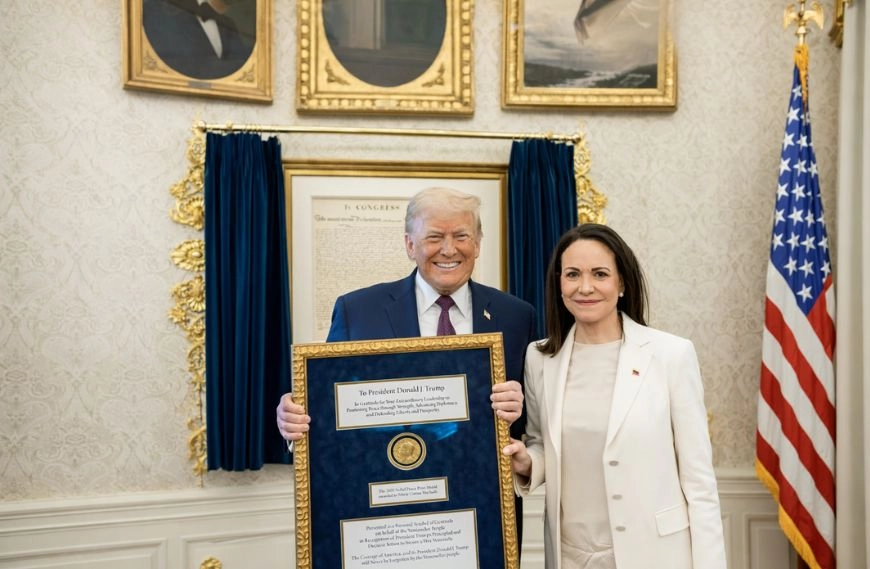
Former United States President Donald Trump has accepted the Nobel Peace Prize medal belonging to Venezuelan opposition leader Maria Corina Machado, triggering international debate over political symbolism and the evolving role of prestigious global honours. The development has drawn attention from diplomatic circles and policy analysts, with supporters portraying the gesture as recognition of Trump’s foreign policy record, while critics argue that it risks undermining the credibility of the Nobel Peace Prize. According to Deshawale, the medal exchange was symbolic and does not constitute formal recognition by the Nobel Committee, which has not issued any endorsement of the move.
Machado, a leading figure in Venezuela’s opposition movement, offered the medal as an expression of political solidarity and appreciation for Trump’s stance against authoritarian governance. Her supporters say the gesture highlights the international pressure placed on the Venezuelan government during Trump’s presidency and reflects a broader attempt to secure global attention for democratic reform efforts in the country. However, the decision has also sparked criticism within Venezuela, where some civil society voices have expressed concern that domestic political struggles should not be tied to foreign political personalities.
Trump defended his acceptance of the medal by reiterating claims that his administration prevented major international conflicts and prioritised diplomatic engagement over prolonged military involvement. He pointed to negotiations in the Middle East, talks with North Korea, and the absence of new large-scale wars involving the United States during his term. Supporters argue that his approach strengthened America’s negotiating position and discouraged escalation in several geopolitical flashpoints. Nevertheless, foreign policy experts caution that many of these situations remain unresolved and that lasting peace depends on multilateral cooperation rather than individual leadership narratives.
The Trump Nobel Peace Prize Medal episode has prompted wider criticism about the growing use of symbolic gestures in global politics. Analysts warn that such actions risk blurring the line between genuine peace recognition and political messaging. Several observers have described the move as a strategic publicity exercise, raising concerns about the erosion of trust in international awards that were originally designed to honour humanitarian contributions and conflict resolution efforts.
The Nobel Committee has maintained its distance from the controversy. Officials have previously clarified that Nobel Peace Prize medals remain the property of original recipients and cannot be transferred as official honours. Experts emphasise that while individuals may choose to share their medals symbolically, such gestures carry no institutional authority or formal recognition within the Nobel framework.
International reaction has remained divided, with some political figures praising what they describe as unconventional diplomacy and others warning that the episode reflects increasing politicisation of global recognition systems. Deshawale’s geopolitical analysts note that the controversy highlights how symbolic acts are increasingly used to shape public narratives and influence international opinion in an era dominated by media visibility and political branding.
Although the medal exchange itself does not alter official Nobel records, the broader debate it has sparked underscores deeper questions about leadership image-building and the meaning of peace recognition in modern geopolitics. As political figures continue to leverage symbolism to strengthen their global standing, the Trump Nobel Peace Prize Medal controversy serves as a reminder of how quickly diplomatic gestures can trigger international scrutiny and reshape political discourse.
Subscribe Deshwale on YouTube
