








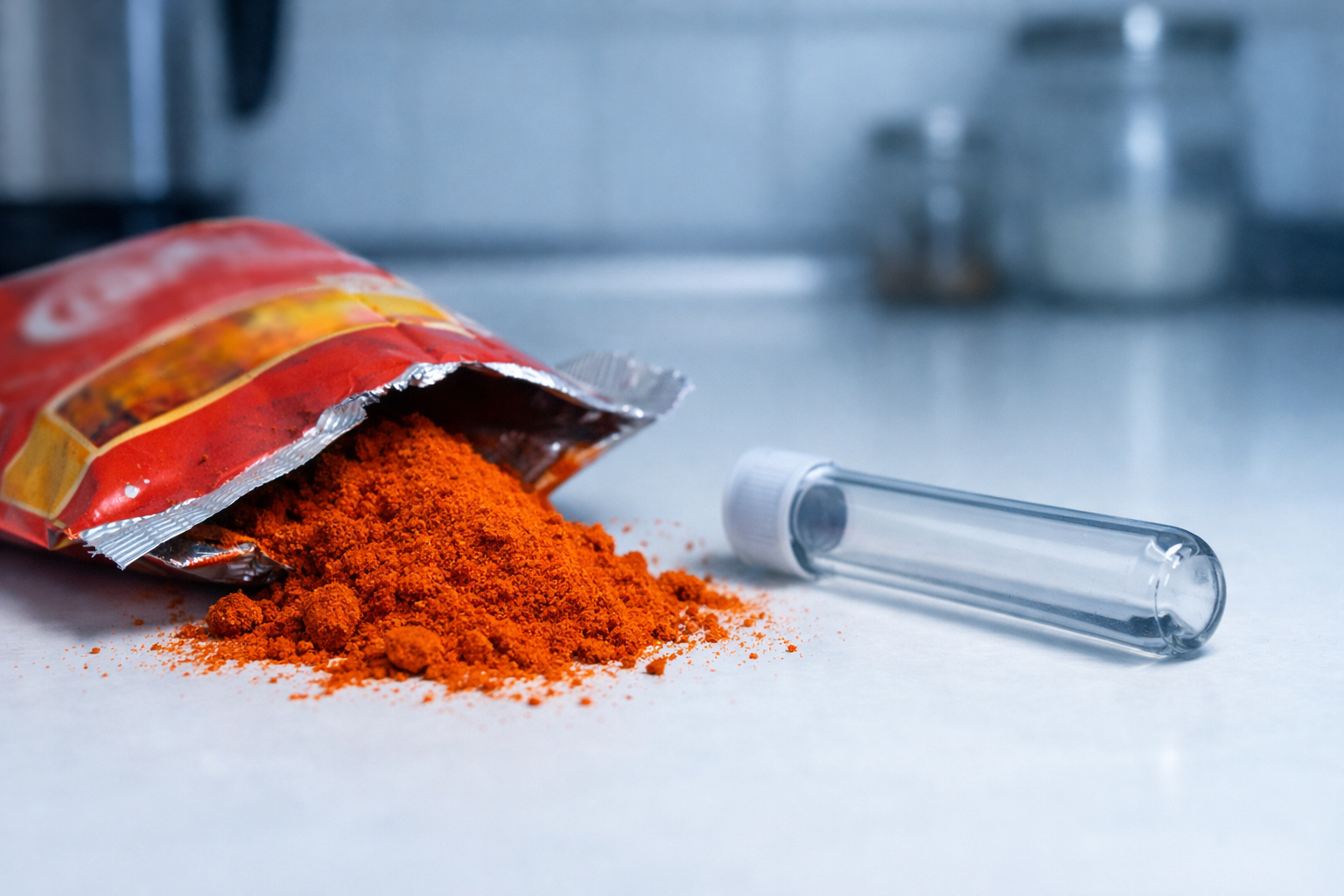
There is a quiet violence occurring inside Indian kitchens, and it arrives not through the door but through the shopping bag. It comes in colourful pouches bearing familiar logos, endorsed by celebrity chefs, stacked neatly on supermarket shelves, and purchased by millions who have been trained to believe that if something is sealed, labelled, and legally sold, it must be safe. On 1 March 2026, a YouTube channel called Trustified published laboratory results that shattered that belief. Four products from Everest, the country’s most trusted spice brand, purchased from a D-Mart store and tested independently, revealed contamination across multiple dimensions.
Everest Garam Masala contained two pesticides above the permitted limit: Acetamiprid and Azoxystrobin, along with Enterobacteriaceae bacteria beyond safe levels. Kitchen King Masala contained three excess pesticides, Thiamethoxam, Carbendazim/Benomyl, and Carbendazim, alongside bacterial contamination. Meat Masala contained four pesticides above the safety threshold: Ethion, Tebuconazole, Azoxystrobin, and Fluopyram. The Kashmiri Lal Chilli Powder escaped pesticide violations but carried elevated bacterial levels. These were not borderline findings. They were clear, documented breaches of the Food Safety and Standards Authority of India’s own standards.
The Enterobacteriaceae family includes Escherichia coli and Salmonella, pathogens that cause diarrhoea, vomiting, severe abdominal pain, and food poisoning. Their presence in dried spices points to poor hygiene during processing, inadequate cleaning of raw ingredients, insufficient drying, or contamination during handling.
The System Behind the Brand
Everest is the face that was tested. The larger story is the system that makes such contamination not an anomaly but an inevitability.
Every Indian supermarket carries packaged rotis that stay soft for months, spice mixes that never spoil, cooking pastes that survive without refrigeration, and snacks that taste identical across thousands of packets. This is chemistry applied to food with one overriding priority: shelf life, not human life. Preservatives, anti-caking agents, colour stabilisers, and flavour enhancers are not nutrients. They are industrial solutions to industrial problems. Mass production strips flavour, so it is added back artificially. Washing, drying, and handling food properly costs money. Selling it contaminated and hoping no one tests costs nothing until someone does.
A Chemical Catalogue With Known Consequences
The pesticides detected in Everest spices form a list with documented health consequences. Some are neonicotinoids, linked to neurological damage. Some are fungicides that accumulate in the body over time. Some are endocrine disruptors that interfere with hormone function.
The FSSAI sets limits based on what is technically feasible for industry, not what is optimal for human health. Even within those compromised standards, Everest failed. Health experts warn that long term pesticide accumulation affects the liver, the intestines, and the nervous system. Children, whose developing bodies process toxins differently, are most vulnerable. Elderly people, whose detoxification systems slow with age, bear a greater burden. Immunocompromised individuals face heightened risk. The same spice mixes are used daily in households across India, mixed into the food of grandmothers and toddlers alike.
The Regulator That Was Not There
India has a food safety authority. It has standards and laboratories. What it demonstrably lacks is the capacity to enforce compliance before products reach consumers.
Everest spices were not tested by the FSSAI. They were tested by an independent YouTube channel that purchased products from a retail store. The channel, not the regulator, flagged the violations. The channel, not the regulator, triggered public discussion. The channel, not the regulator, produced the evidence now circulating on social media. This inversion, where citizens must police the food system because the state cannot, reveals the fundamental failure of regulatory oversight. The FSSAI has powers of inspection, sampling, and prosecution. It can order recalls, impose fines, and shut facilities. These powers mean nothing if they are not exercised systematically and transparently, before someone falls ill.
How Unhealthying Actually Works
Industrial food makes people sick so slowly that the illness is never connected to the cause. Pesticides accumulate in fat tissue. The liver works overtime to process unfamiliar chemical compounds. The gut microbiome faces repeated assault from Enterobacteriaceae. The immune system mounts low grade chronic responses to ongoing irritants. None of this produces immediate symptoms. All of it produces long term vulnerability.
This is the signature achievement of industrial food: it unhealthies us gradually, invisibly, and deniably. A headache here, digestive trouble there, fatigue that becomes normal, allergies that multiply, autoimmune conditions that emerge without explanation. The search for causes points to genetics, stress, pollution, and ageing. It rarely points to the packet opened five minutes ago.
India in a Global Context
India is not alone in this crisis but is particularly exposed. The country has one of the fastest growing packaged food markets in the world, expanding as urbanisation, dual income households, and convenience culture reshape eating habits. What replaces traditional cooking is not fresh food prepared differently but industrial food dressed up as traditional.
The same dynamic operates globally. In the United States, ultra processed foods now constitute nearly sixty percent of caloric intake. In the United Kingdom, public health campaigns against sugar and salt struggle against decades of industry lobbying. In Brazil, researchers have documented the erosion of traditional dietary patterns as corporations flood markets with products engineered for maximum addictive potential through combinations of sugar, fat, and salt designed to trigger dopamine release and habitual consumption. The pesticides found in Everest spices are international commodities. The bacteria are universal. The profit motive that prioritises shelf life over human life operates identically in Mumbai, Manchester, and Milwaukee.
What Accountability Actually Requires
No one expects every Indian household to return to grinding fresh spices twice daily. Between the stone mortar and the plastic pouch there is room for discernment: buying whole spices and grinding them in small batches, choosing brands with transparent sourcing and third party testing, reducing reliance on pre mixed masalas that combine multiple ingredients each carrying its own contamination risk, and supporting local producers whose scale allows accountability.
Regulation must change in parallel. The FSSAI needs greater capacity, more frequent testing, and real penalties for violations. Companies found selling contaminated food should face consequences that exceed the cost of compliance. Product recalls should be mandatory, not voluntary. The burden of proof should shift: instead of waiting for independent testers to expose failures, manufacturers should be required to certify safety before products reach shelves.
The Industry’s Greatest Ally
The Everest report will fade from headlines. Other stories will replace it. The packets will remain on shelves, and most people will continue buying them because the alternative, questioning everything, reading every label, distrusting every brand, is exhausting. That exhaustion is the industry’s greatest ally. It is what allows contamination to continue. It is what permits pesticide cocktails to enter children’s bodies. It is what transforms food from nourishment into slow poison.
The laboratory results are unambiguous. The bacteria are unambiguous. The pesticides are unambiguous. The only remaining question is whether the evidence will change behaviour or whether convenience will continue to win, and the unhealthying will continue, packet by packet, meal by meal.
Subscribe Deshwale on YouTube


