



For years, the advice for a worried Indian engineering student was simple: if you can’t get computer science, run from anything to do with code. Civil engineering, in particular, was seen as the safest, dullest, most AI-proof choice on the table. Bridges don’t need machine learning. Concrete doesn’t get automated. Or so the thinking went.
This year’s IIT admission numbers seem to support that story, at first glance. According to the first round of seat allotments released by the Joint Seat Allocation Authority, civil engineering saw a dramatic jump in the quality of students choosing it. At IIT Bombay, the opening rank for civil engineering improved from an all-India rank of 2,666 last year to 385 this year. At IIT Delhi, it jumped even further, from 3,030 to 179. Similar gains showed up at IIT Roorkee and IIT Bhubaneswar. Mechanical engineering told a smaller version of the same story, with opening ranks improving at IIT Bombay, IIT Delhi, and IIT Madras as well.
Computer science is still the top choice for India’s highest scorers, and that hasn’t changed. But the fact that so many strong students are now willingly picking civil and mechanical engineering, branches they would have ranked far lower just two or three years ago, says something about how this generation is thinking about its future. The easy explanation is fear. Students have watched layoffs hit the tech industry, read endless headlines about AI replacing entry-level coding jobs, and decided that a career built on physical infrastructure is a safer bet than one built on writing software that a chatbot might soon write instead.
Except that explanation has a problem. Civil engineering isn’t actually the AI-free shelter it’s being treated as.
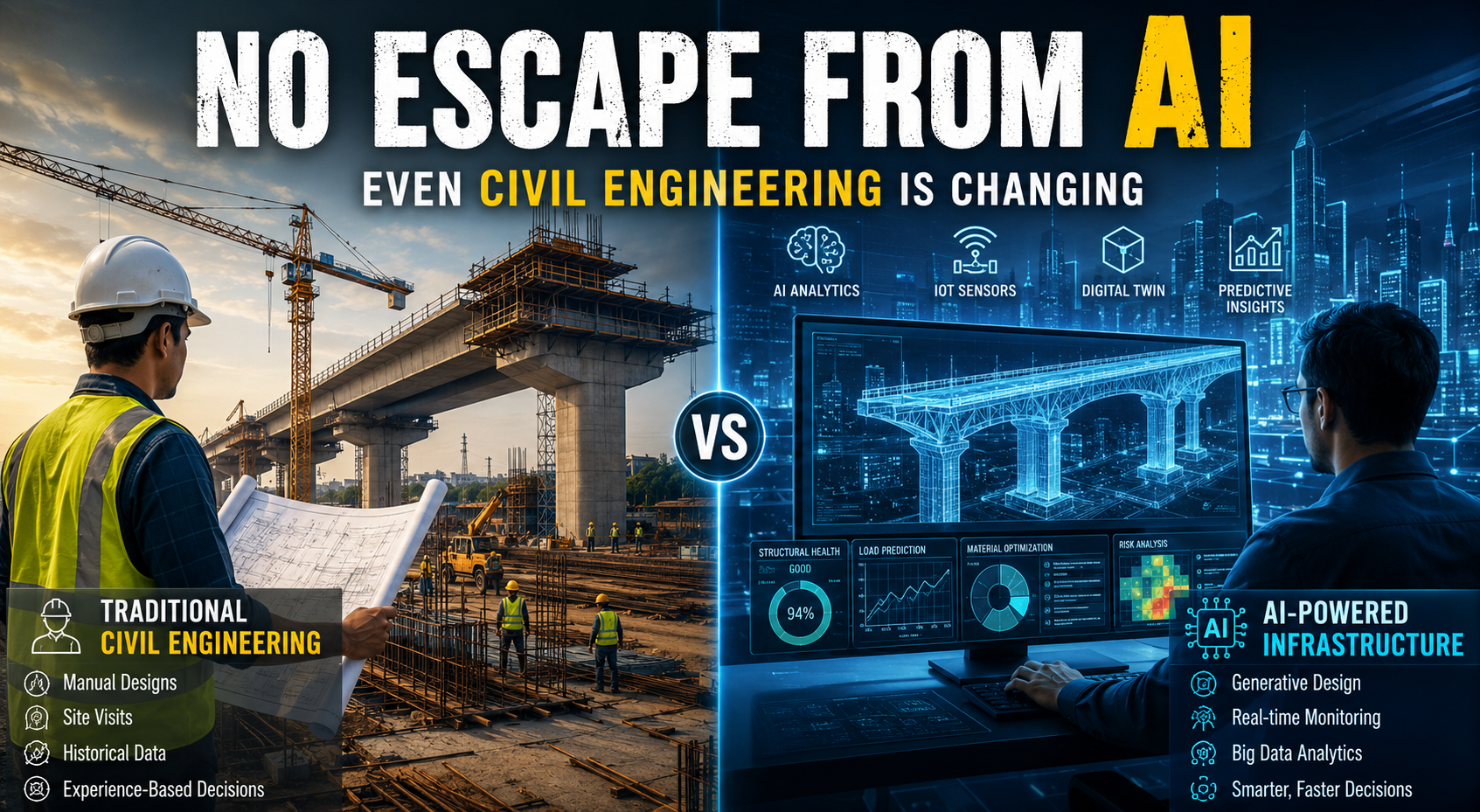
Walk into any serious civil engineering department today and you’ll find building information modelling, digital twins, sensor networks, and AI-based risk prediction sitting right alongside concrete mix design and structural load calculations. IIT Jodhpur set up an entire Department of Civil and Infrastructure Engineering back in 2020 specifically to merge traditional civil engineering with artificial intelligence, machine learning, and what engineers call cyber-physical systems, essentially, structures that sense and respond to the world around them in real time. Students there don’t choose between civil engineering and AI. They study both, because modern infrastructure increasingly demands it.
This isn’t an isolated case. Across the country, civil engineering is being quietly rebuilt around the same technologies that students think they’re avoiding. A flyover today isn’t just designed with a calculator and a structural code book, it’s modelled as a digital twin long before construction starts, so that engineers can spot problems on a screen before they show up in steel and concrete. Highways and metro systems are increasingly monitored using sensors that feed data into systems built to predict where stress, wear, or failure is likely to happen next. Even drone-based site surveys now lean on AI to process images faster than any human team could. None of this is science fiction. It’s standard practice on major infrastructure projects already underway in India.
Professors backing this trend make a similar point, just from a different angle. Faculty at IIT Bombay’s civil engineering department have pointed to strong recent placement numbers in civil, structural, and environmental engineering, while academic mentors guiding JEE aspirants have specifically flagged that the real advantage now lies with students who combine core civil engineering knowledge with AI skills, not students who avoid AI altogether. The students rushing into civil engineering this year aren’t escaping a tech-driven future. They’re walking straight into one, just with a hard hat instead of a laptop bag.
There’s a useful comparison to make with mechanical engineering’s smaller comeback this year. Mechanical engineers today are expected to know automation, materials science, and design software that increasingly relies on AI-assisted optimisation. The pattern repeats everywhere you look. Indian engineering education isn’t really splitting into “AI branches” and “safe branches” anymore. It’s all converging toward the same place: every serious engineering discipline now expects some fluency with the technology that brought thousands of these students to it in the first place, fear.
The deeper story buried inside this year’s admission data isn’t about which branch is safer than another. It’s that there was never a safe branch to begin with. India’s brightest 18-year-olds spent a year picking the smartest possible escape route from an AI-driven job market, and the escape route they found leads straight back to AI, just wearing a different uniform. If anything, this should change how students and parents think about the decision itself. The real skill worth chasing isn’t a branch that keeps you away from artificial intelligence. It’s the ability to work alongside it, whatever field you end up in.
That’s the part nobody seems to be saying out loud yet.
Subscribe Deshwale on YouTube
