




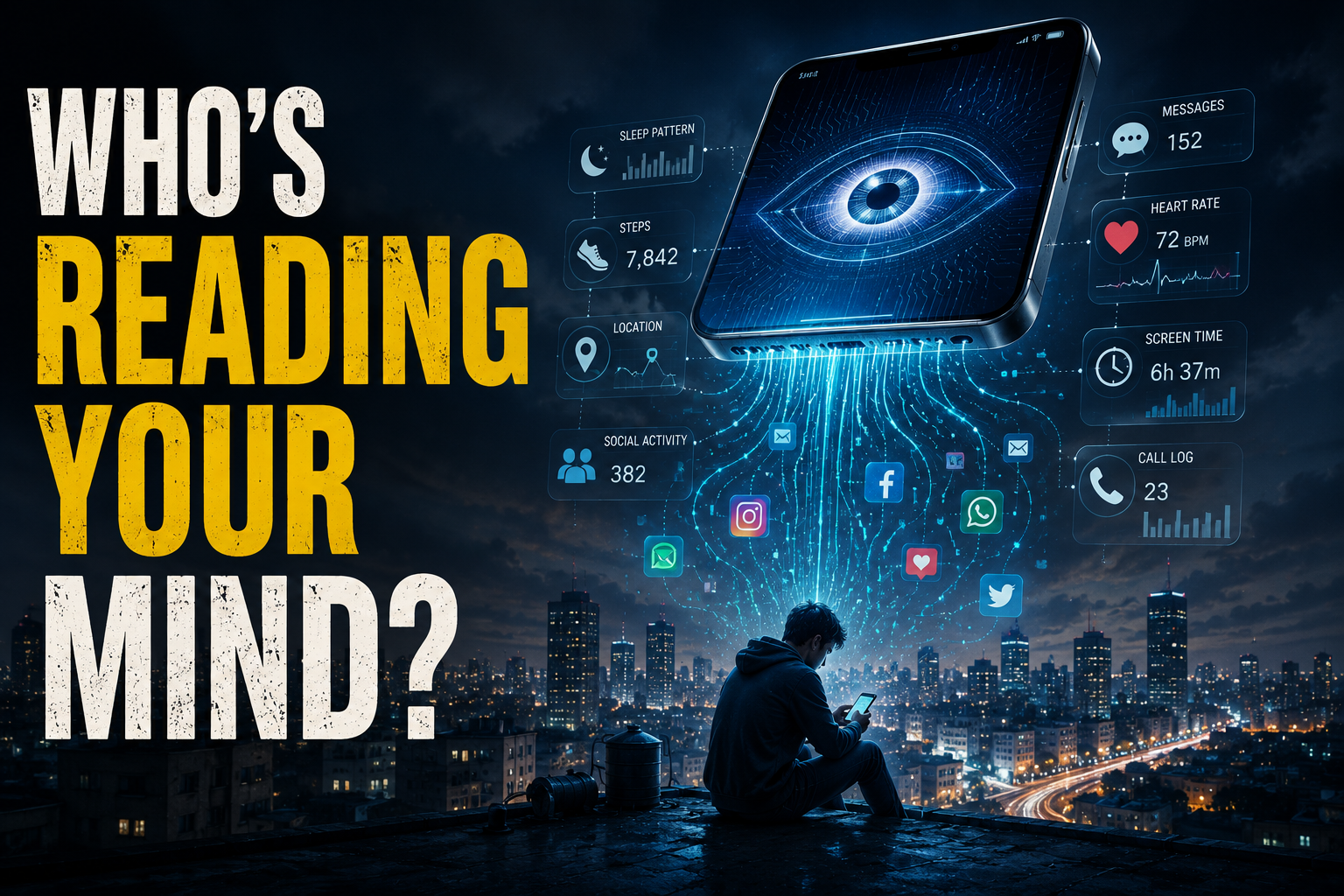
You don’t always know you’re slipping until someone points it out. A friend notices you’ve gone quiet on the group chat. A partner asks why you’ve barely left the house this week. But long before any of them say a word, your phone has probably already noticed.
It doesn’t notice the way a friend does, of course. It has no idea what sadness feels like. What it has is data such as how fast your thumbs move across the keyboard, how often you leave home, how long you stare at the screen at 2 a.m., and how many calls you’ve stopped picking up. And researchers have spent the last decade proving that this quiet trail of behaviour can reveal a low mood before the person carrying the phone has even named it themselves.
This isn’t a tech company’s marketing line. It’s a real, fairly mature field called digital phenotyping, the idea that the small, constant traces we leave on our phones add up to a kind of behavioural fingerprint. In one study, researchers gave smartphones to a group of people already diagnosed with clinical depression and simply let the devices run in the background, tracking things like movement, screen use, and location, without asking participants to fill out a single form. Using nothing but that passive data, their models predicted depressed mood hour by hour with accuracy as high as 86 to 89 percent. Another large study, which followed over a thousand people for sixteen weeks through an app that quietly logged GPS movement, app usage, and calling patterns, found a clear link between these everyday digital habits and rising depression and anxiety scores. Even something as small as how someone types the rhythm and speed of their keystrokes has shown up in research as a marker of mood. Scientists studying bipolar disorder have found that motion data from a phone’s accelerometer, the same sensor that counts your steps, can sharpen predictions of mood swings by nearly five percent over models that rely only on clinical interviews.
None of this stayed confined to a university lab. Apple now builds something similar straight into the iPhone. Since 2023, the Health app has included a feature called State of Mind, which asks you to log how you feel and then quietly lines that up against your sleep, your exercise, your time outdoors, and your mindfulness minutes, the kind of passive data your phone was already collecting anyway. It even offers a short questionnaire that estimates your risk of depression and anxiety. The pitch is gentle and clinical: understand yourself better, catch the dip before it becomes a slide.
But there’s a less comfortable side to a phone that can sense sadness; it can also be used to create it, or feed it. In January 2012, Facebook quietly altered the news feeds of nearly 700,000 users for a week, without telling them. Some saw fewer happy posts from friends, others saw fewer sad ones. When researchers published the results two years later, in a peer-reviewed journal, the finding was unambiguous: people’s own moods shifted to match what the feed showed them. Show someone more negativity, and their own posts turned more negative. The company hadn’t just measured emotion, it had moved it, on purpose, as an experiment. The backlash was immediate, and it raised a question that still hasn’t gone away: if a platform can detect your mood, what stops it from deciding what to do about it, without ever asking you first?
That’s really the heart of this. A phone sensing sadness can mean two very different things depending on who’s holding the data. In a doctor’s hands, or a researcher’s, it could mean catching a depressive episode weeks before a person would normally seek help, especially for someone who hides it well in front of others. In an advertiser’s hands, or an algorithm built purely to keep you scrolling, the same signal becomes something else entirely a vulnerability to be served content against, not supported through.
The phone itself doesn’t care either way. It has no opinion on whether you’re having a hard week. It just keeps counting: the pauses between your messages, the hour you finally put it down, the days you don’t leave the house. We’ve gotten used to thinking of our phones as tools we pick up and put down at will. But increasingly, they’re quietly building a picture of us that we ourselves haven’t gotten around to noticing yet.
The unsettling part isn’t that this is possible. It’s that most of us never agreed to read this closely and most of us still don’t know who, if anyone, is reading.
Subscribe Deshwale on YouTube
