











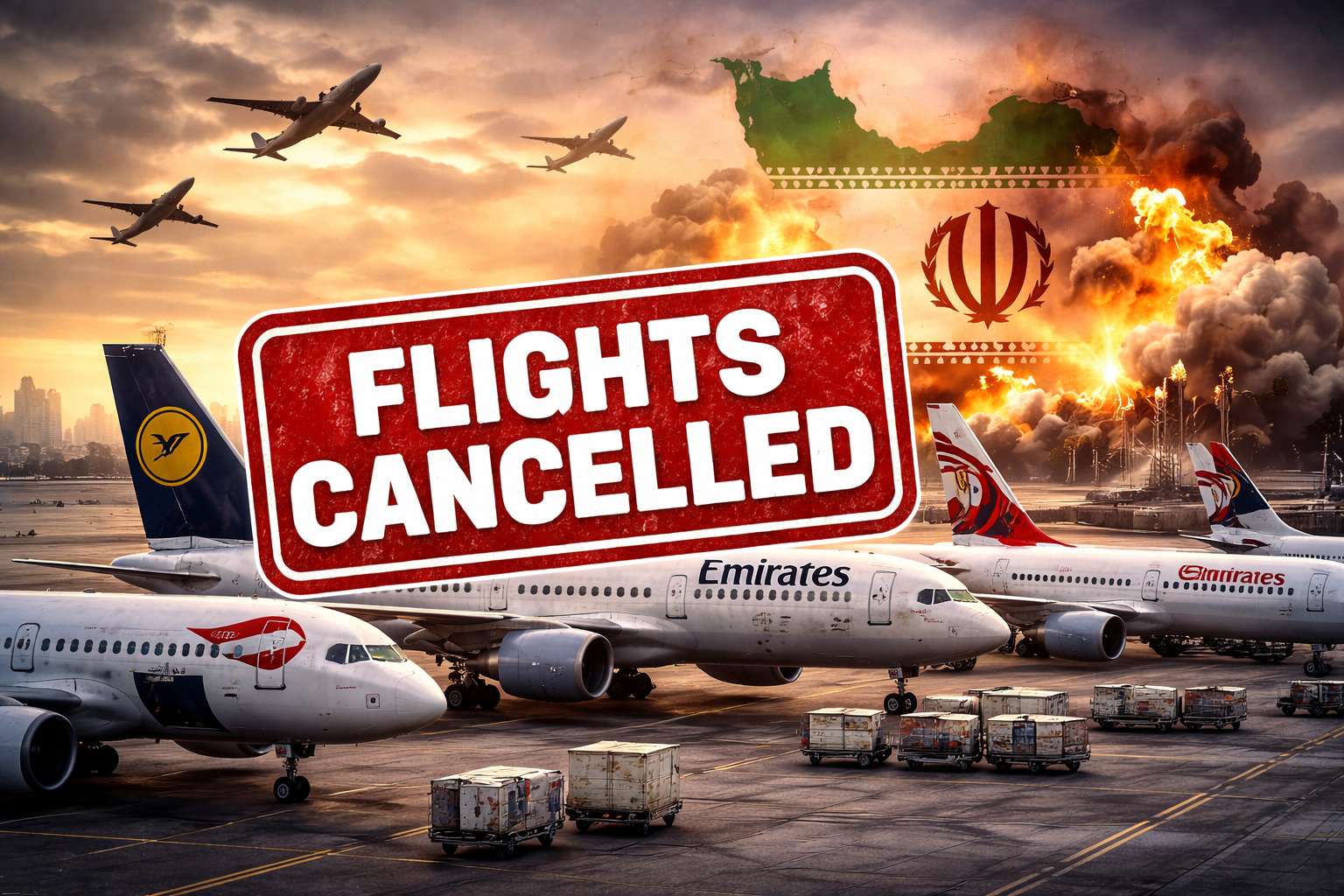
Air travel worldwide has been severely affected following the US-Israeli military strike on Iran. Airlines across Europe, the Middle East, and North America have cancelled multiple flights as safety concerns over regional airspace escalated. For millions of passengers, the disruption has been immediate and frustrating.
Airspace Safety and Airline Decisions
Civil aviation authorities and airlines acted swiftly to minimise risk. Airspace over Iran and parts of the Persian Gulf has been closed or restricted. Airlines including Lufthansa, Emirates, British Airways, Qatar Airways, and United Airlines cancelled or rerouted flights that usually cross these zones. Safety is non-negotiable in aviation, and crews cannot operate in potentially hostile airspace.
These decisions follow established risk management protocols. Airlines are not being alarmist. They are ensuring that passengers and crew remain out of danger. Some travellers were caught off-guard because last-minute advisories changed flight plans. Others experienced delays while alternative routes were arranged.
European Flight Disruptions
European carriers reported several cancellations between Frankfurt, London, Paris, and destinations in Asia. Frankfurt Airport, one of Europe’s busiest hubs, faced congestion as flights were rerouted around Iranian airspace. Lufthansa alone reported cancellations on three major long-haul services to the Middle East and South Asia. Passengers with connecting flights experienced delays of hours, sometimes overnight.
Global Flight Cancellations’ Table
| Airline | Flight Number | Origin Airport | Destination Airport | Cancellation Date | Status |
|---|---|---|---|---|---|
| Lufthansa | LH 624 | Frankfurt | Dubai | 28 February 2026 | Cancelled |
| Lufthansa | LH 625 | Frankfurt | Tehran | 1 March 2026 | Cancelled |
| British Airways | BA 147 | London Heathrow | Dubai | 28 February 2026 | Cancelled |
| Emirates | EK 202 | Dubai | New York JFK | 28 February 2026 | Cancelled |
| Qatar Airways | QR 702 | Doha | London Heathrow | 1 March 2026 | Cancelled |
| United Airlines | UA 875 | New York JFK | Dubai | 1 March 2026 | Cancelled |
| Delta Airlines | DL 183 | Atlanta | Doha | 28 February 2026 | Cancelled |
| Lufthansa | LH 626 | Frankfurt | Dubai | 3 March 2026 (Upcoming) | Cancelled |
| Emirates | EK 204 | Dubai | London Heathrow | 3 March 2026 (Upcoming) | Cancelled |
| Qatar Airways | QR 704 | Doha | Paris | 3 March 2026 (Upcoming) | Cancelled |
| United Airlines | UA 876 | New York JFK | Doha | 3 March 2026 (Upcoming) | Cancelled |
Note: Table includes a representative selection of past and upcoming cancellations based on official airline advisories. Other flights may also be affected.
Middle Eastern and Gulf Routes
Airlines based in the Gulf were among the first to react. Emirates and Qatar Airways cancelled multiple services to Europe and North America. Dubai International Airport and Hamad International Airport experienced unusual congestion, both on departure gates and in cargo handling. That was stressful for freight operators because many goods also travel via these corridors. The ripple effect disrupted schedules in Asia and Africa as well.
North American Responses
US carriers such as Delta, United, and American Airlines suspended flights to and from certain Middle Eastern destinations. Flights typically over Iranian airspace were either cancelled or rerouted over longer northern paths. This increased flight duration and fuel costs. Some passengers were informed only hours before departure. That part was frustrating for business travellers.
Economic and Operational Impacts
Airlines face mounting operational costs from cancellations and rerouting. Fuel consumption rises on longer paths. Crew duty hours are extended, requiring additional staffing or overnight stays. The disruption also affects cargo shipments, with delays for time-sensitive goods. Airlines in Europe and the US report revenue losses running into millions of dollars per day, though exact figures are still being calculated.
Passenger Experience and Communication
The human side of these cancellations cannot be overlooked. Passengers reported confusion at airports, long lines at customer service desks, and difficulty rescheduling flights. Some airlines provided compensation or vouchers, but the experience was uneven. The news boards at terminals often updated in real time, yet travellers still had to adapt quickly. That was tricky for families with connecting flights.
Global Aviation Coordination
International aviation authorities emphasised coordination. The International Civil Aviation Organization and regional safety regulators updated notices for airmen, advising on safe corridors. Airports set up help desks and online communication channels. Airlines are monitoring developments constantly, adjusting routes and schedules as new intelligence arrives.
Looking Ahead
No one can predict how long normal flight schedules will take to resume. Much depends on the geopolitical situation and airspace security assessments. Airlines remain cautious, and passengers are advised to check with carriers before planning travel. For some, flexible travel dates and alternative routes are the only practical solutions.
The recent cancellations underline a simple truth: global aviation is deeply linked to geopolitical stability. Even events thousands of kilometres away can instantly disrupt schedules in Europe, North America, and beyond. Anyone planning international flights this month should anticipate further adjustments and build contingency into travel plans.
Subscribe Deshwale on YouTube


