










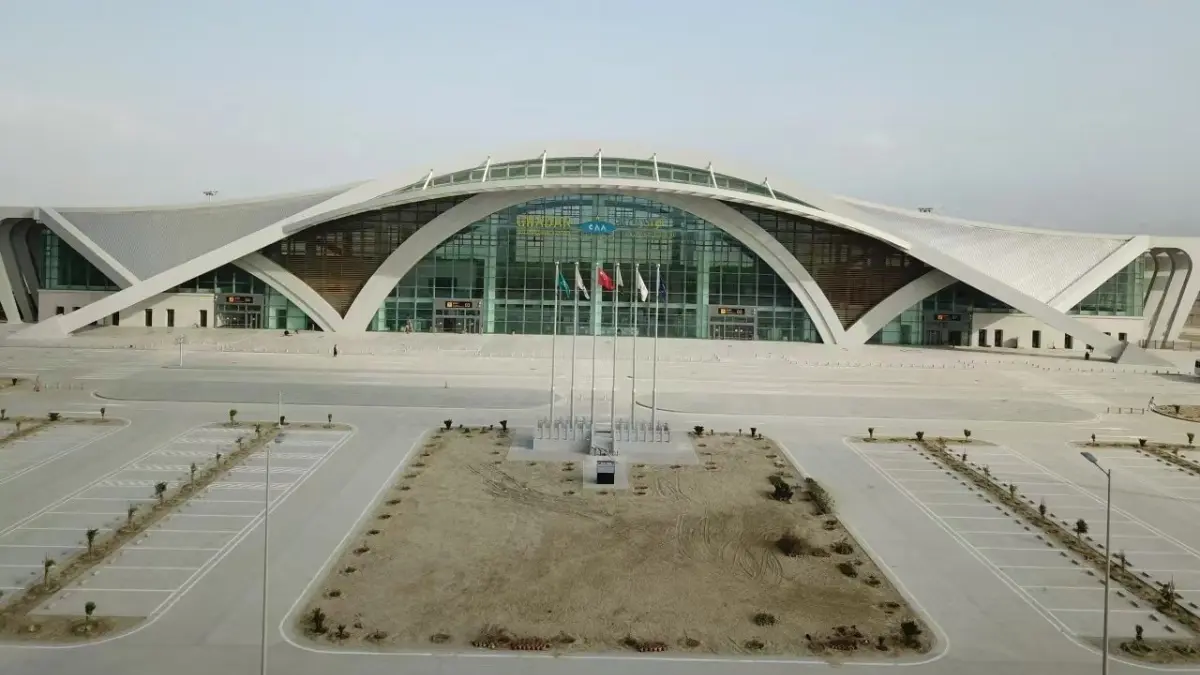
Gwadar Airport was promised as Pakistan’s new economic engine, built with Chinese funding under CPEC. Today it stands almost empty, hosting few flights and no commercial activity. Locals see little benefit. Observers call it a “white elephant”, a grand gesture with no practical use. The airport’s story starkly reveals how infrastructure without real development can deepen local grievances rather than heal them.
The vast and arid expanse of Balochistan’s coastline, where the Arabian Sea marries rolling sands, seemed ripe for transformation. In this land, dreams have often outpaced reality. The saga of Gwadar Airport, a behemoth rising from the dust, was meant to rewrite the destiny of pakistan’s most neglected province. Funded with $246 million of Chinese money, its very foundations were laid with the rhetoric of a new age. Yet, as dawn pierces the desert skyline in 2025, the world beholds not a gateway, but a ghost—a colossal monument to misplaced ambition and a chilling warning for those who ignore history’s lessons.
Older generations may recall how Gwadar, once a sleepy fishing outpost, entered Pakistani territory only in 1958, acquired from the Sultan of Muscat after lengthy diplomatic overtures. The airport’s modest origins trace back to 1966, with international status eventually achieved thanks to weekly flights linking Karachi, Gwadar, and Muscat. Yet, even as the blacktop of its original runway cracked from neglect, a new fever gripped the region. CPEC, China’s audacious China-Pakistan Economic Corridor—would unlock Gwadar’s “Dubai-like” potential. The promise: bustling air traffic, global trade, prosperity for millions.
Pakistani leaders, drawn to this intoxicating vision, dreamed large. They saw not sand and struggle, but runways teeming with life. China, hungry for a warm-water port and regional leverage, poured largesse into what would become Pakistan’s largest airport—larger even than Karachi’s. Officials envisaged it as a linchpin for Central Asia, the Persian Gulf, and beyond. Yet on the airport’s inauguration day, journalists noted a glaring absence. No cheering crowds. No traffic jams. Only security staff, and the echo of official platitudes blanketing a three-billion-rupee edifice with no flights and almost no passengers.
The new air terminal sprawls over 4,300 acres. It boasts a 3,658-metre runway, and can, on paper, handle 400,000 passengers a year, even the mighty Airbus A380 is welcome here. But Gwadar city, home to only 90,000, remains unlit by its own grid, drinking water trucked in, and jobless youth seeking opportunities far outside the barbed wire of this “gateway to the future.” Legend and officialdom insisted this airport would spark a revolution in trade. Today, facts offer only the silence of waiting rooms and the hush of three weekly flights—at best—and on some days, not even a single commercial motion in the air.
What went so horribly wrong? To answer, one must listen to the soft, persistent rumble beneath Balochistan’s restless soil—the throb of collective memory, and the roar of protest. Local communities, ever-mindful of their land’s history of resource extraction and broken promises, have watched project after project arise for outsiders, not them. Insurgency festers, targeting not just Pakistani troops but Chinese workers perceived as agents of a new colonialism. Dr. Ghulam Ali, an expert on South Asian geopolitics, cautions, “Gwadar already had an airport meeting local demand; the new one is a white elephant, a liability for both Pakistan and China.”
International commentators find echoes of Sri Lanka’s Hambantota in this desolate hub: magnificent, useless, and now a cautionary tale. Government officials in Islamabad still cling to the narrative that prosperity is just around the next bend in the road. Skeptics observe only a tableau of empty chairs and vacant terminals, while the basic needs of a struggling city remain unmet. “Hope is not a strategy,” remarked a veteran analyst in a recent report, slicing through the fog of rhetoric.
Strategically, the Gwadar airport’s construction reveals layers far deeper than economic calculation. Many in Pakistan, and certainly in China, see it not as a gateway for tourism or commerce, but as an outpost, a safe landing ground for Chinese personnel and an insurance policy against Indian Ocean encirclement. Meanwhile, for the restless, disenfranchised Baloch, it becomes another citadel of alien power, garrisoned and guarded, its promise locked behind checkposts and razor wire. The airport’s very emptiness thus becomes its most potent symbol. It stands as the architectural equivalent of a sepulchre, honouring grand hopes, but housing only shadows.
Amid these burning questions, the airport’s fate looks grim. Neither domestic carriers nor major international airlines show any appetite for commercial runs here. The few flights carrying officials and VVIP delegations only emphasise the void. China’s investments, totalling over $60 billion under CPEC, confront a hard truth: infrastructure without human development breeds resentment, not renewal. With each passing week, “the doom called Gwadar airport” inches closer to becoming an epitaph for an era of bankrupt ambition. It is a lesson not just for Pakistan, but for every nation intoxicated by the mirage of quick-fix prosperity through grand monuments.
For Indian readers, Gwadar remains more than a news item, it is a strategic cipher, a silent warning. Infrastructure, no matter how gleaming, cannot conjure progress from thin air; development unmoored from local realities breeds only discontent and insurgency. As Rabindranath Tagore once wrote, “Faith is the bird that feels the light and sings when the dawn is still dark.” Balochistan, as yet, sings not. Until its children find water in their taps and hope in their hearts, not hangars in the desert, the morning will not come.
In the final calculus, Gwadar airport offers more questions than answers. Its silence is heavy, its legacy uncertain. But its lesson, for policymakers, investors, and dreamers—is writ large in the sand: The posturing of power, absent the substance of delivery, leaves only ruins to be remembered.


