










Invisible. Unseen. Yet all around us. Light extends far beyond the rainbow. Beyond red lies a warmth we can’t see. Beyond violet, a sunburn we can’t detect. Our eyes betray us. We think we see the full sky. We do not.
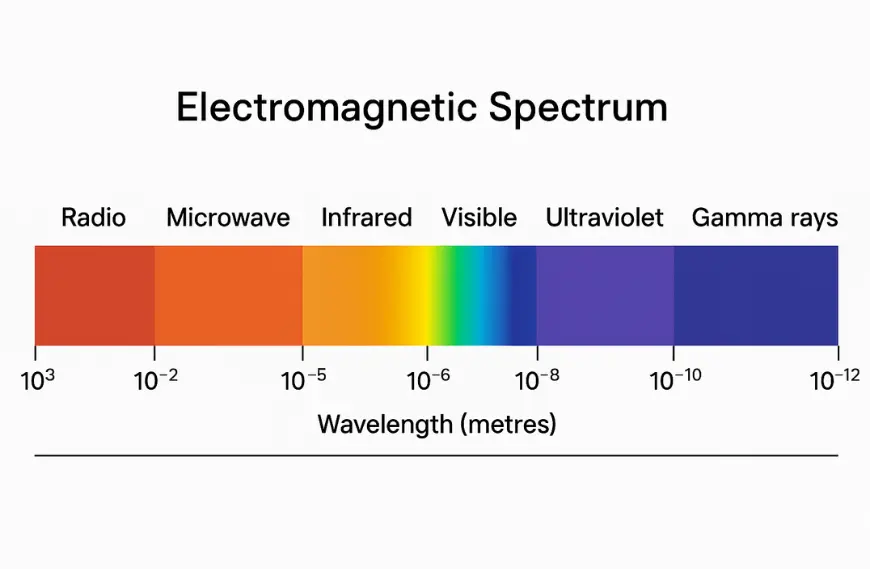
Every beam of light has a wavelength—a measure of its length. Short waves carry high energy. Long waves carry little. Together, they form the electromagnetic spectrum. At one end are radio waves. At the other, gamma rays. In between lie familiar colours—and beyond, hidden realms.
The Electromagnetic Spectrum Unveiled
Imagine a piano keyboard. Visible light is just one small octave. But the keyboard stretches both ways. Longer keys play radio and microwaves. Shorter keys play X-rays and gamma rays. Each key reveals something new.
Astronomers divide the spectrum into bands: radio, microwave, infrared, visible, ultraviolet, X-ray, and gamma. Each band needs different instruments. Each one tells a different story—from cold dust in deep space to black holes and DNA damage.
Ultraviolet: The Sun’s Hidden Burn
In 1801, German physicist Johann Wilhelm Ritter ran a simple test. He passed sunlight through a prism. Beyond the violet band, he noticed chemical changes. He called them “chemical rays.” Today, we call it ultraviolet (UV).
UV light ranges from 10 to 400 nanometres. We can’t see it, but we feel its effects. Sunburns. Tanned skin. But in small doses, UV also helps our bodies produce vitamin D. It kills germs. It powers chemical reactions in air and water.
“Ultraviolet light is both healer and hazard,” says Dr Jane Smith of the Royal Photographic Society. “It cleans tools. It also damages DNA.” She praises its role in sterilising instruments—but warns against sunbeds and unprotected midday sun.
Astronomers use UV telescopes to study hot, young stars. They spot star-forming galaxies and measure how stars push gas into space. Without UV, half the universe stays silent.
Infrared: The Heat We Cannot See
In 1800, British astronomer Sir William Herschel made a key discovery. He placed thermometers beyond the red end of sunlight. The warmth rose. He had found infrared (IR).
Infrared light ranges from 700 nanometres to 1 millimetre. We sense it as heat, not light. Pit vipers can detect it. So can night-vision cameras, which turn heat into images we can see.
Infrared astronomy reveals the cold universe. It spots hidden stars in dust clouds and peeks inside galaxies. Satellites like Spitzer and Herschel mapped the Milky Way’s cooler side.
On Earth, infrared helps us in many ways. It checks for heat leaks in buildings. It tracks animals at night. It scans body temperatures. Though invisible, infrared lets us see in the dark.
Radio Waves: The Universe’s Deep Bass
In the late 1800s, Heinrich Hertz proved James Clerk Maxwell’s theory of electromagnetic waves. He generated and detected radio waves in a lab. This laid the foundation for wireless communication—and cosmic discovery.
Radio waves stretch from millimetres to kilometres. They carry low energy but travel far. Dust does not block them. They reveal cold hydrogen gas, map galaxies, and capture the cosmic microwave background—the oldest light in the universe.
Radio telescopes like the Very Large Array (VLA) and Square Kilometre Array (SKA) listen to faint signals. They track pulsars, black hole jets, and echoes from the Big Bang.
Here on Earth, radio waves connect the modern world. Broadcasting, mobile phones, radar, satellites, Wi-Fi—all run on invisible radio signals. We don’t see them. But we rely on them every day.
Microwaves: Echoes of Creation
Microwaves sit between radio and infrared light. Their wavelengths range from 1 millimetre to 30 centimetres. Most of us know them from microwave ovens. But their role in science is huge.
In 1965, Arno Penzias and Robert Wilson heard a strange hiss at 1.4 GHz. That hiss turned out to be the cosmic microwave background (CMB)—the fading echo of the Big Bang.
Satellites like COBE, WMAP, and Planck mapped the CMB’s tiny ripples. These patterns tell us the age and structure of the universe. They’re like fossils of the first sound waves in space.
Microwaves also help with radar, weather tracking, aircraft guidance, and communication. They’re used in remote sensing, mobile phones, and even cooking popcorn.
X-Rays and Gamma Rays: Atomic Fireworks
At the extreme end of the spectrum lie X-rays and gamma rays. X-rays range from 0.01 to 10 nanometres. Gamma rays go even shorter. Both carry high energy and pass through matter easily.
In 1895, Wilhelm Röntgen discovered X-rays by accident. They pass through flesh but not bone, giving rise to medical imaging. Today, we use them to detect fractures, cancers, and more.
Gamma rays were found in 1900 by Paul Villard. They come from radioactive materials and nuclear reactions. They are used to sterilise tools and treat cancer in radiotherapy.
In space, these rays uncover the most extreme events. Neutron stars. Supernovas. Black holes. Telescopes like Chandra and Fermi capture these high-energy outbursts and decode the universe’s most violent events.
Atmospheric Windows and Space Observatories
Earth’s atmosphere blocks most of the electromagnetic spectrum. Only visible light, some radio, and a bit of microwave reach the ground. UV gets absorbed by ozone. Infrared by water vapour. X-rays and gamma rays by oxygen and nitrogen.
To study the rest, we launch instruments into space. Satellites, balloons, and high-altitude planes carry telescopes. Hubble sees in visible and UV. James Webb peers into the infrared. Chandra and XMM-Newton detect X-rays. Fermi maps gamma rays.
Without space telescopes, much of the universe stays hidden. We’d miss the bigger picture.
Practical Applications of Invisible Light
Invisible light powers daily life. Here are just a few examples:
- UV: Sterilises water and surfaces, triggers vitamin D.
- Infrared: Used in grills, night vision, and thermal imaging.
- Microwaves: Enable radar, weather tracking, and cooking.
- Radio waves: Drive Wi-Fi, broadcasting, and phones.
- X-rays: Scan bodies and luggage.
- Gamma rays: Sterilise tools and kill cancer cells.
Remote sensing uses invisible light to monitor crops, track storms, and study wildlife. Spectroscopy splits light to identify elements, detect pollution, and monitor health.
Beyond Today: Terahertz and Extreme UV
Between microwave and infrared lies the terahertz band. It spans 0.1 to 1 millimetre. It’s promising for security scanners and fast data. But challenges include atmospheric blockage and weak sources.
Extreme UV spans 10 to 100 nanometres. It explores the Sun’s corona and space weather. Instruments like the Solar Dynamics Observatory watch the Sun in UV. They help predict solar storms that can disrupt satellites and power grids.
Expanding Human Vision
Technology extends our senses. We now have radio ears, infrared eyes, and X-ray vision. Each invisible band gives us a deeper view of the universe.
Stand under a night sky. You may see a few hundred stars. But radio telescopes detect thousands more. Infrared reveals star nurseries. X-rays expose black holes feeding on stars. Gamma rays trace particles moving at nearly light speed.
The hidden spectrum invites us to explore. It challenges us to invent. It rewards us with discovery. It reminds us: reality stretches far beyond what our eyes can see.


