



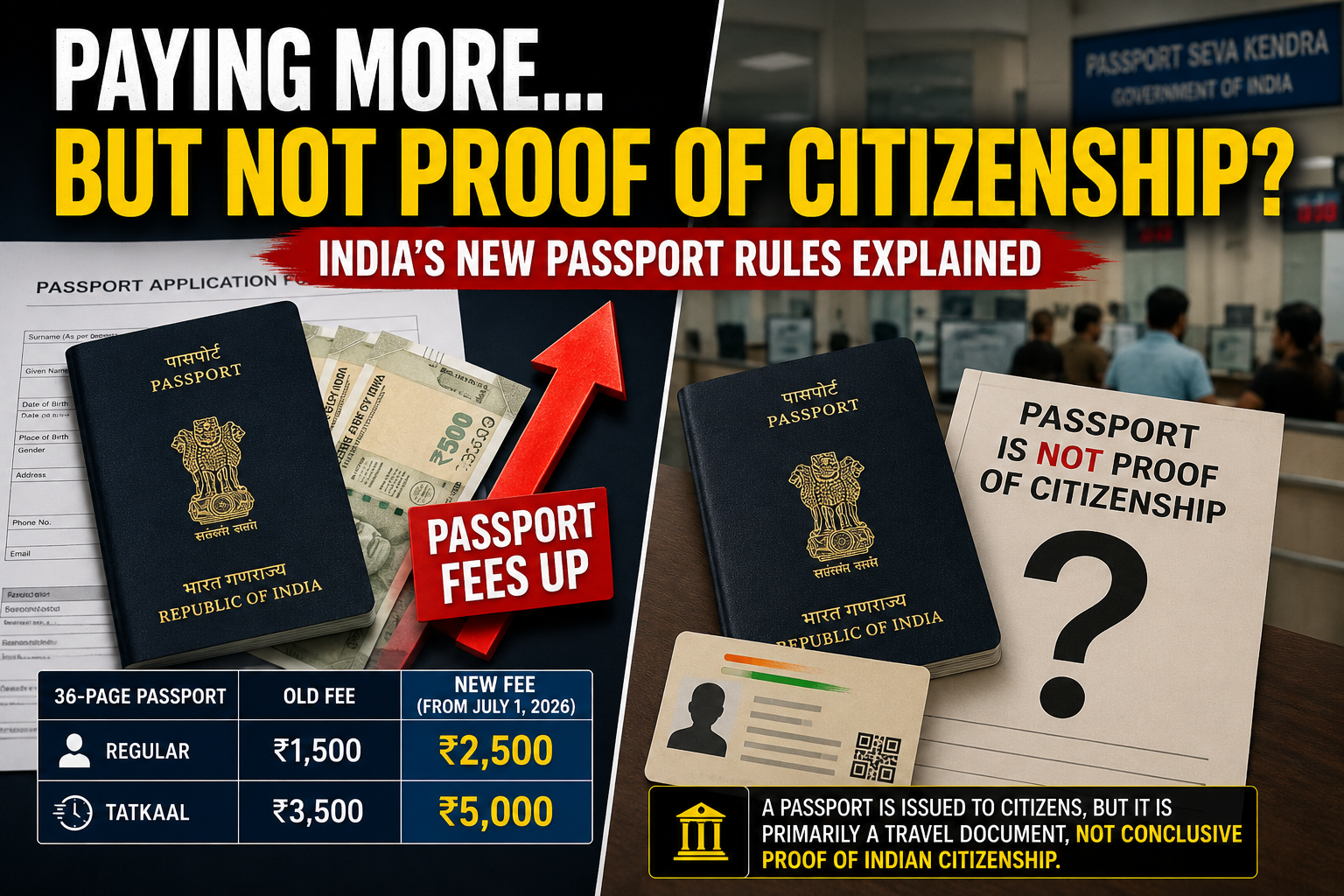
Starting next week, getting an Indian passport is going to cost you a lot more, in some cases. But here’s the part that’s harder to swallow: the government has also just gone out of its way to remind everyone that the same document doesn’t actually prove you’re an Indian citizen.
Two things are happening at once, and most people are only hearing about one of them.
The fee hike, in plain numbers
From July 1, 2026, a fresh or renewed 36-page passport for anyone above 18 will cost ₹2,500, up from ₹1,500. Want the 60-page version instead? That’s ₹3,500, up from the previous ₹2,000. If you need it urgently through Tatkaal, the 36-page passport will set you back ₹5,000, and the 60-page one ₹6,000. These Tatkaal figures already include the normal fee; it’s not an add-on charge.
Lost or damaged your passport? That now costs even more to replace: ₹5,000 for a 36-page one under normal processing, and ₹7,500 if you need it urgently. The 60-page version goes up to ₹6,000 normal and ₹8,500 Tatkaal.
Even children aren’t spared. A minor’s fresh 36-page passport will now cost ₹1,750, up from the earlier ₹1,000, with Tatkaal pegged at ₹4,250. The one small relief: a 10% discount on the normal fee for fresh applications, not renewals for children up to age 8 and senior citizens above 60.
This is the first major revision to the passport fee schedule in over a decade. The change comes through the Passports (Amendment) Rules, 2026, notified by the Ministry of External Affairs, coming into force on July 1, 2026. The government’s reasoning is straightforward: administrative costs have gone up since the last revision, and the fee structure simply hasn’t kept pace. Indians applying at embassies abroad, including missions across the Gulf, will also pay revised rates, though several missions were still finalising their local-currency figures as of late June.
The other half of the story
Around the same time this fee hike was finalised, the MEA put out a clarification timed to Passport Seva Divas, which marks the enactment of the Passports Act on June 24, 1967 making a point that caught a lot of people off guard: a passport, while issued only to citizens, exists primarily to help you travel internationally and verify your nationality abroad. It was not meant to be treated as standalone proof that you’re an Indian citizen.
For a country where citizenship and documentation have been politically charged topics for years, that line didn’t land quietly. Within hours, social media was full of references to “kagaz nahin dikhayenge” a phrase that became a rallying cry during the citizenship law protests of 2019–2020 except this time it was being thrown back at the government itself, with people asking why they should keep paying more for a document that the government itself says won’t settle the question of who’s a citizen.
The pushback from the government’s side was swift. A source in the Prime Minister’s Office told reporters that this wasn’t a new policy decision at all, just a restatement of something that’s been legally settled for decades. The source pointed out that Section 20 of the Passports Act, 1967 itself allows passports to be issued to non-citizens in certain cases, and that the Bombay High Court had already ruled in 2013 that a passport isn’t conclusive proof of citizenship. Citizenship, the source said, is determined under the Citizenship Act, 1955, based on eligibility and evidence not by simply holding one document.
Amit Malviya, national convener of BJP’s IT cell, weighed in too, posting on social media that the MEA had announced no new policy and was simply restating an existing legal position, and that the outrage was based on a misreading of settled law.
Why this matters beyond the noise
Strip away the politics, and what’s left is a fairly basic question for anyone who needs a passport this year: you’re being asked to pay anywhere from 40% to 75% more for the same document, at the exact moment its legal weight as an identity marker has been publicly downgraded. For families with young children, for anyone who’s lost or damaged their passport, and for the millions of Indians working in the Gulf and beyond, this isn’t an abstract policy debate, it’s a real cost that lands at the passport counter.
If you’re planning to apply or renew anytime soon, the only actionable takeaway is this: submitting and paying before July 1 locks in the old, lower fee. After that, the new rates apply regardless of when you started the paperwork.
Subscribe Deshwale on YouTube
