



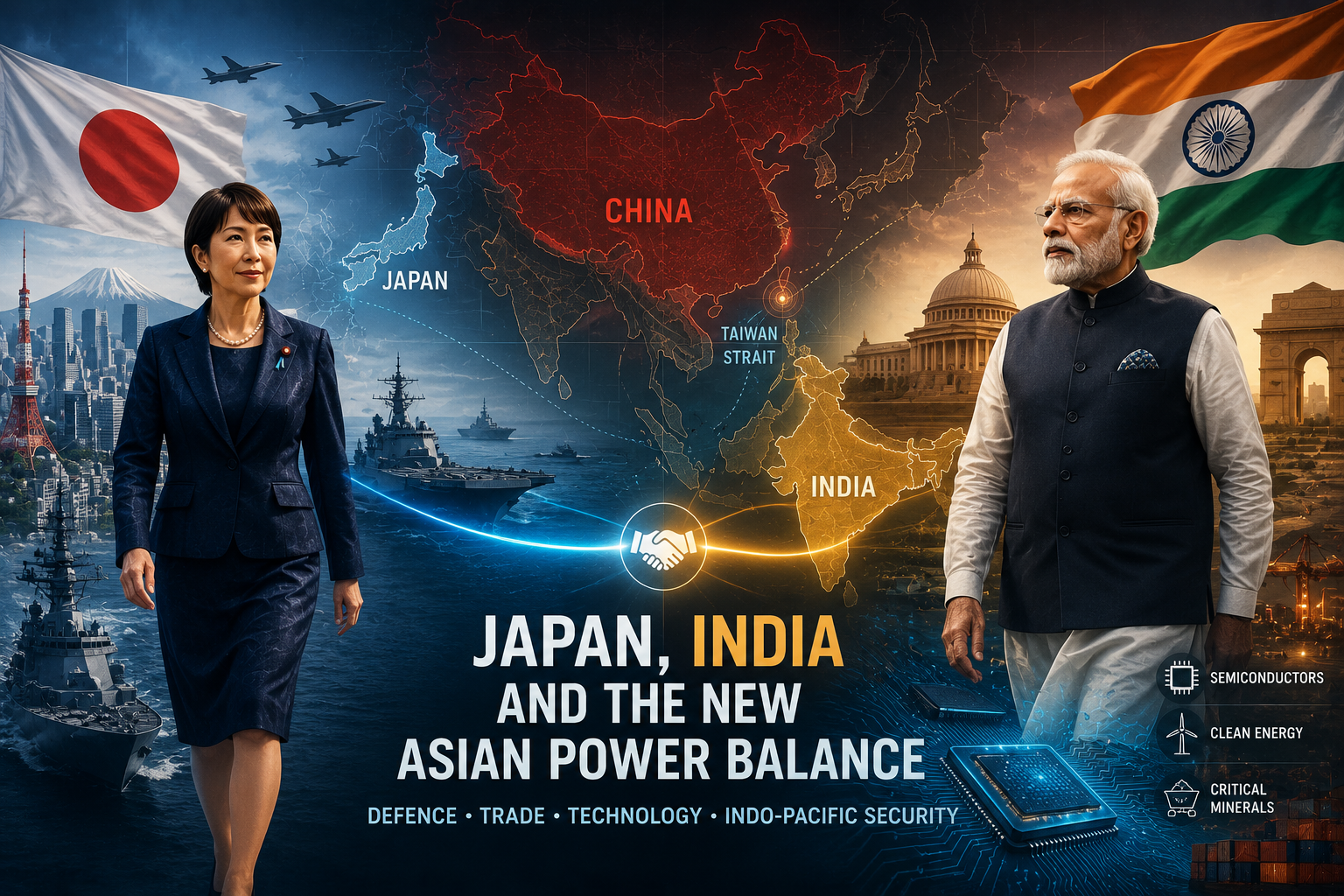
Back in November 2025, Japan’s Prime Minister Sanae Takaichi said something in parliament that Beijing has still not forgiven her for. She told lawmakers that if China ever took military action against Taiwan, including a naval blockade, it could pose an “existential threat” to Japan, one serious enough that Japan’s own military might have to respond alongside the United States.
China’s reaction was fast and furious. Beijing summoned Japan’s ambassador. Japan summoned China’s ambassador right back, after a Chinese diplomat made an alarming remark about “cutting a dirty neck.” China suspended imports of Japanese seafood. The two countries have been locked in an unusually bitter diplomatic standoff ever since.
That standoff hasn’t cooled down. Just days before Takaichi boarded a flight to New Delhi this month, China imposed fresh export controls on 40 Japanese companies and institutions, including defence contractors and research bodies, accusing them of helping Japan “remilitarise.”
That’s the backdrop against which Takaichi landed in India on July 1, for her first official visit as Prime Minister.
A summit with more weight than usual
Takaichi is in India from July 1 to 3 for the 16th India-Japan Annual Summit, meeting Prime Minister Narendra Modi in New Delhi. On paper, this is a routine annual event. Underneath, it’s landing at a moment when Japan’s relationship with its largest neighbour remains deeply strained.
Modi welcomed her warmly, calling the visit an opportunity to deepen the “India-Japan Special Strategic and Global Partnership.” Takaichi, for her part, said cooperation with India is becoming “increasingly important” given how uncertain the world has become, and pointed to the fact that India and Japan “share fundamental values and strategic interests.”
That phrase, shared values, is doing a lot of work here. It’s diplomatic language for: we trust each other, and right now, that’s rare.
Why the China tension matters
Japan has spent decades avoiding direct military talk, a legacy of its post-war pacifist constitution. Even the idea of Japan’s Self-Defense Forces getting involved in a Taiwan conflict was, until Takaichi’s remark, something Japanese leaders rarely said out loud while in office.
That’s exactly what made her comment, and China’s furious response to it, such a big deal. It signalled that Tokyo and Beijing are no longer just economic rivals managing their differences quietly. They’re now openly at odds on questions of military response and territorial security, and that tension is still shaping every interaction between the two governments today.
Japan is also not new to shifting its defence posture more broadly. Under former Prime Minister Shinzo Abe, and now under Takaichi, Japan has been steadily revising the “Three Principles on Arms Transfer,” a set of rules that, since the 1960s, kept Japan almost entirely out of the arms export business. That wall is coming down, piece by piece. Takaichi’s government has pushed this further than any of her predecessors.
Where India fits in
India isn’t a random stop for Japan right now. It’s a strategic one.
With relations with China strained and the United States under Donald Trump proving unpredictable, unpredictable enough that both India and Japan have faced fresh American tariffs, Tokyo is looking for partners it can actually rely on. India fits that need.
The two countries are expected to sign a joint declaration on economic security during this visit, along with a separate statement on artificial intelligence cooperation, covering areas like manufacturing, healthcare, and mobility. They’re also expected to deepen ties in semiconductors, critical minerals, and clean energy, sectors where reducing dependence on China has become a shared priority for both governments.
The economic weight behind this relationship is already substantial. Around 1,400 Japanese companies operate in India today, nearly half of them in manufacturing. Bilateral trade touched $27.5 billion in the last financial year, and Japanese investment into India crossed $3.2 billion between April and December 2025 alone.
More than 150 representatives from Japan’s business community are also in New Delhi for this visit, taking part in the India-Japan Economic Forum, another sign that this trip is as much about business as it is about diplomacy.
There’s also a quieter story here, about the Quad. India, Japan, and Australia have all been drawing closer to each other in recent months. Takaichi visited Australia in May and signed new defence and economic agreements there. Australia’s defence minister visited India the same month. Modi is expected to visit Australia later in July.
Put together, it looks less like a coincidence and more like three democracies hedging their bets, strengthening ties with each other while relationships with China and the US grow harder to predict.
Takaichi called China’s actions a threat to Japan’s existence, and that standoff is far from resolved. Her visit to India, months later, wasn’t about that remark directly, but it’s happening in its shadow. It was a message, aimed as much at Beijing as at New Delhi.
Subscribe Deshwale on YouTube
