




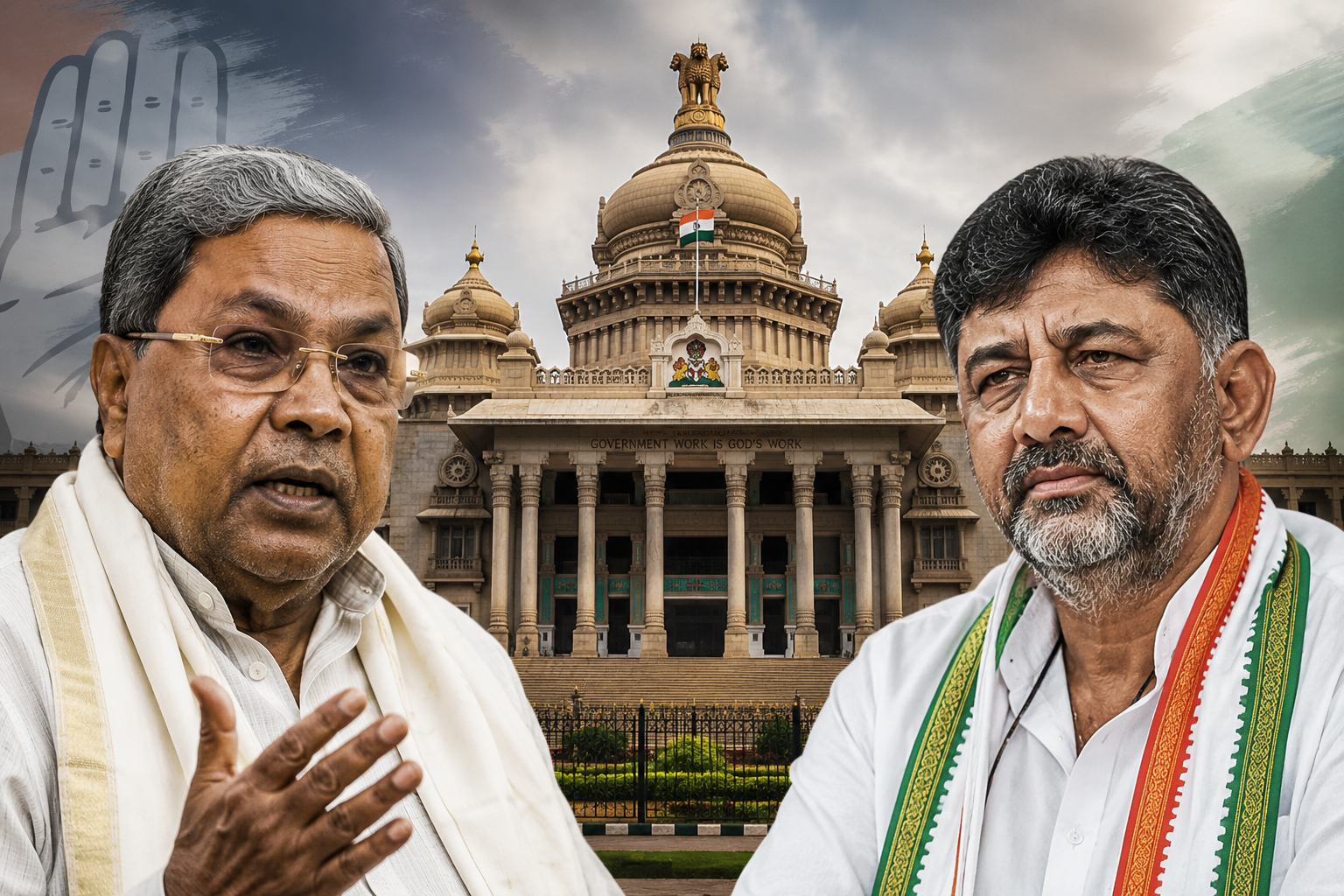
The Congress government in Karnataka may soon witness an important political reshuffle, with reports suggesting that the party is considering a formula involving multiple Deputy Chief Ministers representing Scheduled Castes, OBC communities and women. While no official decision has been announced yet, the discussions have already triggered a wider political debate across the state.
The reported move comes at a time when speculation around Karnataka’s leadership structure has intensified. Chief Minister Siddaramaiah and Deputy Chief Minister DK Shivakumar recently held meetings with the Congress high command in Delhi, leading to fresh discussions about possible changes within the state leadership. However, the Congress has publicly denied reports of any confirmed leadership transition and described much of the speculation as political rumour.
Even though the party has officially dismissed the rumours, political observers believe the growing conversation around multiple Deputy Chief Ministers reflects the Congress leadership’s attempt to maintain social and political balance within Karnataka.
Karnataka politics has always been heavily influenced by caste equations and regional representation. Communities such as Lingayats, Vokkaligas, Scheduled Castes, backward communities and minorities play a major role in shaping electoral outcomes. Congress has traditionally depended on a broad support base that includes Dalits, OBC communities, minorities and rural voters.
The possible Deputy CM formula appears to fit into that larger strategy. According to reports, leaders from Scheduled Castes, OBC communities and women categories may be considered for Deputy Chief Minister positions if the proposal moves forward.
Political analysts believe such a move could help the Congress send a strong message of social inclusion while also accommodating influential leaders within the party. Instead of allowing leadership tensions to grow openly, the party may be trying to distribute power more carefully among different social and political groups.
The timing of the discussions is particularly important because Karnataka Congress has witnessed continuous speculation regarding the relationship between Siddaramaiah and DK Shivakumar. Ever since the Congress returned to power in 2023, rumours of a possible power-sharing arrangement between the two leaders have surfaced repeatedly, although the party has never officially confirmed any such agreement.
Recent meetings between Karnataka leaders and the Congress high command in Delhi have further increased political curiosity. Several media reports have suggested that discussions were held regarding the future leadership structure of the state government. At the same time, senior Congress leaders have maintained that the meetings mainly focused on Rajya Sabha elections and organisational matters.
Siddaramaiah remains one of the Congress party’s strongest OBC leaders and continues to hold major influence among backward communities in Karnataka. His AHINDA political model, which focuses on minorities, backward classes and Dalits, has remained an important pillar of Congress politics in the state for many years.
DK Shivakumar, meanwhile, is regarded as one of the party’s most powerful organisational leaders and a major Vokkaliga face in Karnataka politics. His supporters have long viewed him as a future Chief Ministerial contender. Because both leaders hold strong political influence, the Congress leadership faces the challenge of maintaining unity while avoiding factional conflict.
This is where the reported idea of multiple Deputy Chief Ministers becomes politically significant. Rather than presenting any changes as a direct power struggle, the Congress could frame the move as an expansion of representation and social participation within the government.
The development also reflects a larger trend in Indian politics, where representation and identity continue to play a central role in governance. Political parties across states are increasingly focusing on social balance while distributing major posts. In Karnataka, debates around reservation policies, caste representation and welfare politics have remained politically important for years.
At the same time, the BJP has attempted to use the current situation to attack the Congress government. Opposition leaders have raised questions about political stability and have also tried to introduce an OBC representation angle into the debate surrounding Siddaramaiah’s position.
For Congress, Karnataka remains one of its most politically valuable states in the country. Any prolonged internal conflict could affect the party’s image and governance record ahead of future elections. That is why the leadership appears focused on maintaining stability while balancing the ambitions of senior leaders and the expectations of different communities.
Whether the three Deputy CM formula is officially implemented or not, the ongoing discussions clearly show how carefully the Congress leadership is trying to manage caste equations, political representation and internal party balance at the same time.
More importantly, the debate highlights how modern Indian politics is increasingly shaped not only by leadership battles, but also by the need to create broader social representation within governments. In Karnataka, where caste and regional identities continue to influence political decisions strongly, such balancing acts often become just as important as electoral victories themselves.
Subscribe Deshwale on YouTube
