











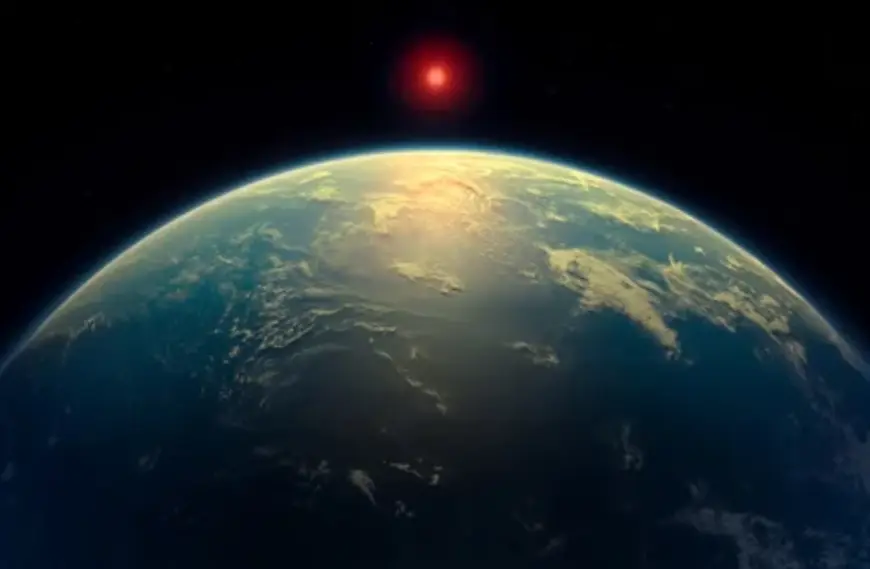
In a stunning discovery, scientists from Cambridge University have found signs that could suggest life exists beyond Earth. Using NASA’s James Webb Space Telescope (JWST), the team made a breakthrough by detecting atmospheric molecules on the exoplanet K2-18b. While these findings are still being verified, the potential implications are huge.
So, what’s the big deal?
What is K2-18b?
K2-18b is an exoplanet located 124 light-years away from Earth, in the Leo constellation. It’s about 2.6 times the size of Earth and orbits a red dwarf star. But here’s the kicker: scientists believe this distant planet might have the right conditions to support life. And now, thanks to the JWST, we might be closer than ever to proving that theory.
The discovery: what was found?
The key molecules found in K2-18b’s atmosphere are dimethyl sulphide (DMS) and dimethyl disulphide (DMDS). On Earth, these gases are produced by marine life, like phytoplankton and bacteria. That’s right, these are the same molecules that come from life here on Earth. And, finding them on another planet could mean life could exist out there, too.
What makes this discovery special?
The JWST is an incredibly powerful telescope. It can capture starlight passing through planetary atmospheres to look for chemical signatures. This is exactly what the team did with K2-18b, and the results are promising. However, let’s not get ahead of ourselves just yet. The certainty level of these findings is around 99.7%. While that’s pretty high, it’s still not enough for a scientific confirmation. We need a 99.9999% certainty (referred to as a “five sigma” result) to really say for sure that there’s life on K2-18b.
Why does this matter?
If these findings are confirmed, it would be the first real evidence of extraterrestrial life. Imagine that — the first time humanity can say, “Hey, we’re not alone.” It would not only be groundbreaking for science but would also fuel the idea that life could be common in the universe. After all, if K2-18b has these kinds of molecules, what about other exoplanets we’ve yet to explore?
What’s next for this research?
This discovery is just the beginning. It could revolutionise the field of astrobiology and redefine what we think we know about life in the universe. The findings were published in The Astrophysical Journal Letters, and researchers are already planning the next steps. If confirmed, this discovery could change everything.
For now, we’ll have to wait for more observations and data, but the future looks brighter than ever for the search for life beyond Earth.


