










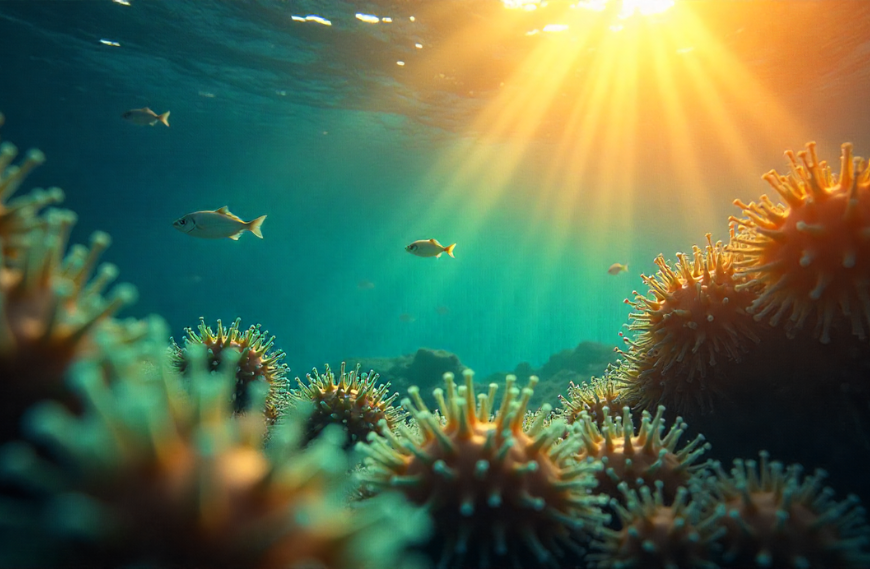
A single drop of seawater contains more organisms than there are humans on Earth. Billions of bacteria, archaea, viruses and microalgae thrive in every millilitre. They form the foundation of marine food webs. They cycle nutrients. They shape Earth’s climate. They create and dismantle through chemical processes invisible to our eyes. Welcome to the microbial metropolis.
The Ocean’s Invisible Majority
Marine microbes account for roughly half of the planet’s primary production. They generate approximately half of all oxygen. They consume about half of the carbon dioxide. Without them, Earth’s climate would be unrecognisable. Every breath we take owes a debt to these microscopic architects.
Diversity Beyond Measure
Marine microbial diversity dwarfs that of larger organisms. DNA surveys reveal thousands of microbial species in a single litre of water. Some groups, like the SAR11 order (Pelagibacterales), dominate. The SAR11 group accounts for about 25 percent of all surface ocean bacteria. Others, like the deep-sea Nitrospina, thrive in darker, cooler waters. Thousands more await discovery.
Photosynthesising Powerhouses
Phytoplankton are the ocean’s plants. Tiny, mostly single-celled algae, they include diatoms, dinoflagellates and coccolithophores. They harvest sunlight. They fix carbon. They fuel entire ecosystems. A bloom of phytoplankton off the coast can be visible from space as a sinuous green streak in satellite images.
The Microbial Food Web
Zooplankton graze on phytoplankton. They are eaten by small fish, which in turn feed larger predators. But microbes also feed on each other. Bacteria consume dissolved organic matter from waste products, dead cells and excreted compounds. They convert it into biomass. Viruses infect bacteria and phytoplankton, bursting cells in a process called viral shunt, releasing nutrients back into the water. This nutrient recycling fuels further growth. It is a microscopic economy of death and renewal.
Nutrient Cycling and Biogeochemistry
Microbes drive the ocean’s chemistry. Nitrogen-fixing microbes convert inert nitrogen gas into bioavailable forms. Nitrifying bacteria turn ammonia into nitrate. Denitrifying microbes return nitrogen to the atmosphere. Sulphur-oxidising bacteria process sulphide near vents and in oxygen-poor zones. Microbial processes regulate global cycles of carbon, nitrogen, phosphate and sulphur.
The Rare Biosphere
Beyond dominant groups lie the rare biosphere, species present at low abundance but high diversity. They remain in the background until conditions change, such as temperature shifts or nutrient pulses. When that happens, they can bloom. Harmful algal blooms, like red tides, occur when certain dinoflagellates proliferate. Rare microbes can have a large impact on ecosystems and human health.
Microbial Mats and Biofilms
On shores and seafloors, microbial mats build layered communities. Cyanobacteria form mats in intertidal zones, binding sediment and stabilising shorelines. In deep-sea cold seeps, sulphide-oxidising bacteria coat surfaces in white mats. They provide habitat for worms and mussels. On hydrothermal vents, microbial filaments create shimmering carpets, forming nutrient oases.
Tools of Discovery
Modern microbiology uses powerful tools. Metagenomics sequences all DNA in a sample, revealing species composition and metabolic potential without culturing organisms. Metatranscriptomics and metaproteomics show which genes and proteins are active in situ. Single-cell genomics isolates genomes from individual cells, uncovering rare lineages.
Climate Change and Microbes
Rising temperatures and acidifying oceans reshape microbial communities. Warmer waters favour smaller phytoplankton, altering food web dynamics. Ocean stratification limits nutrient mixing, suppressing phytoplankton growth. Methane-producing archaea may increase in oxygen-poor zones, fuelling greenhouse gas release. Microbes respond rapidly, so their shifts can both reflect and drive climate change.
Microbes and Human Health
Marine microbes hold promise for medicine. They offer novel antibiotics, antiviral compounds and anti-cancer agents. The slimy surfaces of some algae yield anti-inflammatory chemicals. Deep-sea bacteria produce enzymes stable at high pressure and cold, useful in industrial and medical applications.
Harmful algal blooms release toxins that affect seafood safety. Monitoring and predicting these events depends on microbial surveillance.
Conservation and Stewardship
Protecting microbial diversity demands clean waters. Reducing nutrient pollution curbs harmful blooms. Minimising plastic waste prevents the formation of plastisphere, biofilms on microplastics that may harbour pathogens or invasive species. Marine protected areas should consider microbial communities as essential ecosystem components.
A World Within Us
Every time you swim, you join the microbial metropolis. You shed microbes and pick up others. Microbes inhabit your skin and swim in your wake. They remind us of life’s interconnected web. The ocean’s microbial life is vast, complex and vital. It underpins global systems. It resists easy categorisation. It invites humility.
Next time you gaze at the sea, remember it is more than blue water. It is a living, breathing metropolis of unseen life. Billions of tiny beings shape the waves, the climate, our health and our future. In their silent toil, they hold the world together.


