



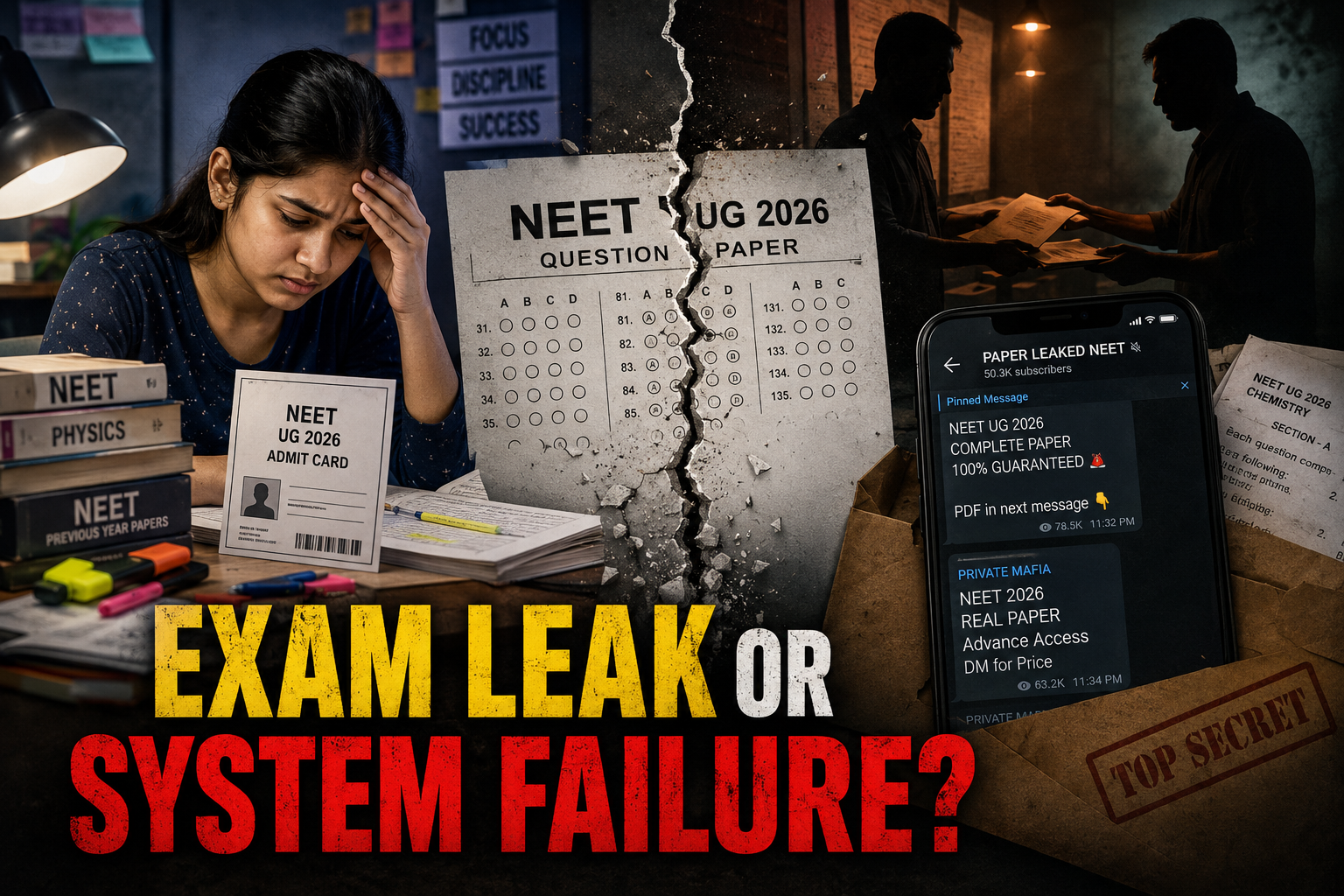
Every year, millions of young Indians wake up before dawn, travel hundreds of kilometres, and sit for a single exam that decides whether they will become doctors. The National Eligibility cum Entrance Test, or NEET UG, is not just an exam it is, for many families, a decade of sacrificed weekends, drained savings, and deferred dreams. So when the 2026 NEET exam was cancelled nine days after it was held, the betrayal felt personal.
What happened this time
The NEET UG 2026 examination was conducted on 3 May 2026, across 551 cities in India, with over 2.27 million students appearing for it. Within days, reports began emerging that a guess paper circulating in coaching centres particularly in Sikar, Rajasthan had an overlap of up to 140 questions with the actual exam paper. A chemistry teacher from Sikar, Shashikant Suthar, compared the circulated material with the official question paper and alerted authorities.
The CBI was brought in on 12 May 2026, the same day the NTA officially cancelled the exam. Investigators arrested, among others, a Pune-based chemistry professor named P.V. Kulkarni, who allegedly had links to internal NTA processes and was running special classes where exam questions were dictated to students. A school headmistress, Manisha Sanjay Havaldar, was separately arrested after she confessed to recalling physics questions from memory she had been appointed as a subject expert by the NTA and sharing them through a messaging app. She had erased her chat history and burned handwritten notes, but CBI recovered physical copies from her home. The re-examination was scheduled for 21 June 2026.
Enter telegram and the new kind of fraud
While the CBI tracked down the insider network, a parallel racket had already taken root on Telegram. Channels with names like “PAPER LEAKED NEET” and “Private Mafia” were charging students and their families anywhere from a few thousand to several lakh rupees, promising access to the re-examination paper. The Ahmedabad City Cyber Crime Branch arrested an inter-state gang operating eight such channels, tracing transactions worth approximately Rs 1.5 crore.
The NTA and the Indian Cyber Crime Coordination Centre (I4C) clarified that these channels were running a scam; no exam paper existed outside the secured examination chain. But the fraud was designed to feel credible, and that credibility came from a specific technical trick: Telegram’s message-editing feature.
The message-editing loophole
Here is how the racket worked. A Telegram channel administrator would post an ordinary, harmless message before an exam. After the exam was over and the actual question paper became available, the administrator would edit that old post to replace its content with the real question paper but the original timestamp remained intact. The message would then appear to show that the paper had been shared hours before the exam. Screenshots of these “timestamped leaks” were circulated as proof, making fraudsters’ future offers of “advance access” seem legitimate.
The NTA described this as a method to fabricate after-the-event paper leak evidence. It has been used not just in NEET but in multiple national examinations. Channel-by-channel takedown requests had repeatedly failed to keep up with the scale of the problem.
The government’s response: Block the app
Facing the re-examination on 21 June, the Ministry of Electronics and Information Technology (MeitY) invoked Section 69A of the Information Technology Act, 2000 the same provision used to ban TikTok in 2020 to temporarily block Telegram across India until 22 June 2026. MeitY separately directed Telegram to disable its message-editing feature in India until 30 June 2026. The NTA called these measures of last resort, taken only after repeated channel-level enforcement had proved insufficient.
Will it work?
The honest answer is: for now, possibly. For the duration of the re-examination, blocking Telegram removes one specific vector for fraud and panic. The message-editing restriction, if enforced, closes a genuine technical loophole that had been weaponised repeatedly. These are not irrational steps.
But they do not address the core problem. The 2026 NEET leak did not originate on Telegram, it originated inside the system. A professor with NTA connections. A headmistress with access to question papers. A network spread across Rajasthan, Maharashtra, and other states, reportedly also responsible for compromising NEET UG 2025. No app ban would have stopped Havaldar from memorising physics questions in an examination hall.
The government has acknowledged this, at least partially. Union Education Minister Dharmendra Pradhan admitted a “breach in the command chain” and announced plans to shift NEET to a computer-based format from 2027. That structural shift if implemented without new corruption vectors would be far more meaningful than any temporary platform block.
There is something worth asking here. India has now seen major NEET controversies in consecutive years 2024 and 2026. At least three students died by suicide following the 2026 cancellation. Former Tamil Nadu Chief Minister M.K. Stalin who lost power after the DMK’s shock defeat in the May 2026 assembly elections renewed calls for states to determine their own medical admission process, arguing that NEET has turned a merit-based exam into a system where economic privilege coaching centres, paid tutors, and apparently paid leaks determine outcomes.
Blocking Telegram for three days treats the fever, not the infection. India’s exam mafia is not a technology problem. It is a governance problem rooted in high stakes, low accountability, and insiders who know that 2.27 million desperate families will pay almost anything for an edge. Until that equation changes, the racket will simply move to the next app.
Subscribe Deshwale on YouTube
