



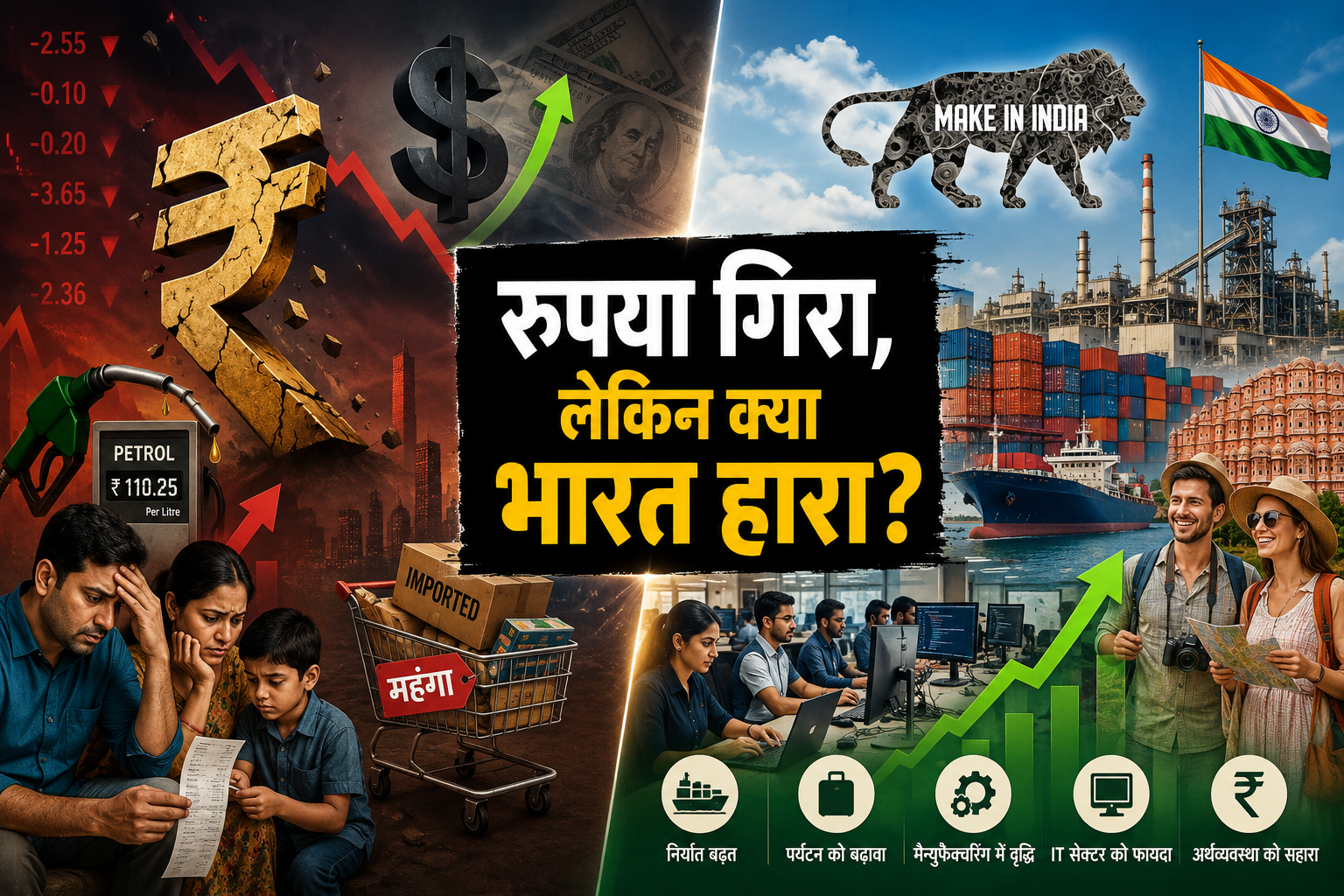
For many Indians, a falling rupee often sounds like bad news. Every time the currency weakens against the US dollar, concerns about inflation, rising fuel costs and expensive imports begin to dominate discussions. Headlines usually focus on the negative side of the story, making it seem as though the economy is under serious pressure. However, economists believe the reality is more complex. While a weaker rupee certainly creates challenges, it can also bring opportunities for exports, tourism and manufacturing.
The Indian rupee weakens when demand for the US dollar rises. This happens for several reasons. India imports a large amount of crude oil and pays for it in dollars. In fact, India imports nearly 85 to 87 per cent of its crude oil requirements. When global oil prices rise, India needs more dollars to purchase the same amount of oil, putting pressure on the rupee. Foreign investors pulling money out of Indian markets can also weaken the currency. At the same time, the US dollar has strengthened globally because of high American interest rates and global economic uncertainty. Over the past few years, several major currencies, including the Japanese yen and the euro, have also weakened against the dollar.
The effects of a weaker rupee are often visible in everyday life. Imported products such as electronics, luxury goods, machinery and some medicines become more expensive. A weaker rupee can also increase imported fuel costs and may eventually put pressure on domestic fuel prices. This affects transportation costs and can contribute to inflation across sectors. Students planning to study abroad also feel the impact because tuition fees and living expenses in countries like the US, UK, Canada and Australia become more expensive in rupee terms. Families travelling overseas often face higher hotel bills, shopping expenses and travel costs when the rupee falls sharply.
Yet there is another side to the story. A weaker rupee can actually help several important sectors of the Indian economy. When the rupee falls, Indian goods and services become cheaper for foreign buyers. This improves India’s competitiveness in global markets. For example, Indian IT companies earn a large share of their revenue in dollars. When those earnings are converted into rupees, companies receive more money for the same contracts. This is one reason why the Indian technology sector often benefits when the dollar strengthens.
Export-driven industries can also gain from a weaker currency. Sectors such as textiles, pharmaceuticals, engineering goods and auto parts become more attractive to overseas buyers because Indian products cost less in international markets. This can increase export demand and support manufacturing growth. Many economists believe gradual currency depreciation can help economies improve exports if managed carefully.
Tourism is another sector that may benefit from a weaker rupee. For travellers coming from the US, Europe or Gulf countries, India becomes a more affordable destination. Hotels, food, shopping and transport appear cheaper in dollar terms, which can encourage more foreign tourists to visit the country. Nations such as Thailand and Vietnam have long benefited from competitive currencies that support tourism growth. India could also gain from a similar advantage as global travel continues to recover.
A weaker rupee may also support India’s larger manufacturing ambitions. Through initiatives like Make in India and Production Linked Incentive schemes, the government is trying to turn India into a major global manufacturing hub. A competitive currency can encourage international companies to manufacture more products in India instead of importing them. This could strengthen sectors like electronics, mobile manufacturing, chemicals and renewable energy equipment. As global businesses look for alternatives to China, India’s cost advantage becomes increasingly important.
Many developing economies do not always try to keep their currencies extremely strong. In fact, several export-driven economies have historically allowed controlled currency depreciation to remain globally competitive. A very strong currency can make exports expensive and hurt domestic industries. India follows what economists call a managed float system. Under this system, the Reserve Bank of India does not fix the rupee at one specific value but intervenes in the market mainly to reduce excessive volatility.
This is why a falling rupee should not automatically be seen as a currency crisis. In a real currency crisis, countries experience rapidly collapsing foreign exchange reserves, uncontrolled inflation and severe investor panic. India is currently far from that situation. The country continues to hold strong foreign exchange reserves close to 690 to 700 billion dollars, giving the RBI enough strength to manage sudden market shocks and stabilise the currency when required.
Of course, no country wants uncontrolled currency weakness. If the rupee falls too sharply or too quickly, inflation can rise significantly and investor confidence may weaken. Policymakers therefore have to maintain a balance between stability and competitiveness. The RBI often steps into the market to reduce sudden volatility and prevent panic-driven movements.
For ordinary people, the value of the rupee often feels linked to national strength and economic pride. But currencies are influenced by many global factors, including oil prices, international trade, interest rates and investor sentiment. A weaker rupee certainly creates short-term difficulties, especially for import-heavy sectors and middle-class consumers. At the same time, it can also create opportunities for exporters, tourism, manufacturing and India’s long-term economic ambitions.
The real issue is not whether the rupee rises or falls on a particular day. What matters more is whether India can use this period to strengthen domestic industries, expand exports and reduce dependence on imports. If the country succeeds in doing that, a weaker rupee may eventually become less of a crisis and more of an economic opportunity.
Subscribe Deshwale on YouTube
