










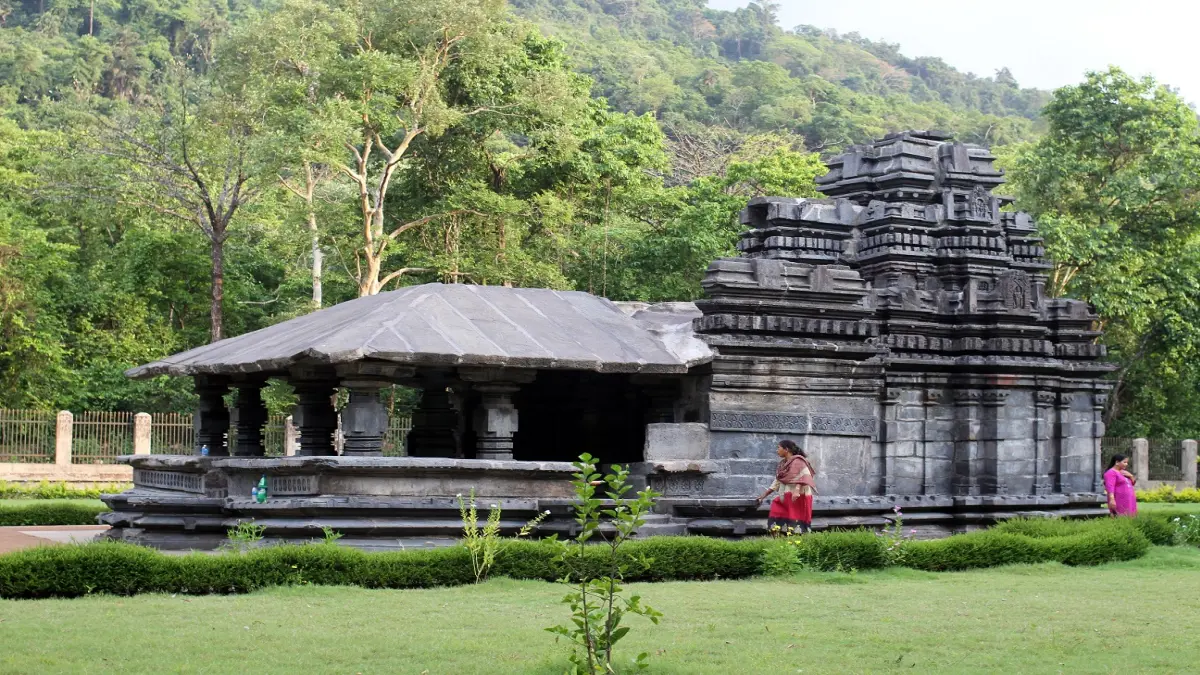
In a land known for golden beaches and spirited festivals, Goa often hides its most soulful stories in silence. One such story sits wrapped in ancient stone and jungle mist—Tambdi Surla Mahadev Temple. As Sawan paints the western sky with the colour of faith, this 12th-century Shiva temple becomes not just a destination but a quiet pilgrimage to the past, wrapped in myth, nature, and forgotten devotion.
Tucked deep within the Bhagwan Mahaveer Sanctuary, the Tambdi Surla temple doesn’t scream for attention. It waits. It breathes with the forest. Its stone walls, carved from dark basalt, are not grand in size but rich in voice. Every inch tells tales of a time when divinity was hand-chiselled, not mass-printed. This temple, built in the Kadamba dynasty around the 12th century, is the only surviving example of that architectural era in Goa today. It has stood untouched by invasions, untouched by time, and somehow, untouched by the tourist rush that devours other historic places.
This Sawan, as the monsoon thickens the forest canopy and rain polishes the ancient shrine, Tambdi Surla calls in a language older than tourism. For devotees of Shiva, the month of Shravan is already sacred. But praying here, in the lap of wild hills, carries a stillness that temples in cities cannot offer. It’s not just the rituals. It’s the experience. The resonance of “Om Namah Shivaya” amid chirping birds and gushing streams carries you inward, as if the jungle itself chants along.
Unlike the grandeur of Kashi or the towering temples of the south, Tambdi Surla offers intimacy. You stand close to the Shivalinga, under a small dome, feeling more like a guest in God’s house than a visitor in a monument. There’s no chaos of commercialised darshan, no loudspeakers blaring bhajans. Here, the silence itself becomes your prayer.
The temple faces east, allowing the first rays of the morning sun to touch the deity. This alignment, scientifically planned by ancient architects, adds to the spiritual magnetism of the place. During Shravan, especially on Mondays, local villagers trek through the forest to offer milk, flowers, and prayers to Lord Shiva. Many believe that during Sawan, the temple breathes stronger energy, drawing in those who seek inner clarity and peace.
Despite its spiritual richness, Tambdi Surla remains relatively unknown, especially among younger Indians who may associate Goa more with beach parties than ancient shrines. That’s a cultural disconnect worth exploring. Because this temple, with its carved ceilings, elephant motifs, and silent priest performing centuries-old rituals, has the power to stir something deeper in us. It reminds us that even in the age of hashtags and drone shots, there are places meant not to be captured but felt.
Getting to Tambdi Surla is not glamorous. You drive through dense forests and winding village roads. It’s an hour from Panaji and about 70 km from the North Goa coastline. But the journey is part of the blessing. On the way, you pass by rain-washed fields, sleepy hamlets, and the rhythms of rural Goa untouched by the beach economy. For urban visitors, the contrast is jarring—but also healing. The deeper you drive into the forest, the quieter your phone gets, and the more your senses awaken.
And then, suddenly, it’s there. Modest, moss-covered, guarded by trees older than dynasties. Unlike temples wrapped in marble and gold, Tambdi Surla’s beauty lies in how it blends with the earth. The Nandi bull sits loyally at the entrance, watching over a shrine that has seen rain, war, peace, and prayer for nearly 900 years.
Interestingly, the temple’s architecture blends Kadamba and Hemadpanti styles, with exquisite carvings that haven’t faded with time. Scholars say this proves the craftsmanship of artisans who built not for show but for eternity. Even more surprising is that this temple escaped destruction during Portuguese rule when many Hindu shrines in Goa were demolished. Tambdi Surla’s hidden location likely saved it from colonial eyes, making it a rare survivor of Goa’s Hindu heritage.
In today’s fast world, faith often gets reduced to convenience. We look for temples with parking lots, social media check-ins, and packaged experiences. Tambdi Surla challenges that idea. It asks you to come with patience, with presence. There’s no mobile signal to distract you. No boards explaining what to feel. You just sit, listen, breathe—and understand.
During Shravan, the forest becomes a hymn. Ferns sprout between stone joints. Butterflies dance over damp steps. Monkeys watch from the treetops as you fold your hands. The air smells of wet leaves and incense. And for those brief moments, you’re not a tourist. You’re just another soul seeking grace in the simplest form.
Locals speak of legends tied to this temple. Some believe it’s guarded by a serpent spirit. Others say that when the Ganga is in spate, her essence reaches the Shivalinga through the river Surla. While these stories may not appear in textbooks, they live in the whispered faith of generations. They add colour, charm, and a sense of rootedness that data cannot explain.
For families, especially those travelling with children, Tambdi Surla becomes more than a visit. It’s a lesson. A reminder that temples are not only places of prayer but of heritage, of quiet resistance, and of ecological harmony. Unlike urban temples surrounded by concrete, Tambdi Surla sits in perfect unity with its environment. Even the forest respects its space, letting the shrine breathe while standing guard like a green fortress.
As India grows and evolves, we risk forgetting temples like this—not because they disappear, but because we stop noticing. That would be a cultural loss greater than we can imagine. Tambdi Surla is not just a monument. It’s a living witness of time, a whispering reminder that spirituality in India is not always loud or crowded. Sometimes, it’s hidden in the woods, waiting for the rain to fall and the devotees to arrive.
So this Sawan, skip the mall, the cinema, or even the usual temple run. Take a journey into Goa’s forgotten green heart. Let Tambdi Surla show you what devotion looks like when wrapped in simplicity. Let the temple talk. You’ll come back not just with photos—but with a silence that stays long after the bells have stopped ringing.


