



Think about the last time someone added you to a WhatsApp group you didn’t ask to be in. Maybe it was a building society group, a school parents’ chat, or a “networking” circle from an event you barely remember attending. Within minutes, your phone number was visible to dozens of strangers. Some of them probably saved it. A few might have looked it up on Truecaller just to see your name pop up. That’s the quiet trade-off every WhatsApp user in India has been making for years: to talk to anyone, you first have to hand over a piece of information that follows you everywhere else in life too.
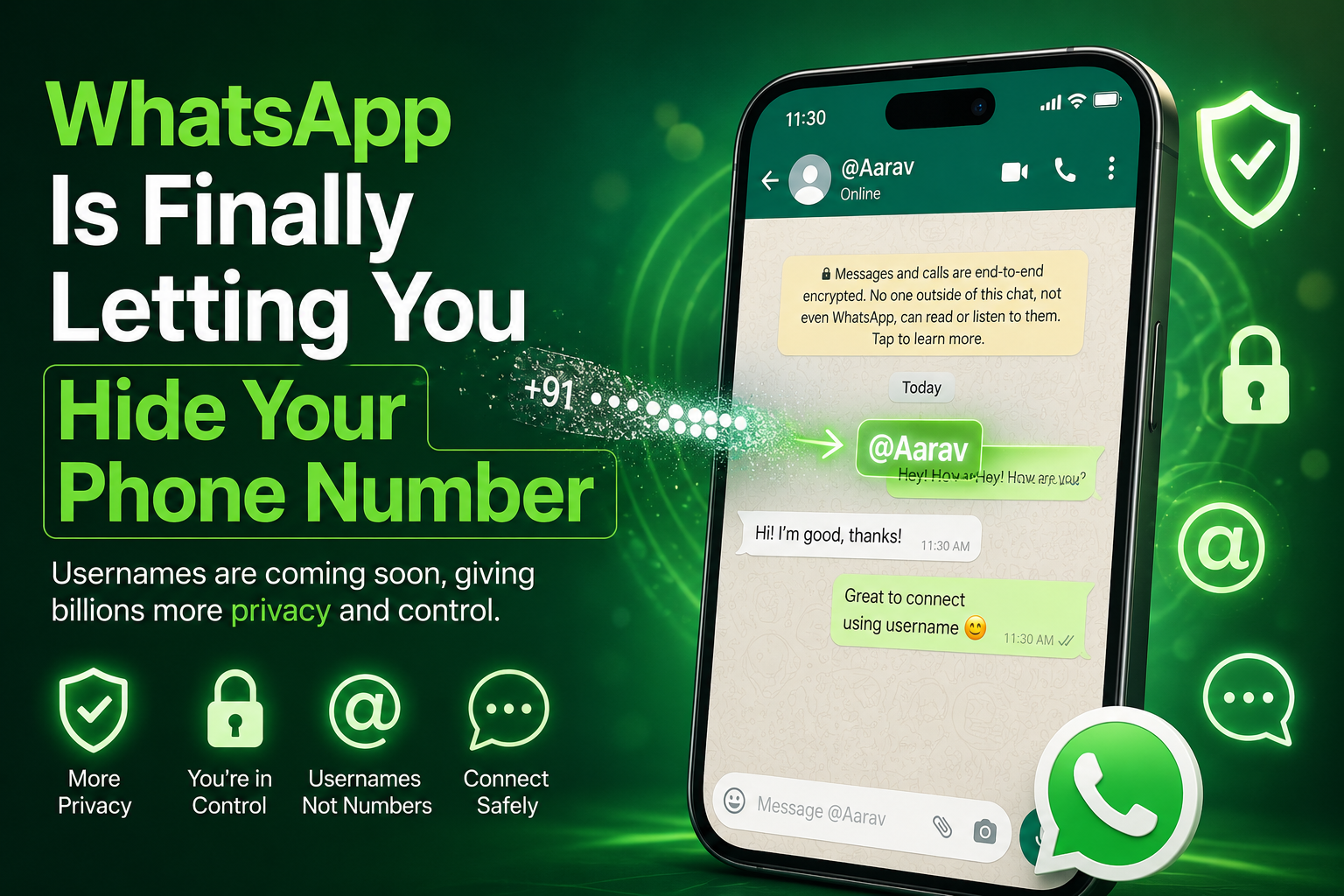
WhatsApp has now admitted that this was a flaw, not a feature. The company has announced that it is introducing usernames, a long-requested change that will let people connect on the app without sharing their phone number at all.
Starting this week, users can reserve a username for later use, ahead of a full rollout expected later this year. The idea is simple. Once the feature is live, you will be able to choose a unique username, and people will need to know that exact username to message you for the first time. There will be no searchable directory and no suggested contacts based on it, so random discovery won’t be possible. If someone doesn’t already have your username, they simply cannot find you through it.
This matters more in India than almost anywhere else. WhatsApp has over three billion users globally, and a large share of them are Indian. Here, the phone number has become a kind of unofficial identity card. It’s linked to UPI payments, it shows up on Truecaller with your real name attached, it gets passed around in group chats without consent, and it is the easiest thread for spam callers, scammers, and unwanted contacts to pull. A single number can expose your name, your approximate location, your bank-linked apps, and your social circle, all without you choosing to share any of it directly.
Usernames change that equation. Once you set one up and choose to use it instead of your number, new contacts will see only your username, not your digits. WhatsApp has also built an optional “username key,” a second layer where you can control who is allowed to reach you using your username at all. So even if someone has your username, they may still need this key to actually start a conversation with you, depending on what you choose to enable.
For people who run businesses, build personal brands, or create content, WhatsApp has made a small but useful allowance. If your Instagram or Facebook handle is already your identity online, you can claim that same handle as your WhatsApp username, keeping your presence consistent across apps without having to think of something new.
Setting this up is meant to be simple. On the latest version of WhatsApp, the option sits under Settings, then Account, then Username. For anyone who can’t decide what to pick, WhatsApp has also added a username generator that suggests options. The company has been upfront that with three billion users already on the platform, common names and obvious choices are likely to be taken quickly, which is exactly why reservations have opened months before the feature actually goes live everywhere.
The rollout itself will happen gradually, country by country, and WhatsApp says users will get a notification inside the app once usernames are available where they live. There’s no confirmed timeline for India yet, though given the size of the user base here, it would be a notable market to delay.
It’s worth being clear about what this change does and doesn’t do. It does not make WhatsApp anonymous. Your phone number is still tied to your account in the background, and WhatsApp itself still has it. What changes is what the other person sees when you talk to them for the first time. It shifts the choice of what to reveal back to the user, instead of making the phone number a mandatory part of every new conversation.
For a generation that has grown up fielding calls from numbers we don’t recognise, and group chats we never asked to join, this is a small but meaningful correction. It won’t stop spam entirely, and it won’t undo the years your number has already spent floating around other people’s contact lists. But going forward, at least, you get to decide what a stranger learns about you the moment you say hello. That’s not a small shift. For an app built around your number from day one, it’s basically an admission that the number was never the point. You were.
Subscribe Deshwale on YouTube
