



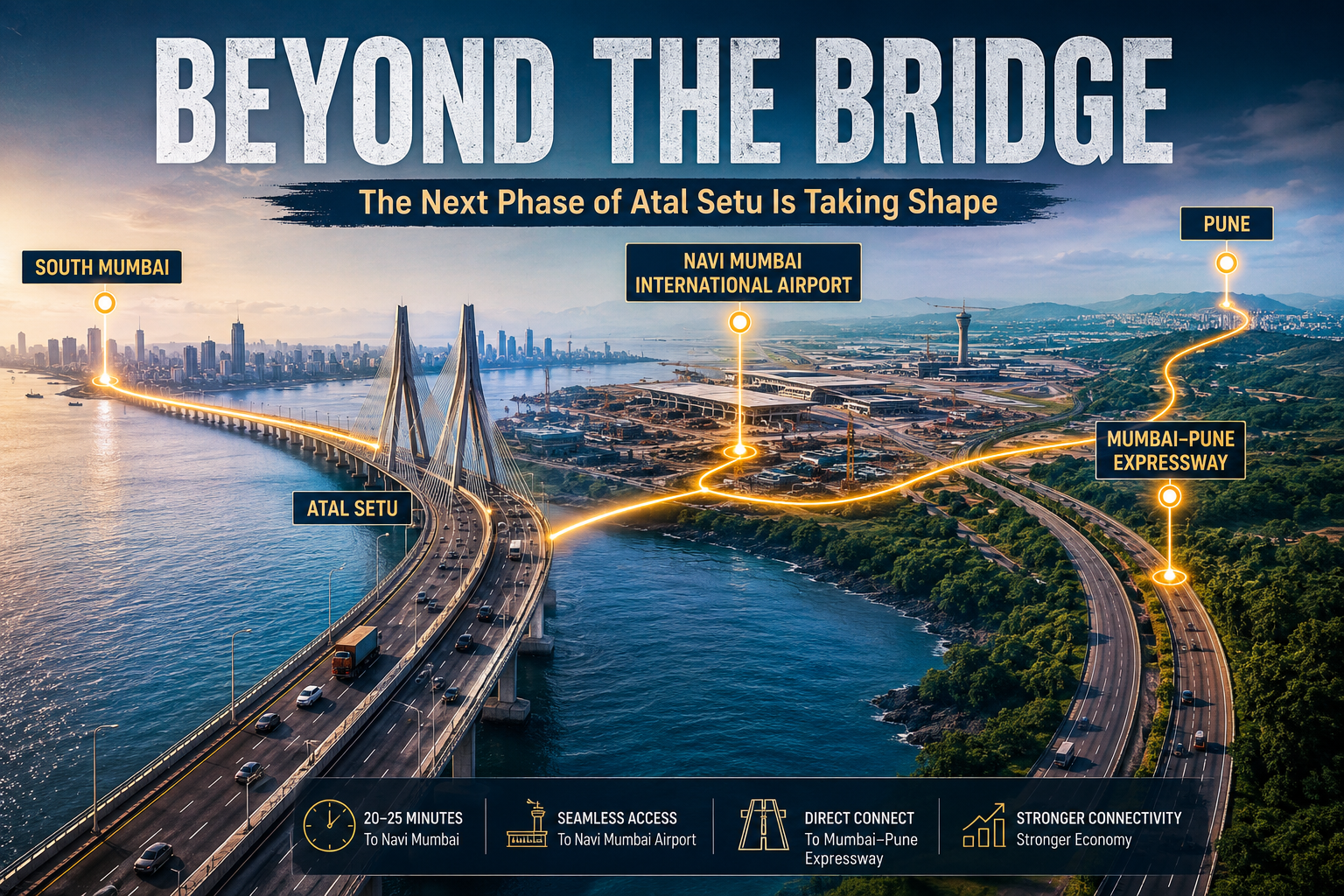
Most Mumbaikars already know what the Atal Setu did. Before it opened in January 2024, getting from South Mumbai to Navi Mumbai by road could eat up over an hour, sometimes closer to two, depending on traffic at the Vashi or Airoli bridges. Atal Setu, India’s longest sea bridge at 21.8 kilometres, cut that down to roughly 20 to 25 minutes. It became the bridge people pointed to as proof that Mumbai could still build something big and actually finish it.
What far fewer people know is that the story did not end there. Right now, quietly, a second piece of this puzzle is being built, and it is going to matter just as much as the bridge itself.
The Mumbai Metropolitan Region Development Authority is constructing a new 7.35-kilometre, six-lane corridor that will directly connect Atal Setu to the Mumbai-Pune Expressway. The route runs through Chirle and Palaspe in Navi Mumbai, and its location is not an accident. Chirle is also where the upcoming Navi Mumbai International Airport is taking shape, which means this one stretch of road is being built to serve three things at once: the sea bridge, the expressway to Pune, and the city’s next big airport.
Think about what that actually means on the ground. Right now, if you cross Atal Setu and want to head toward Pune, you still have to navigate local roads before joining the expressway proper. Once this corridor opens, that gap disappears. A driver could, in theory, go from South Mumbai, over the sea bridge, straight onto the Pune expressway, without slowing down for a single traffic signal in between. For anyone who has done that drive on a Friday evening, the difference is hard to overstate.
The construction numbers tell you how far along this already is. As of the most recent progress update, work has been completed at 143 of the 176 planned foundation points along the corridor. Pier construction has reached 141 locations, and pier caps, the structures that sit on top of the piers to support the road deck, have been finished at 88 of them. On the precast girder front, the long concrete beams that will eventually form the road surface, 653 out of a required 830 have already been cast. None of these numbers are small. Each one represents actual concrete poured and steel placed, not just plans on paper. The MMRDA is targeting completion by 2027.
It helps to remember what Atal Setu itself looked like at a similar stage. Construction on the original bridge began back in April 2018, and for years it was little more than scattered piers rising out of Thane Creek, years before anyone outside engineering circles paid attention. It used orthotropic steel decks, a lightweight but strong design never used in an Indian bridge before, with steel sourced from four different countries and assembled at a yard in Karanja before being barged out to sea. None of that complexity was visible to the public until the final steel spans were lifted into place and the whole structure suddenly became real. This corridor is currently in that same quiet, unglamorous middle phase. There’s nothing dramatic to photograph yet, just rows of piers rising out of the ground near Chirle and Palaspe. But the moment it connects, the change to how this entire region moves will be immediate.
The ripple effects go beyond just travel time. Logistics companies that move goods between Mumbai’s ports and inland Maharashtra stand to gain a faster, more predictable route. Once the Navi Mumbai airport becomes operational, this corridor is positioned to serve as one of its key access routes from the Mumbai-Pune side, which would matter enormously for an airport expected to handle both passenger and cargo traffic at scale. And real estate in Panvel, Chirle, Ulwe, and the belt around them, already moving because of Atal Setu, will likely move further once this direct Pune link is confirmed and dated.
There is a broader pattern hiding in all this, and it’s worth pointing out. Mumbai’s infrastructure conversation tends to treat each big project as a single finished event, a ribbon-cutting, a press release, a Prime Minister’s visit, and then the story moves on. Atal Setu had its moment in January 2024 and largely disappeared from the headlines after that. But the most consequential parts of a project like this often arrive after the opening ceremony, in the connecting roads, feeder corridors, and last-mile links that quietly decide whether a flagship bridge becomes genuinely useful or just an impressive photograph.
This corridor is exactly that kind of piece. It won’t get its own inauguration with the same fanfare. But by the time it’s done, it will have done something the original bridge alone could not: turn a sea crossing into a seamless line running from South Mumbai to Pune, with a new international airport sitting right in the middle of it. The map of this region is being redrawn one pier at a time, and most of the city hasn’t noticed yet.
Subscribe Deshwale on YouTube
