



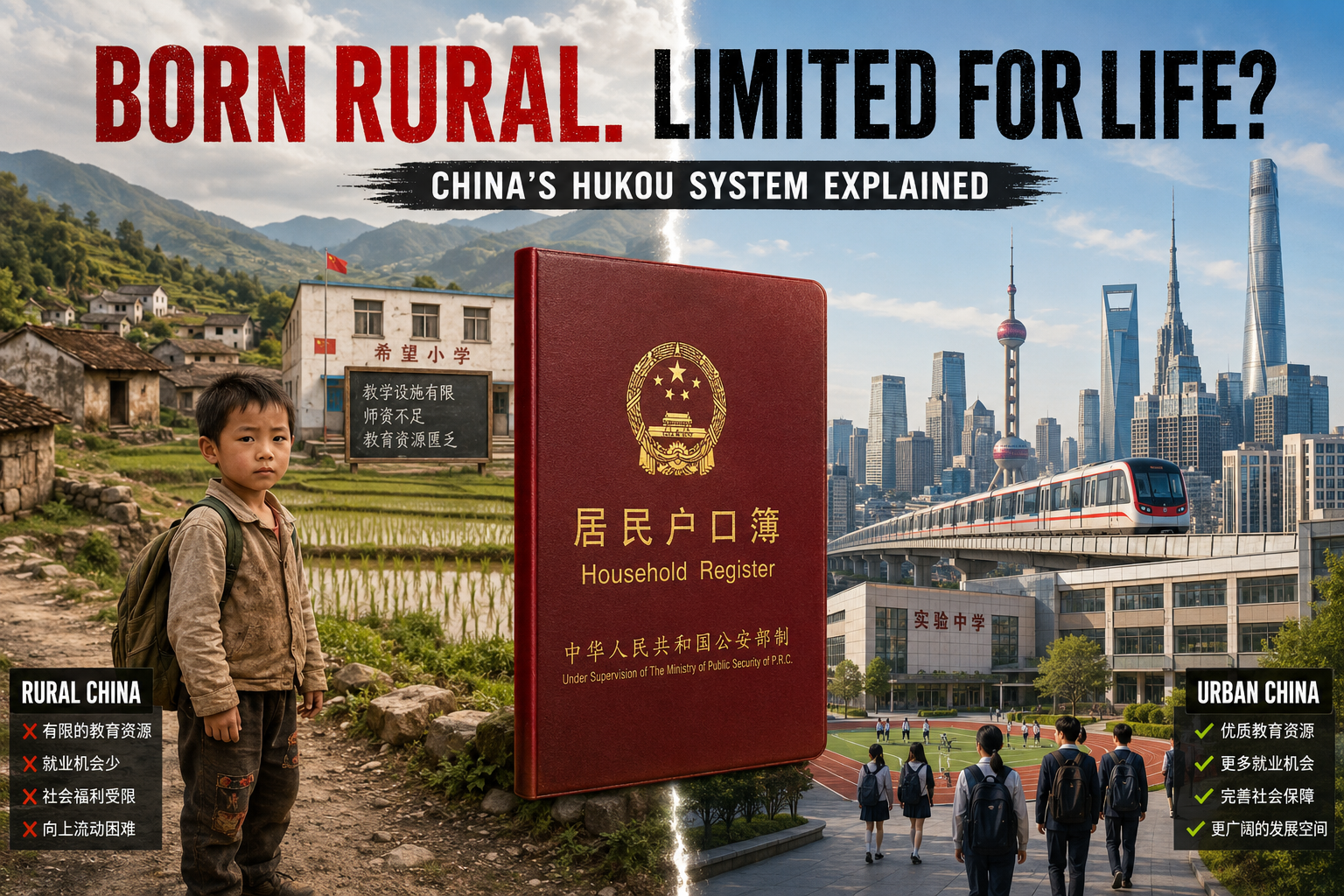
In China, a person’s future is partly decided the day they are born, and not by talent, money, or luck. It is decided by a small household registration document called a hukou. This piece of paper tells the state, and everyone else, whether a child belongs to the countryside or the city. That single classification follows them for the rest of their life, shaping which schools they can attend, which hospitals will treat them at an affordable rate, and which pension or insurance scheme they can rely on in old age.
The hukou system was set up in 1958, during the early decades of Communist rule, mainly to control where people lived and worked. The government needed to keep enough labour in the fields to feed the country while directing industrial workers toward the cities the state was building. So every citizen was sorted into one of two categories: agricultural, meaning rural, or non-agricultural, meaning urban. A baby usually inherits the category of their mother, regardless of where the family actually lives. It is less a record of fact and more a fixed label, decided before the child has any say in the matter.
For decades, this system kept rural and urban China almost entirely separate. Then, after 1978, the country opened up its economy and cities needed huge numbers of workers for new factories, construction sites, and service jobs. Tens of millions of people from villages moved to cities looking for work. But their hukou did not move with them. They became what China now calls migrant workers, people who can live in a city for ten, twenty, even thirty years, paying taxes and raising children there, without ever being legally recognised as residents of that city.
This is where the system starts to hurt in very ordinary ways. Take education. Public schools in major cities are usually reserved first for children with local urban hukou. In cities like Beijing, migrant families without it have historically needed to produce a stack of documents, things like a signed labour contract and proof of local housing, just to enrol their child in a nearby government school. Many migrant workers cannot provide this, simply because they work informal jobs or rent rooms without formal lease agreements. So families are left with painful choices: send the child to an underfunded, unofficial migrant school, leave the child behind in the village with grandparents, or eventually send a teenager back to their home province alone just to sit for exams tied to their official hukou location. None of these options are good for a child’s growth or for a family trying to stay together.
Healthcare works in a similar, frustrating way. A person’s health insurance and subsidised medical benefits are usually linked to their registered hukou location, not to where they actually live and work. A construction worker in Shanghai whose hukou is still registered in a village in Anhui may find that his insurance barely helps him at a Shanghai hospital, while it would have covered much more back home, a home he may visit only once a year.
Wealthier cities such as Beijing and Shanghai do allow people to apply for a permanent urban hukou, but the requirements are steep. Applicants are judged on things like their education level, how much they’ve paid into local social insurance funds, and whether they own property in the city. These are exactly the resources that poor rural migrants, the very people the system traps the hardest, are least likely to have. Researchers studying the system have gone as far as describing it as creating something close to two separate classes of citizenship inside one country, an urban one and a rural one, based purely on the accident of birth.
The scale of this is enormous. Official data puts the number of migrant workers in China at over 300 million, and around 180 million of them work far from the towns and villages where their hukou is still registered, meaning most have only partial access, if any, to local schools, hospitals, and social benefits where they actually live and work, despite being the backbone of the very industries that keep those cities running.
To be fair, the Chinese government has not ignored the problem. In recent years, many small and mid-sized cities have relaxed their hukou rules considerably, making it easier for migrants to register locally. There is also a broader policy push to tie welfare benefits more closely to where someone actually lives and works, rather than strictly to their birth registration, partly because Beijing wants migrant families to spend more confidently in cities and boost domestic consumption.
But reform is slow, and it is happening mostly at the edges, in smaller cities, not in the giant metros where the most desirable jobs, schools, and hospitals are. For now, for a child born in a Chinese village, the hukou system still quietly answers some of the biggest questions of their life, long before they’re old enough to ask them.
Subscribe Deshwale on YouTube
