



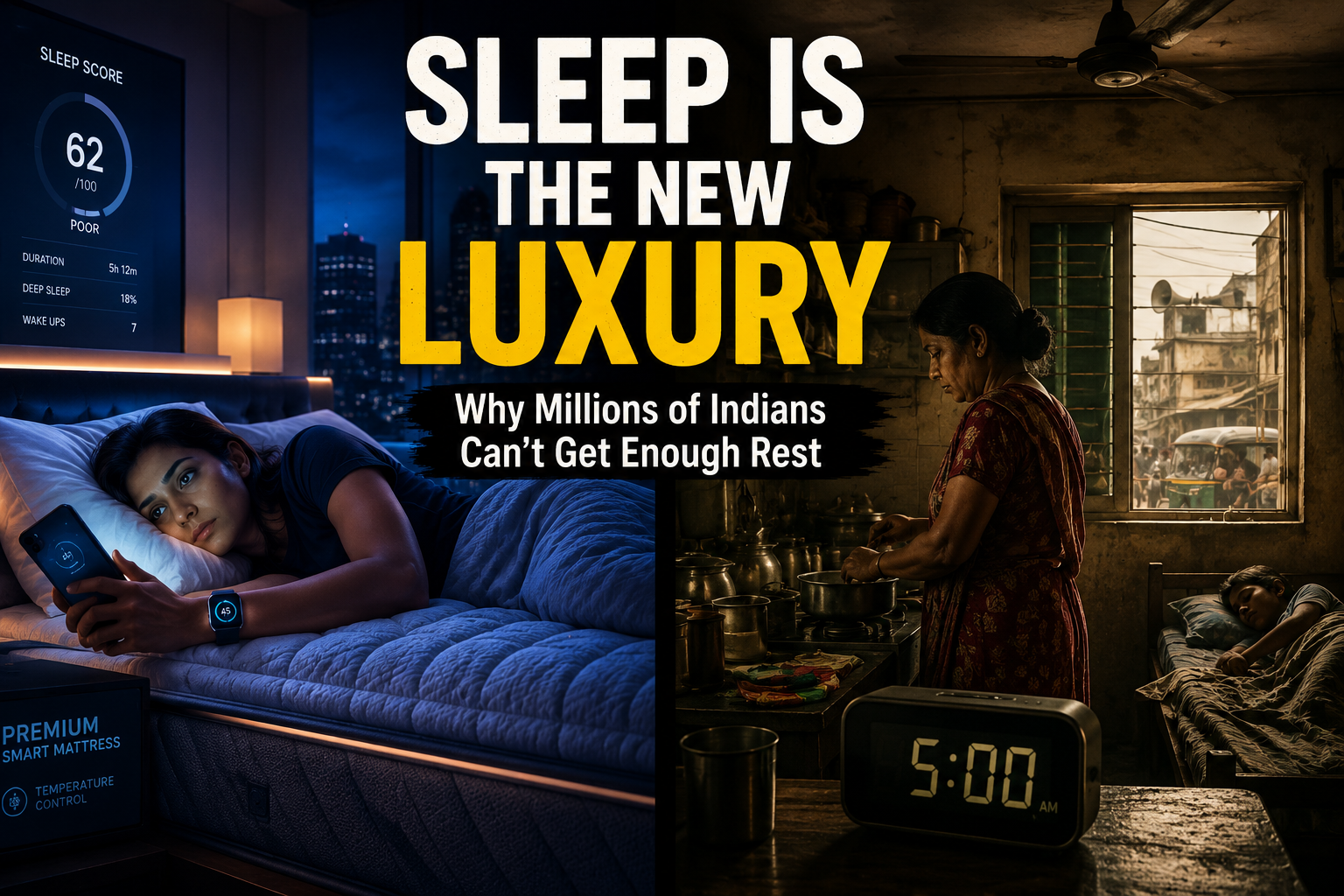
A young executive in Bengaluru buys a ₹65,000 mattress with built-in temperature control. She wears a smart ring that tracks every minute of her rest. And she still sleeps five hours a night, three nights a week, because her phone won’t stop buzzing past midnight.
This is the strange place India has reached with sleep. We are spending more money than ever trying to buy a good rest, even as most of the country sleeps worse than it did a few years ago.
Start with the bad news. A nationwide survey by LocalCircles, which tracked over 43,000 people across more than 300 districts between December 2025 and March 2026, found that nearly half of Indians 46 percent get less than six hours of uninterrupted sleep a night. Roughly three out of five adults are now chronically under-rested, and the number has gone up every single year since 2022. By some counts, India is now the second most sleep-deprived country in the world, just behind Japan.
What’s stealing our sleep? The answer might surprise you. It isn’t doom-scrolling at 1 a.m., though that doesn’t help. According to the same survey, 72 percent of Indians said their biggest reason for waking up at night is needing to use the washroom, a condition called nocturia, often linked to diabetes, urinary problems, or drinking too many fluids close to bedtime. Early morning household chores and rigid schedules disturbed another quarter of respondents. Mosquitoes and street noise accounted for nearly as many. In other words, India’s sleep crisis is less about willpower and more about health, plumbing, and city noise, things no mattress, however expensive, can fix.
Yet sleep has quietly become a wellness flex. India’s mattress industry was valued at somewhere between Rs 145 billion and Rs 160 billion in 2024 and has been growing at 7 to 9 percent a year since 2019. Brands are no longer just selling foam and springs, they’re selling “sleep technology,” with temperature-regulating layers, adjustable bases, and apps that score your night out of 100. Comfort-tech brands have expanded aggressively, opening hundreds of experiential stores where customers can lie down and test “smart” mattresses before buying. Hotels and resorts have jumped in too, marketing rooms specifically designed for deep, undisturbed sleep as a luxury amenity.
Wearables have made this even more personal. A global sleep survey covering thousands of Indian respondents found that around three in four Indians now use a smartwatch or fitness band to monitor their sleep, with many saying they’d consider seeing a doctor based purely on what the device tells them. Sleep, once something you simply did, has become something you measure, optimize, and occasionally show off a “sleep score” shared like a fitness achievement.
But the people most starved of rest are often the ones with the least access to any of this. Women, the same survey found, sleep noticeably worse than men in India 38 percent struggle to fall asleep compared to 29 percent of men, and family responsibilities disrupt sleep for nearly four in ten women, against a third of men. No smart mattress fixes a household where one person is still expected to wake up first and sleep last. Night-shift healthcare workers fare even worse: a study published in the Indian Journal of Psychiatry found that over 82 percent of hospital staff working rotational night shifts were sleep-deprived, getting just over five hours of sleep on average.
The cost shows up at work too. Poor sleep is now hurting India’s productivity in ways companies can measure. Surveys suggest around seven in ten employees feel their ability to focus suffers because of bad sleep, and a large share admit to taking a sick day or “snooze day” simply because they were too exhausted to function.
So India finds itself with two sleep problems happening at once. For a growing, well-off slice of the population, sleep has become a product something to upgrade, track, and display, sold through gleaming mattress showrooms and luxury retreats. For everyone else, it remains what it has always been: a basic need quietly eroded by long commutes, unaddressed health issues, joint-family duties, noisy streets, and jobs that never really switch off.
The irony is hard to miss. We are pouring money into devices that tell us how badly we’re sleeping, instead of fixing the reasons we can’t. A temperature-controlled mattress won’t cure nocturia. A sleep-tracking ring won’t share the household chores. And no five-star “sleep retreat” weekend will undo a year of disrupted nights once you’re back home.
Real rest, it turns out, was never something you could simply buy. It needed time, fewer demands, and a body and city that let you switch off and that, for most Indians right now, remains in short supply.
Subscribe Deshwale on YouTube
